Embraer
Brazilian manufacturer of commercial, executive and military aircraft, founded as a state company in 1969
Brazilian manufacturer of commercial, executive and military aircraft, founded as a state company in 1969

Embraer is a Brazilian aerospace company that designs and builds commercial jets, business jets and military aircraft and supports them in service.[1] The Brazilian government founded it in 1969 and privatized it in 1994.[1]
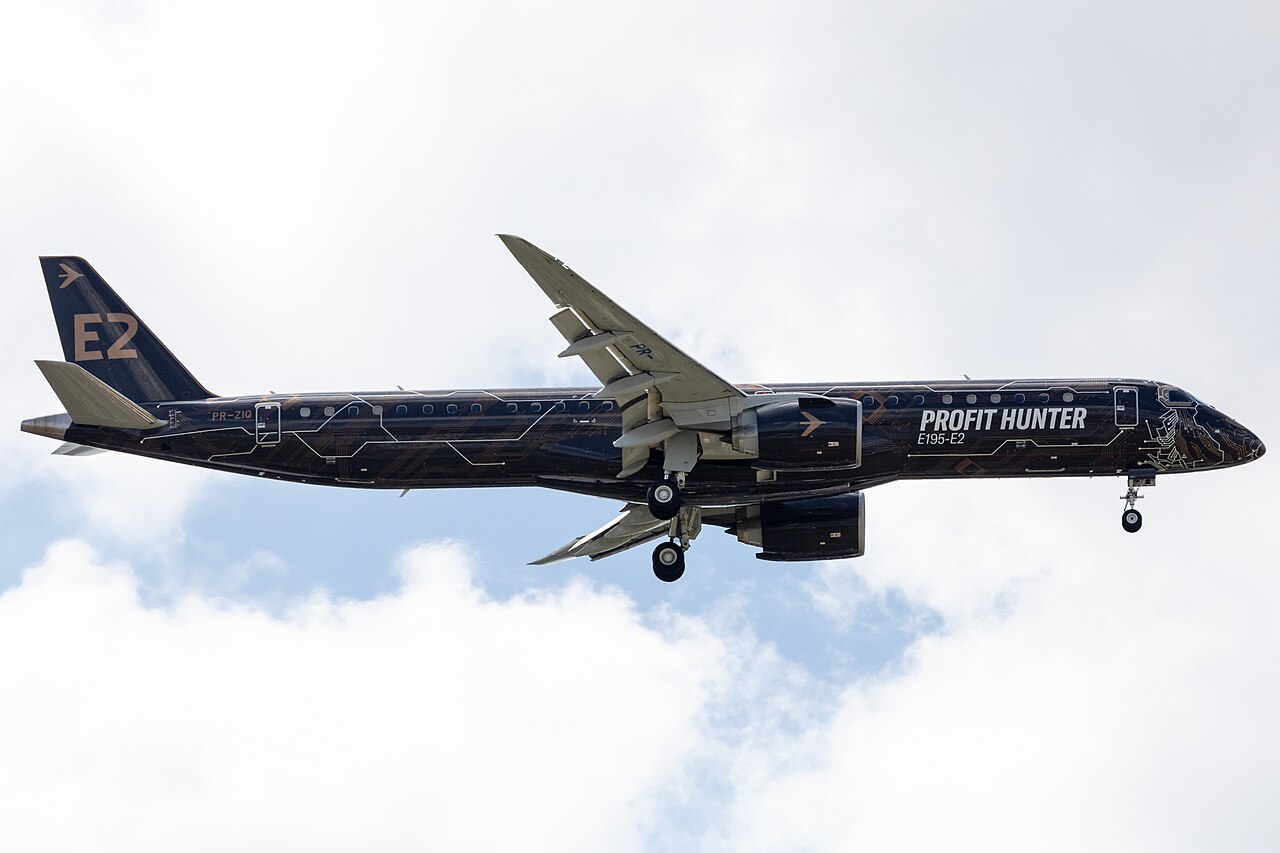
Via Wikimedia Commons: Embraer E195-E2, Air Show 2019, Le Bourget (SIAE0894) by Matti Blume, CC BY-SA 4.0.
Embraer S.A. is a publicly held corporation organized under Brazilian law, with its principal executive office in the city of São Paulo.[1] It reports its business in four main segments: Commercial Aviation, Executive Aviation, Defense & Security, and Services & Support.[1] In its annual report for 2025, the company described itself as the leading maker of jets with up to 150 seats by number of aircraft delivered, citing Cirium fleet data that gave it a 30% share of cumulative deliveries in that class since 2004.[1] The Brazilian government still holds a single "golden share", which carries a veto over matters such as a change of control, the company's name and corporate purpose, and the creation or alteration of its defence programmes.[1]
Embraer grew out of the Brazilian state's aeronautical research complex at São José dos Campos, in São Paulo state, where the government's aerospace technical centre, known as the CTA, had been set up in 1945.[2] In 1965 the Ministry of Aeronautics asked the CTA to study a medium-sized passenger aircraft for Brazil, a project approved under the designation IPD-6504.[3] The prototype that came out of it, a twin-engine turboprop named the Bandeirante, first flew on 22 October 1968 in the colours of the Brazilian Air Force.[3]
On 19 August 1969 President Artur da Costa e Silva signed Decree-Law No. 770, which authorized the federal government to form Embraer (Empresa Brasileira de Aeronáutica S.A.) as a mixed-capital company linked to the Ministry of Aeronautics, with its seat in São José dos Campos.[4] The decree gave the company the purpose of promoting the development of the Brazilian aeronautical industry and related activities, and required the federal government to hold at least 51% of its voting capital.[4] Embraer was majority-owned by the government and took over the CTA's twin-turboprop project.[2] It began operating on 2 January 1970, when its first board of directors took office.[3]
Embraer's first regional airliner was the EMB 110 Bandeirante, a 19-passenger, twin-engine turboprop without a pressurized cabin, designed at first for the transport needs of the Brazilian Air Force and certified in 1973.[1] The first EMB 110s went to the Brazilian Air Force in February 1973 under the military designation C-95, and the first airline example was delivered to Transbrasil in April of that year.[3] The design was Brazilian, but more than half of the Bandeirante's value consisted of imported parts.[2] The aircraft was taken up by commuter airlines in the United States, and by 1982 it accounted for about a third of the market there for commuter aircraft of 10 to 20 seats.[2]
In its first years Embraer also built the Xavante jet trainer and ground-attack aircraft under licence from the Italian firm Aermacchi.[2] The Ipanema, a crop-spraying aircraft developed at the CTA, made its first flight on 31 July 1970 and joined Embraer's line-up after the company was created.[3] The Ipanema was still in production more than five decades later: by 31 December 2025 Embraer had delivered 1,728 of them, and new ones are delivered with engines that run on ethanol.[1]
The EMB 312 Tucano, a two-seat turboprop military trainer, made its official first flight, in front of the public, on 19 August 1980.[3] It was sold to the British and French air forces and produced under licence in Egypt.[2] In the 1980s Embraer received Tucano orders from Egypt (110 aircraft, 1983), Iraq (80, 1985), Libya (100, 1986) and Iran (50, 1988).[2]
The EMB 120 Brasília, a pressurized turboprop for up to 30 passengers derived from the Bandeirante, first flew on 25 July 1983 and was certified in 1985.[3][2][1] It was designed for the longer routes and heavier traffic of the growing regional airline market, and at first it captured about a third of the market for commuter aircraft of 30 to 40 seats.[1][2] During the 1980s Embraer and Aermacchi also jointly developed the AMX, a jet strike aircraft for the Brazilian Air Force.[1]
The world recession of the late 1980s and the Brazilian government's decision to end FINEX, an export-financing fund, hurt Embraer.[2] The company became publicly held in 1989.[1] In January 1992, despite opposition from the military, the government put Embraer on its list of state-owned enterprises to be sold.[2] In 1994 the company lost US$310 million on sales of only US$177 million.[2]
After six failed attempts, a consortium bought a controlling 45% stake in December 1994 for US$89 million.[2] Embraer's own history dates the privatization to 7 December 1994 and names the buyers as the financial groups Cia Bozano Simonsen and Wasserstein Perella together with the pension funds Previ and Sistel.[3] The government injected new capital, took over the company's debt of US$700 million and kept 6.8% of its shares, including the golden share.[2] The golden share was created in the privatization to give the government veto rights, in particular over military programmes.[1]
Embraer's workforce fell from 6,087 in 1994 to 3,849 in 1996, then rose to more than 10,000 by 2000.[2] The company returned to profit in 1998 after 11 consecutive years of losses.[2] In November 1999 the French companies Aérospatiale-Matra, Dassault Aviation and Thomson-CSF each acquired a 5.5% stake, and Snecma a further 3%.[2] In 2000 Embraer registered with the US Securities and Exchange Commission and listed American Depositary Receipts on the New York Stock Exchange.[1] In 2006 it simplified its capital to a single class of common shares and joined the Novo Mercado listing segment of Brazil's B3 exchange, and since then it has had no controlling shareholder or controlling group.[1] In 2010 its shareholders changed its name from Embraer – Empresa Brasileira de Aeronáutica S.A. to Embraer S.A.[1]
In 1989 Embraer decided to build a 50-seat jet for regional routes, which were generally shorter than 1,000 kilometres.[2] The project was halted while the company sought new owners and accelerated after privatization.[2] The new jet drew on the design of the Brasília, with which it shared 30% of its components, and on jet technology Embraer had acquired on the AMX programme.[2][1]
The EMB 145 first flew on 11 August 1995, and the first one was delivered to the US carrier Continental Express on 27 December 1996.[3] It was certified in 1996, and Embraer's aircraft, previously designated EMB, took the ERJ designation in late 1997.[1][2] The family grew to three models seating up to 37, 44 and 50 passengers.[1] The 300th ERJ 145 was delivered in September 2000, three years and eight months after the first; Bombardier had needed almost seven years to deliver as many of its competing CRJ-200.[2] Embraer has described the ERJ as its most important product until the E-Jets arrived, and as the aircraft that consolidated its presence in the US regional market.[1] As of 31 December 2025, 367 ERJ aircraft remained in service worldwide, according to Cirium data cited by the company.[1] Embraer also adapted the ERJ 145 for special missions, unveiling an airborne early warning and control version and a remote sensing version in May 1999.[2]
The EMBRAER 170/190 family, usually called the E-Jets, has four models: the E170 (66 to 78 seats), E175 (70 to 90), E190 (98 to 114) and E195 (100 to 124).[1] Unlike the ERJ, with its engines at the tail, the E-Jets carry two engines under the wings.[2][1] The E170 first flew on 19 February 2002 and was certified in February 2004.[3][1] Brazil's civil aviation agency, ANAC, certified the E175 in December 2004, the E190 in August 2005 and the E195 in June 2006.[1] About 86% of the components are common to all four models.[1] As of 31 December 2025, 1,744 aircraft of the family had been delivered.[1]
In June 2013 Embraer launched a second generation, the E-Jets E2, made up of the E175-E2, E190-E2 and E195-E2.[1] In 2018 the E190-E2 received type certificates from ANAC, the US Federal Aviation Administration and the European Union Aviation Safety Agency at the same time, and the first was delivered to the Norwegian regional airline Widerøe.[1] The E195-E2 was certified by the same three authorities in 2019, with the Brazilian airline Azul as its launch operator.[1] The E190-E2 entered service in April 2018 and the E195-E2 in September 2019.[1]
The smallest model, the E175-E2, first flew on 12 December 2019.[1] Embraer paused its development in February 2022 and, on 25 February 2025, announced a further four-year pause, mainly because "scope clauses" at US mainline airlines were not expected to change before 2027.[1] Scope clauses are terms in agreements between US airlines and pilots' unions that limit the size of aircraft their regional partner carriers may fly.[2][1] In 2022 Embraer launched passenger-to-freighter conversions of used E190 and E195 aircraft, which entered service in 2025.[1]
Embraer's business-jet line began with the Legacy, a modified version of the 37-seat ERJ 135 regional jet offered in executive and VIP configurations.[2][1] In 2005 it launched the Phenom 100, an entry-level jet, and the Phenom 300, a light jet, and in 2006 it added the Lineage 1000, an ultra-large jet.[1] The Phenom 100 first flew on 26 July 2007.[3] The medium-cabin Legacy 450 and Legacy 500 followed in 2008.[1] In 2018 Embraer introduced the Praetor 500 and Praetor 600, which entered service in 2019, and in 2019 and 2020 it phased out the Legacy 650, Lineage 1000E, Legacy 450 and Legacy 500 to concentrate on the Phenom and Praetor lines.[1] By the end of 2025 it had delivered 430 Phenom 100s and 906 Phenom 300s, and more than 2,070 executive jets in all to over 1,200 customers in 70 countries.[1]
Embraer was originally established to develop and produce aircraft for the Brazilian Air Force, and in its 2025 annual report it described itself as the air force's leading supplier of aircraft by number in the fleet.[1] Its early military programmes included the Tucano trainer and the EMB-111, a maritime patrol version of the Bandeirante, both of which were exported.[1] In 2010 Embraer broadened its corporate purpose to allow its defence business to make and sell equipment and systems for the defence, security and energy industries.[1] As of 31 December 2025, it had sold more than 1,400 defence aircraft, including government transport models, to over 60 armed forces and operators.[1]
The Super Tucano (EMB 314, also designated A-29) is a single-engine turboprop for pilot training and armed reconnaissance that grew out of the Tucano.[2][1] It was developed under a contract with the Brazilian Air Force in a version known as AL-X, with an engine about twice as powerful as the original Tucano's, and two prototypes were flying from 1995.[2] It entered service in 2004, and as of 31 December 2025 more than 300 had been sold to over 20 countries.[1]
The KC-390 Millennium, also marketed as the C-390, is a multi-mission military transport that can also refuel other aircraft in flight, and it is the largest aircraft ever built in Brazil.[1] Its programme began on 14 April 2009 with a contract from the Brazilian Air Force; the first prototype was rolled out on 21 October 2014 and first flew on 3 February 2015.[3] ANAC issued its type certificate and the first aircraft was delivered in 2019, and the Brazilian Air Force received eight between 2019 and 2025.[1] Portugal signed the first export contract in 2019, for five aircraft, and later added a sixth.[1] As of Embraer's 2025 annual report, filed in March 2026, eleven countries had selected the aircraft (Brazil, Portugal, Hungary, South Korea, the Netherlands, Austria, the Czech Republic, Sweden, Lithuania, Slovakia and Uzbekistan), of which Brazil, Portugal and Hungary were operating it.[1]
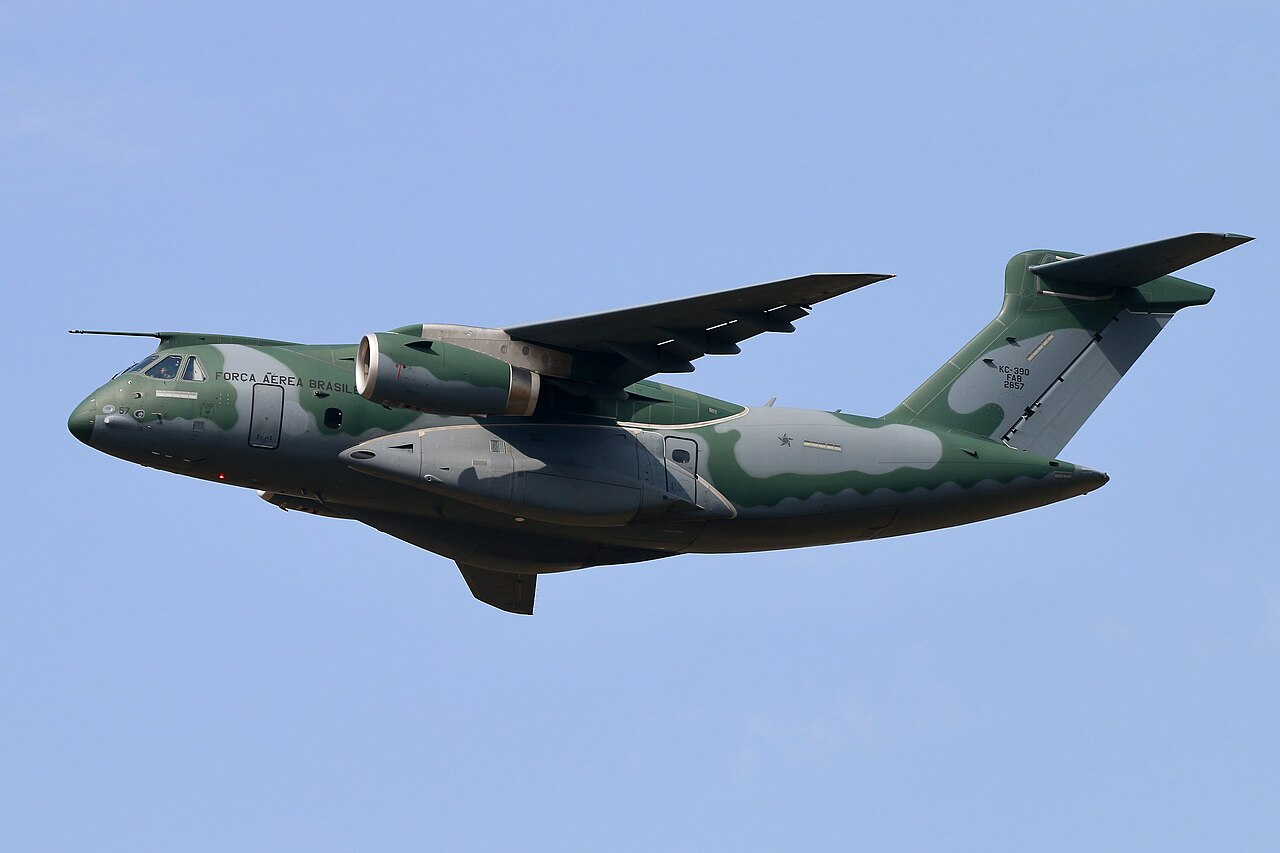
Via Wikimedia Commons: FAB2857 Embraer KC-390 Millenium Brazilian Air Force by Colin Cooke, CC BY-SA 2.0.
Embraer also makes ground radars and, through subsidiaries, command-and-control, cybersecurity and satellite systems; it holds 51% of the satellite company Visiona.[1] In 2019 a consortium formed by Embraer, Thyssenkrupp Marine Systems and Embraer's subsidiary Atech was selected to build four Tamandaré-class frigates for the Brazilian Navy.[1]
From the 1990s Embraer's main rival in regional jets was Canada's Bombardier, and the rivalry between the two companies became a dispute between their governments.[2] Evidence that Brazil submitted in the first case described the two as the only manufacturers of 50-seat regional jets.[5] In June 1996 Canada asked for consultations at the World Trade Organization (WTO) about export subsidies that Brazil's export-financing programme, PROEX, granted to foreign buyers of Embraer aircraft.[5][6] Brazil brought a parallel complaint in March 1997 against Canadian subsidies for exports of civil aircraft; the measures examined included assistance under the Technology Partnerships Canada programme and Canada Account financing for the regional aircraft industry.[7]
The panels in both cases reported on 14 April 1999, each finding that some of the respondent's measures were export subsidies prohibited by the WTO Agreement on Subsidies and Countervailing Measures, and the Appellate Body upheld those findings on 2 August 1999.[6][7] In 2000 compliance proceedings found that Brazil's revised PROEX payments for regional aircraft were still prohibited subsidies, and that Canada had not withdrawn its Canada Account assistance to its regional aircraft industry within the required 90 days.[6][7] Canada asked for authority to impose countermeasures of CAD 700 million a year; on 28 August 2000 an arbitrator set the appropriate level at CAD 344.2 million a year, which the WTO's Dispute Settlement Body authorized on 12 December 2000.[6] A 2002 study in CEPAL Review called Canada's request for retaliation the largest trade confrontation Canada had engaged in and one of the largest disputes in the WTO's history.[2] Brazil then revised the scheme as PROEX III, which a further compliance panel in July 2001 did not find inconsistent, as such, with the subsidy rules, and the compliance proceedings closed on 23 August 2001 without a finding of non-compliance.[6]
In a second Brazilian case, a panel found in January 2002 that Canada Account financing to the airlines Air Wisconsin, Air Nostrum and Comair was a prohibited export subsidy, while rejecting a number of Brazil's other claims.[8] An arbitrator then found countermeasures by Brazil on trade worth up to US$247,797,000 to be appropriate, and these were authorized on 18 March 2003.[8] In February 2017 Brazil opened a further WTO case against Canada over measures concerning trade in commercial aircraft; it withdrew the complaint on 18 February 2021, when the two governments notified a mutually agreed solution.[9]
In December 2017 Embraer and the Boeing Company announced that they were discussing a strategic partnership, and in July 2018 they signed a preliminary, non-binding memorandum of understanding.[10] Under agreements signed on 24 January 2019, as described in Embraer's annual report for 2019, a Brazilian subsidiary of Boeing was to buy 80% of a new company holding Embraer's commercial aviation business, at a value of about US$4.2 billion, and the two groups were to form a joint venture to develop new markets for the C-390 Millennium.[10] The Brazilian government, as holder of the golden share, approved the transaction in early 2019, and Embraer's shareholders approved it on 26 February 2019.[10] On 1 January 2020 Embraer moved its commercial aviation business into the new company in preparation for the sale.[10]
On 25 April 2020 Boeing gave notice that it was ending the agreements, asserting that Embraer had not met certain closing conditions by the 24 April 2020 deadline; Embraer said that it had complied and that the termination was wrongful.[10] Both companies began arbitration proceedings, which were later consolidated into one.[11] The arbitration concluded on 16 September 2024, and under a collar agreement between the parties Boeing paid Embraer a gross US$150 million.[11]
Eve is Embraer's subsidiary for urban air mobility: it is developing an electric vertical take-off and landing aircraft (eVTOL), a maintenance and support network for such aircraft, and an air traffic management system for crowded city airspace.[1] Embraer's interest in the field goes back at least to April 2017, when it agreed with Uber to explore a network of small electric aircraft that take off and land vertically.[3] In 2021 Eve agreed to combine with Zanite Acquisition Corp.; the deal closed on 9 May 2022, Zanite was renamed Eve Holding, and its shares were listed on the New York Stock Exchange the next day.[1] Eve announced in 2023 that its first eVTOL factory would be in Taubaté, São Paulo state, with operations scheduled to begin in 2027, and in July 2024 it announced progress in assembling its first full-scale prototype.[1] Embraer's interest in Eve fell to 72.7% after Eve issued new shares in 2025.[1]
For 2025, Embraer reported revenue of US$7.6 billion, of which 31.3% came from commercial aviation, 29.1% from executive aviation, 25.4% from services and support, 13.0% from defence and security and 1.2% from other activities.[1] Clients in North America accounted for 58.7% of that revenue, Europe for 24.3% and Brazil for 8.3%.[1] In 2025 the company delivered 78 commercial aircraft and 155 executive jets.[1] Its firm order backlog stood at US$31.6 billion at the end of 2025, up from US$26.3 billion a year earlier.[1] The company reported more than 23,000 employees, about one-fifth of them engineers.[1]
In 2025 the United States imposed an additional 10% tariff on most imports and announced a further 40% tariff on a broad range of Brazilian goods, which was later repealed.[1] According to Embraer, civil aircraft and certain related parts were exempted from the higher Brazil-specific tariff, although they may remain subject to the general 10% tariff.[1]
 Get Micwyn on your home screenIts own icon, full screen, and notifications.