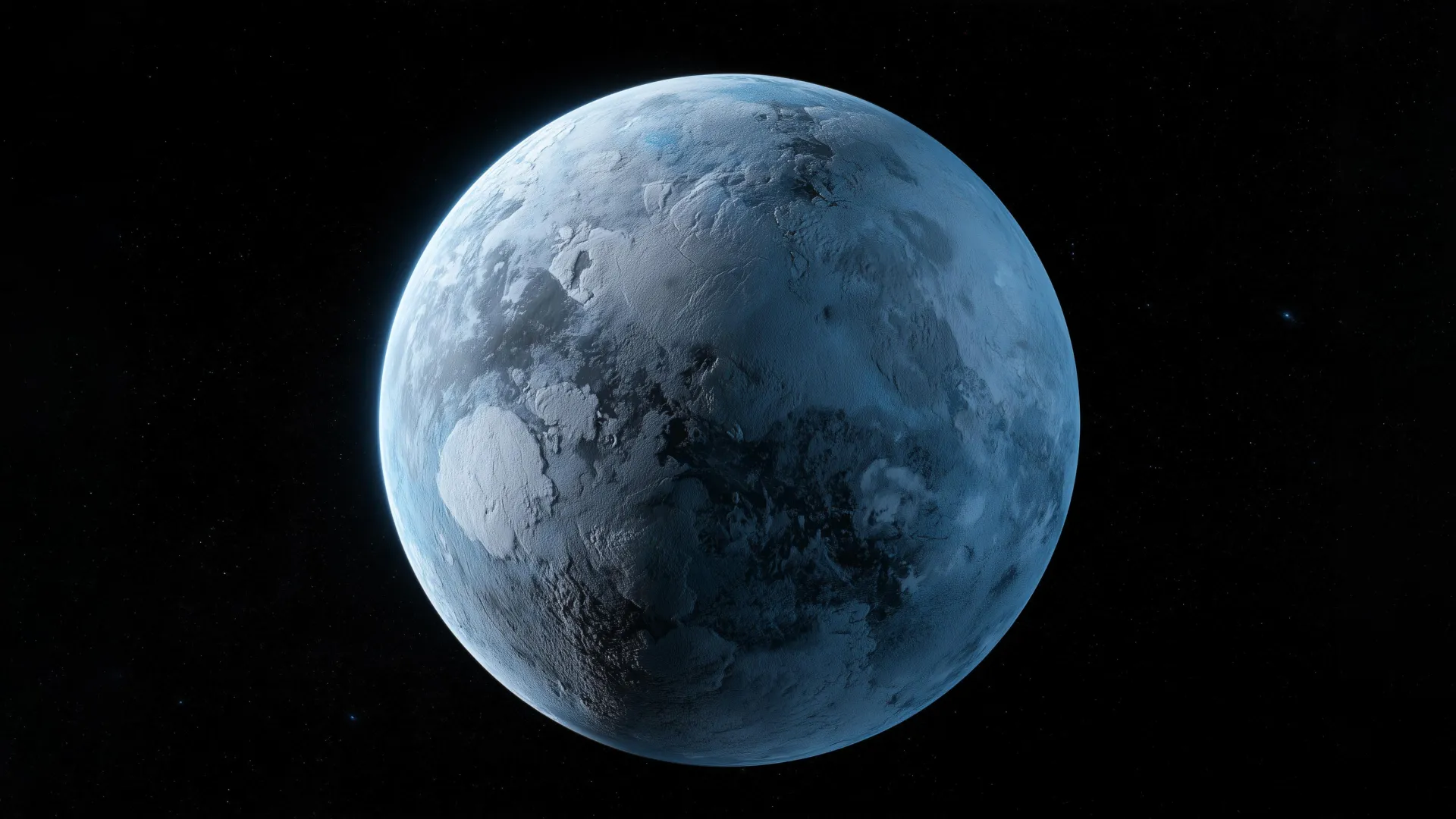
What is it called? How big is enormous?

It doesn't have a name yet. It goes by its provisional designation, 2026 ED138, and an official name would come later, once the orbit and size are settled.
The size estimates are wide. Scientific American reports an initial diameter of 600 to 1,500 km (373 to 932 miles). A later write-up, citing the discovery team, gives about 1,000 km and calls it the largest trans-Neptunian object found in about 20 years. For scale, Ceres, the smallest recognized dwarf planet, is about 958 km across, and Pluto is about 2,377 km.
So "enormous" is relative. At the upper estimate it would be more than half Pluto's width. At the lower one it would be roughly Ceres-sized. Size is only half the test, though. Astronomers still need to show it is round enough to count, and that requires more observations.
🕒 As of November 2026
Why round enough?
Good question to press on. A dwarf planet is defined by three things: it orbits the Sun, it is massive enough that its own gravity pulls it into a roughly round shape (hydrostatic equilibrium), and it has not cleared the neighborhood around its orbit of other bodies. The third rule is the one that excludes Pluto from being a "planet" in the 2006 IAU definition, so it's the first thing that differs between a dwarf planet and a planet, and it has nothing to do with roundness.
Roundness is the test that matters for this object because it is the one that sets its size. A rock of a few hundred kilometres can be lumpy, like an asteroid, while a body above roughly 400 to 1,000 km across, depending on its ice and rock content, usually has enough self-gravity to pull itself into a sphere. Astronomers can't see the shape of an object this far away directly, so they look for indirect signs: a brightness that changes steadily as it spins, or a shape inferred from how it moves past stars. Those measurements take repeated observations over time, which is why the size estimates so far are wide.
That also explains the 600 to 1,500 km range. Size is inferred from brightness, which depends on how reflective the surface is. A dark surface can hide a larger body, a bright one a smaller one. Until the team has a shape or a spin curve, the diameter stays a range, and roundness can't be confirmed either.
The IAU, the body that makes these decisions, would weigh a published, peer-reviewed size and shape against the rules before any naming. I'm going from memory on the exact IAU wording, so check the IAU's own dwarf planet criteria if you want the precise text.
