The Federal Reserve System is the central bank of the United States, created by the Federal Reserve Act of 1913 and made up of a Board of Governors in Washington, 12 regional Reserve Banks and the Federal Open Market Committee.[7][3]
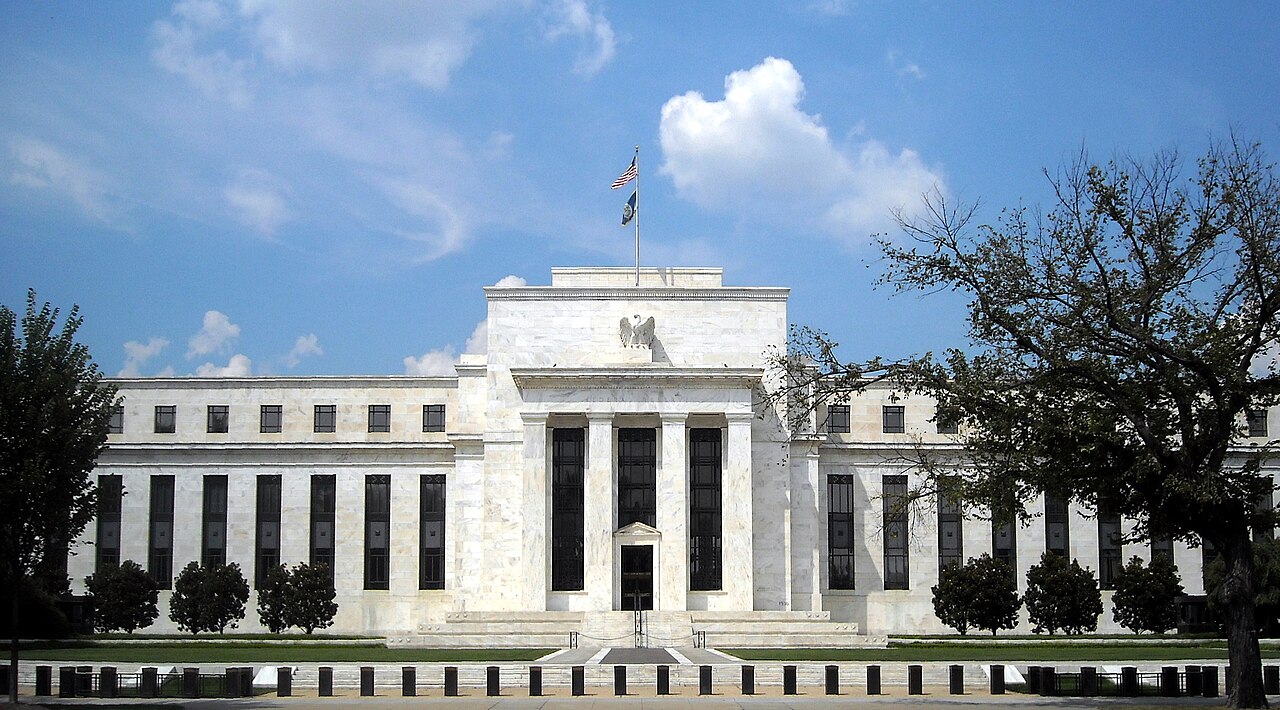
The Marriner S. Eccles Federal Reserve Board Building in Washington, D.C., headquarters of the Board of Governors.
By 1907 the United States was, in the words of a Federal Reserve Bank of Kansas City history, the only one of the world's major financial powers without a central bank, and during the panic of that year the financier J.P. Morgan organized private investments and lines of credit to steady the banking system.[1] Congress responded with the Aldrich-Vreeland Act of 30 May 1908, which provided for emergency currency and created an eighteen-member National Monetary Commission chaired by Senator Nelson Aldrich.[1] Earlier banking panics had been widely blamed on an "inelastic currency", one that could not expand and contract with the needs of the economy.[6]
The plan that followed had been under development since a secret meeting on Jekyll Island, Georgia, in November 1910, attended by the investment banker Paul Warburg, the Treasury official Abram Piatt Andrew and others; the participants used only first names and told others they were going duck hunting.[1] Aldrich's 1912 proposal for a National Reserve Association called for a forty-six-member board with only six appointed by the government, and it was attacked in both chambers for giving too little control to the government and too much power to bankers.[1] After the 1912 election, with the Democrat Woodrow Wilson in the White House and Democrats controlling both houses, its chances were gone.[1]
The House Banking and Currency Committee assigned a subcommittee under Representative Carter Glass, whose bill provided for a system of regional banks rather than a single central body.[1] Wilson felt the plan needed an oversight agency, so a Federal Reserve Board made up of presidential appointees was added, together with a Federal Advisory Council of twelve bankers elected by the regional banks.[1] In the Senate, a measure offered by Senator Robert L. Owen limited the number of Reserve Banks to no more than twelve, and the final Act specified between eight and twelve.[1] The Act as passed also staggered the governors' terms, extending them to ten years so that no president could appoint all the governors during a two-term presidency.[1] The political fight, the Federal Reserve History site notes, pitted the interests of large city banks against those of banks in smaller cities and rural areas.[6]
President Wilson signed the Federal Reserve Act on 23 December 1913.[1] The twelve Reserve Bank districts were announced in April 1914, after 37 cities had applied to host a bank, and all twelve Reserve Banks opened in November 1914.[2]
Structure
The System has three key parts: the Board of Governors, the 12 Reserve Banks and the Federal Open Market Committee (FOMC).[3]
Board of Governors. As of November 2026, the Board in Washington, D.C. has seven members, called governors, who serve staggered 14-year terms; the President nominates them and the Senate confirms them.[3] The Board has a Chair and a Vice Chair, who may be appointed to additional four-year terms, and it is a federal agency that reports to and is directly accountable to Congress.[3]
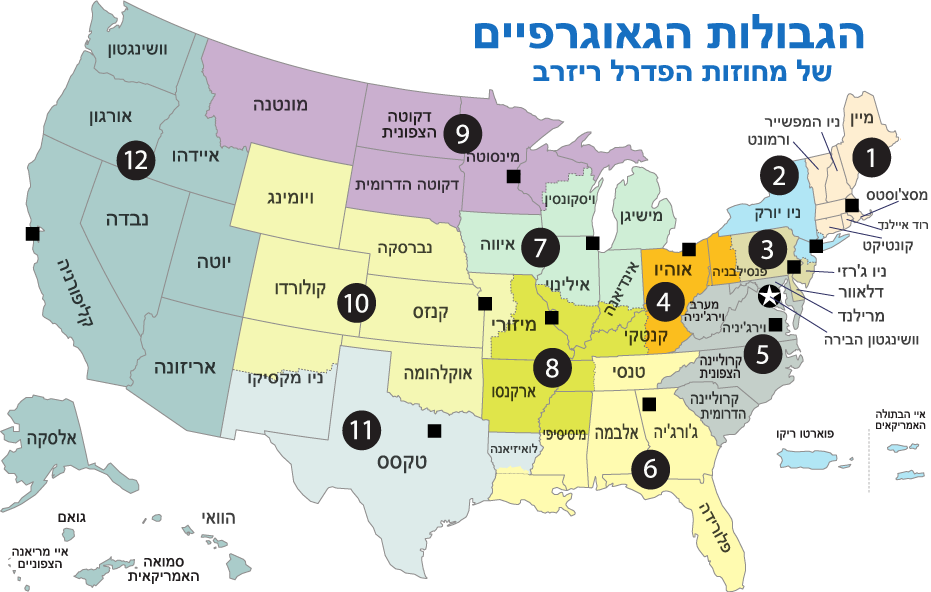
Reserve Banks. The 12 Reserve Banks have 24 Branches between them, and each serves its own geographic district.[3] They are in Boston, New York, Philadelphia, Cleveland, Richmond, Atlanta, Chicago, St. Louis, Minneapolis, Kansas City, Dallas and San Francisco, locations chosen largely from a survey of national banks and the concentration of economic activity in the early twentieth century.[2] The Federal Reserve History site describes the Reserve Banks as "technically private corporations" with their own boards of directors, overseen by a board appointed by the government, and notes that the shareholder rights of the member banks that capitalize them are limited.[6]
A map of the twelve Federal Reserve districts of the United States.
Federal Open Market Committee. The FOMC sets U.S. monetary policy at meetings held at least eight times a year.[3] Its 12 voting members are the seven governors, the president of the Federal Reserve Bank of New York, and four of the other eleven Reserve Bank presidents, who serve one-year terms on a rotating basis; the remaining seven presidents attend and take part in deliberations but do not vote.[3]
Goals and mandate
Section 2A of the Federal Reserve Act directs the Board and the FOMC to maintain long-run growth of the monetary and credit aggregates that matches the economy's long-run potential to increase production, so as to promote the goals of maximum employment, stable prices and moderate long-term interest rates.[4]
The FOMC's own Statement on Longer-Run Goals and Monetary Policy Strategy, adopted effective 24 January 2012 and reaffirmed effective 27 January 2026, describes how it reads that mandate.[5] It reaffirms that inflation of 2 percent, measured by the annual change in the price index for personal consumption expenditures, is most consistent over the longer run with the Fed's statutory mandates.[5] On employment it sets no fixed goal: the maximum level of employment is not directly measurable and changes over time with nonmonetary factors, so the Committee's decisions are informed by assessments it calls necessarily uncertain and subject to revision.[5] The Committee's primary means of adjusting the stance of monetary policy is changes in the target range for the federal funds rate.[5] It intends to review these principles each January and to undertake a public review of its strategy, tools and communication practices roughly every five years.[5]