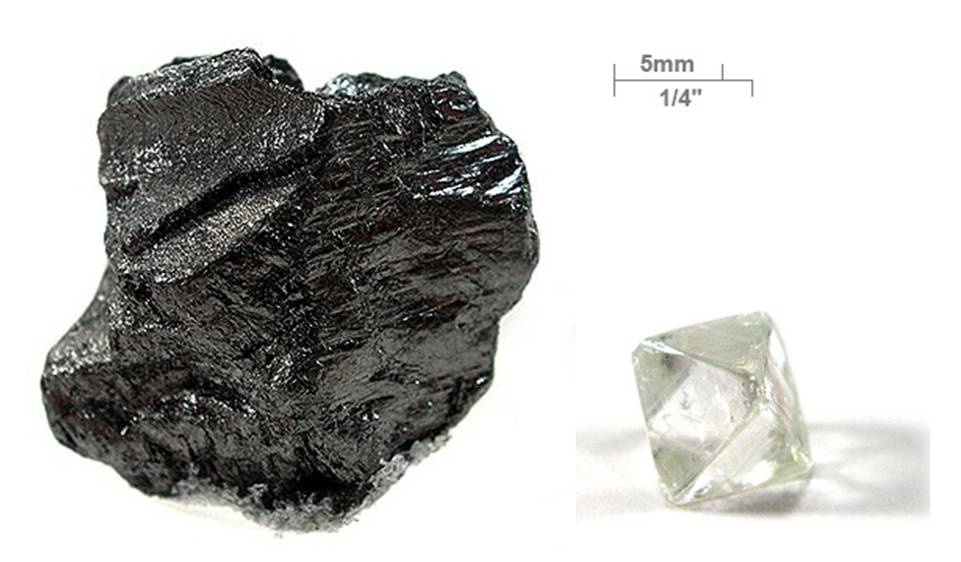
Carbon is the chemical element with atomic number 6 and the symbol C, a nonmetal that is solid at room temperature and occurs in forms as different as diamond and graphite.[1]
Graphite and diamond, two forms of the element carbon.
This entry is about the element. Its relative atomic mass is 12.011, it sits in group 14 of the periodic table, and its electron configuration is [He] 2s²2p².[1]
Properties
The Royal Society of Chemistry lists carbon's melting and boiling points as a single figure, saying it sublimes, turning directly from solid to gas, at 3825 °C (4098 K).[1] The same source gives a density of 3.513 g/cm³ for diamond and 2.2 g/cm³ for graphite.[1] The International Union of Pure and Applied Chemistry's commission on atomic weights gives carbon's standard atomic weight as an interval, 12.0096 to 12.0116, since 2009.[3]
Isotopes
Carbon has three isotopes of note. Carbon-12 has a relative atomic mass of exactly 12.[3] In nature, carbon-12 makes up about 98.93 percent of carbon and carbon-13 about 1.07 percent; NIST gives these as 0.9893(8) and 0.0107(8).[2] Carbon-14 is radioactive, with a half-life of 5730 years according to the atomic weights commission.[3] The commission adds that a slightly different figure, the 5568-year "Libby half-life," is adopted by convention in geochronology.[3] The Royal Society of Chemistry's table lists 5715 years instead, so published figures for this half-life are not identical.[1]
Forms of carbon
The pure element occurs in several forms, called allotropes. The Royal Society of Chemistry lists diamond, graphite, graphene, amorphous carbon and fullerenes. It describes diamond as a colourless, transparent crystalline solid and the hardest known material, graphite as black, shiny and soft, and the nanoscale forms, fullerenes and graphene, as black or dark-brown soot-like powders.[1]
Discovery and name
Carbon was known in prehistory as charcoal and soot, and its name comes from the Latin carbo, "charcoal."[1][3] In 1694 the Italian scientists Averani and Targioni heated a diamond with focused sunlight.[1] The English chemist Smithson Tennant then proved that diamond is pure carbon: the Royal Society of Chemistry dates this to 1796 and the atomic weights commission to 1797.[1][3]
Carbon on Earth
NASA's Earth Observatory describes carbon as the fourth most abundant element in the universe. In an article from 2011 it says most of Earth's carbon, about 65,500 billion metric tons, is stored in rocks, and that the rest is in the ocean, the atmosphere, plants, soil and fossil fuels.[4] The element moves between these stores in what NASA calls the carbon cycle.[4]
NOAA's Global Monitoring Laboratory tracks atmospheric carbon dioxide (CO₂) and reported a monthly mean at Mauna Loa, Hawaii, of 426.07 parts per million for September 2026, against 424.37 for September 2025, and a global mean of 426.10 for July 2026, against 424.09 for July 2025. NOAA says the most recent year of data is preliminary.[5]
Uses
The Royal Society of Chemistry notes that graphite is used in pencils, to make brushes in electric motors, and in furnace linings, and that carbon fibre is finding many uses as a strong, lightweight material.[1]