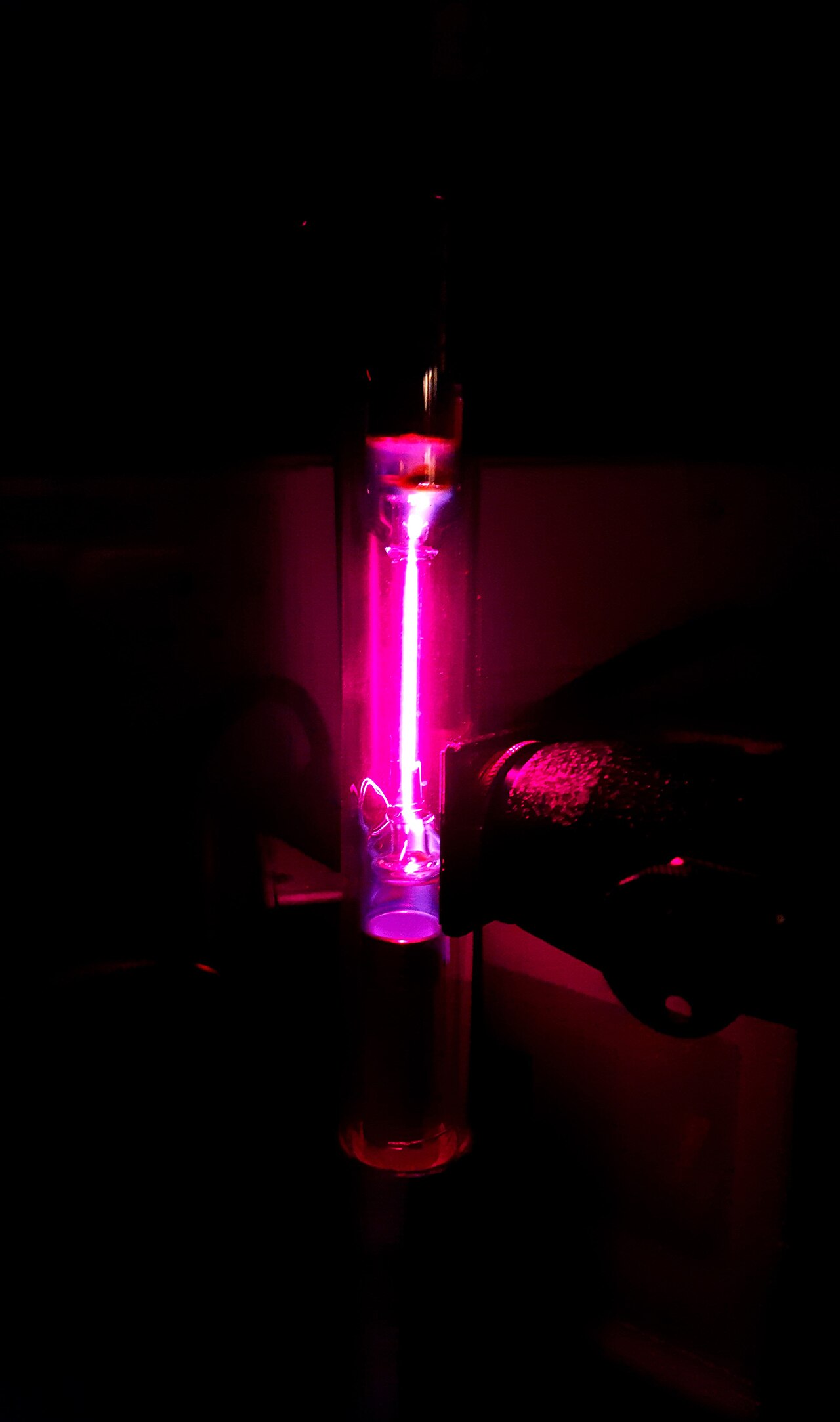
Hydrogen is the chemical element with atomic number 1 and the symbol H, the lightest element, a colourless, odourless gas that has the lowest density of all gases.[1]
A glowing tube of hydrogen gas excited by electricity.
This entry is about the element. Its relative atomic mass is 1.008, it is placed in group 1 of the periodic table, and its electron configuration is 1s¹.[1] The Royal Society of Chemistry calls it "easily the most abundant element in the universe," and says that on Earth it is found in the greatest quantities as water.[1]
Properties
The Royal Society of Chemistry lists hydrogen's density as 0.000082 g/cm³, its melting point as −259.16 °C (13.99 K) and its boiling point as −252.879 °C (20.271 K).[1] The atomic weights commission of the International Union of Pure and Applied Chemistry gives its standard atomic weight as an interval, 1.00784 to 1.00811, since 2009.[3]
Isotopes
Hydrogen has two stable isotopes. The major one, hydrogen-1, is also called protium, and the minor one, hydrogen-2, is called deuterium, with the symbol D.[3] NIST gives their natural proportions as 0.999885 and 0.000115.[2] A third isotope, tritium (hydrogen-3), is radioactive: it decays by beta emission to helium-3 with a half-life of 12.3 years according to the atomic weights commission, or 12.31 years in the Royal Society of Chemistry's table.[3][1] The Royal Society of Chemistry says Harold Urey and colleagues at Columbia University detected deuterium, the second, rarer form of hydrogen, in 1931.[1]
Discovery and name
Both the Royal Society of Chemistry and the atomic weights commission credit the English physicist Henry Cavendish with discovering hydrogen in 1766.[1][3] The Royal Society of Chemistry adds that Paracelsus and Boyle had noted the flammable gas earlier, and that Antoine Lavoisier gave it its name.[1] The name comes from the Greek hydro, "water," and genes, "forming," because the gas burned in air to form water.[3]
Production
Most hydrogen is made by heating natural gas with steam to form syngas, a process the US Department of Energy calls natural gas reforming or steam methane reforming.[1][4] The department says that about 95 percent of all hydrogen was produced from steam reforming of natural gas, as of an October 2026 update of its page. It names the other common method as electrolysis, in which electricity splits water into hydrogen and oxygen.[4][5]
The International Energy Agency reported in June 2026 that global hydrogen demand grew almost 3 percent in 2025 to surpass 100 million tonnes. It said that production remains dominated by unabated fossil fuels, and that low-emissions production reached almost 1 million tonnes in 2025, with demand for low-emissions hydrogen up 20 percent.[6][7]
Uses
The Royal Society of Chemistry lists fuel cells, the Haber process for making ammonia, the hydrogenation of oils, and filling balloons and airships among the uses of hydrogen, and names the Hindenburg airship.[1]