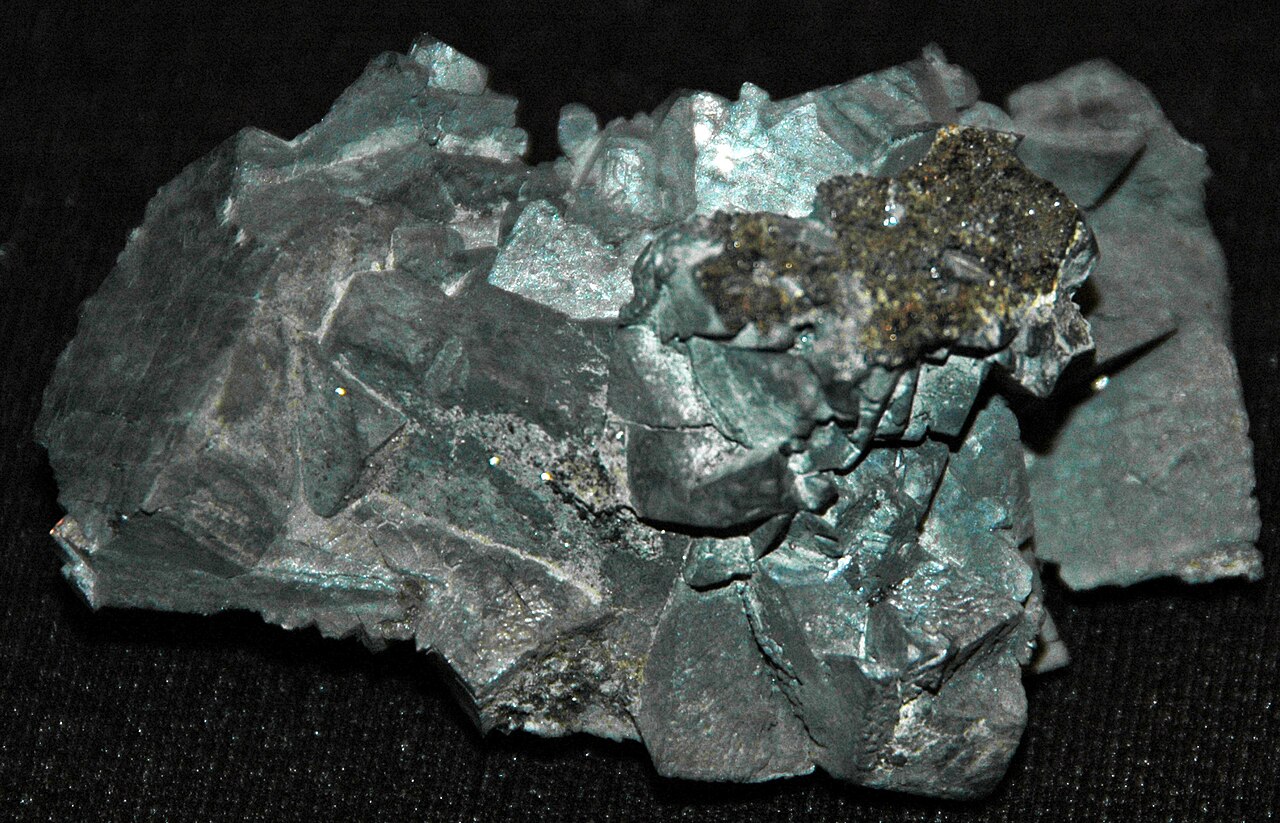
Lead is the chemical element with atomic number 82 and the symbol Pb, a dense, blue-grey metal known since ancient times and now the subject of health and environmental rules because it is toxic.[1][3][7][8]
Galena, the lead sulfide mineral from which most lead is obtained.
This entry is about the element. Its relative atomic mass is 207.2, it is in group 14 of the periodic table, and it is a solid at room temperature.[1] The Royal Society of Chemistry says lead has no known biological role.[1]
Properties
Lead melts at 327.462 °C (600.612 K) and boils at 1749 °C (2022 K), and its density is 11.3 g/cm³.[1] Its symbol, Pb, comes from the Latin plumbum, while the English name derives from the Anglo-Saxon word lead, which the atomic weights commission describes as of unknown origin.[3]
Isotopes
Lead has four stable isotopes. NIST gives their typical natural proportions as 1.4 percent for lead-204, 24.1 percent for lead-206, 22.1 percent for lead-207 and 52.4 percent for lead-208.[2] Unlike most elements, lead's atomic weight is reported as a wide interval: the commission of the International Union of Pure and Applied Chemistry gives 206.14 to 207.94 since 2020, and recommends using 207.2 ± 1.1 when a single value is needed.[3] NIST lists the standard atomic weight as 207.2(1).[2]
History and uses
The element was known from prehistoric times.[3] The Royal Society of Chemistry says the Romans used lead on a large scale, mining it mainly in Spain and Britain and using it for water pipes, and that it has been used for pipes, pewter and paint since Roman times. It adds that those uses have now been banned, replaced or discouraged, and that lead is still widely used for car batteries, pigments and ammunition.[1] The World Health Organization says most global lead consumption is for making lead-acid batteries for motor vehicles.[4]
Lead is obtained chiefly from the mineral galena by a roasting process, according to the Royal Society of Chemistry, which lists China, Australia and the United States as the top three producers. Its table gives a crustal abundance of 11 parts per million.[1]
Lead and health
This section reports what health bodies state. It gives no instructions.
The World Health Organization, the US Centers for Disease Control and Prevention and the US Environmental Protection Agency all say that no safe level of exposure to lead has been identified.[4][5][7] The WHO says there is no level of exposure to lead known to be without harmful effects, and that exposure can permanently affect children's brain development and reduce intelligence quotient (IQ).[4] The EPA says lead is toxic to humans and animals and that no safe level in children has been identified.[7] The CDC says even low levels of lead in blood are associated with developmental delays, difficulty learning and behavioral issues, and that the effects of lead poisoning can be permanent and disabling.[5]
The WHO lists mining, smelting, manufacturing and recycling among the sources of environmental contamination, and describes exposure as mainly coming from inhaling particles produced by burning lead-containing materials and swallowing contaminated dust, soil, water or food. It adds that lead can enter drinking water through plumbing with lead pipes, solders and fittings.[4] It says lead exposure in pregnancy can cause reduced fetal growth and preterm birth, and, citing estimates from the Institute for Health Metrics and Evaluation, attributes more than 3.5 million deaths in 2023 to lead exposure, primarily through cardiovascular effects (fact sheet of June 10, 2026).[4]
The CDC uses a blood lead reference value of 3.5 micrograms per deciliter (µg/dL), set on October 28, 2021 when it lowered the earlier value of 5 µg/dL. It is based on the 97.5th percentile of blood lead in US children aged 1 to 5 years in a national survey from 2015 to 2018, and the CDC says it is not a health-based standard or a toxicity threshold.[6] The WHO says that blood lead concentrations as low as 3.5 µg/dL may be associated with decreased intelligence in children.[4]
The EPA says most exposure comes from the historical use of leaded gasoline, release from industrial facilities and lead-based paint.[7] In the United States the phase-out of lead in gasoline began in the 1970s and culminated in a 1996 ban on lead in gasoline for on-road motor vehicles.[8]
This entry explains; it is not medical advice. Ask a doctor or pharmacist about your own health.