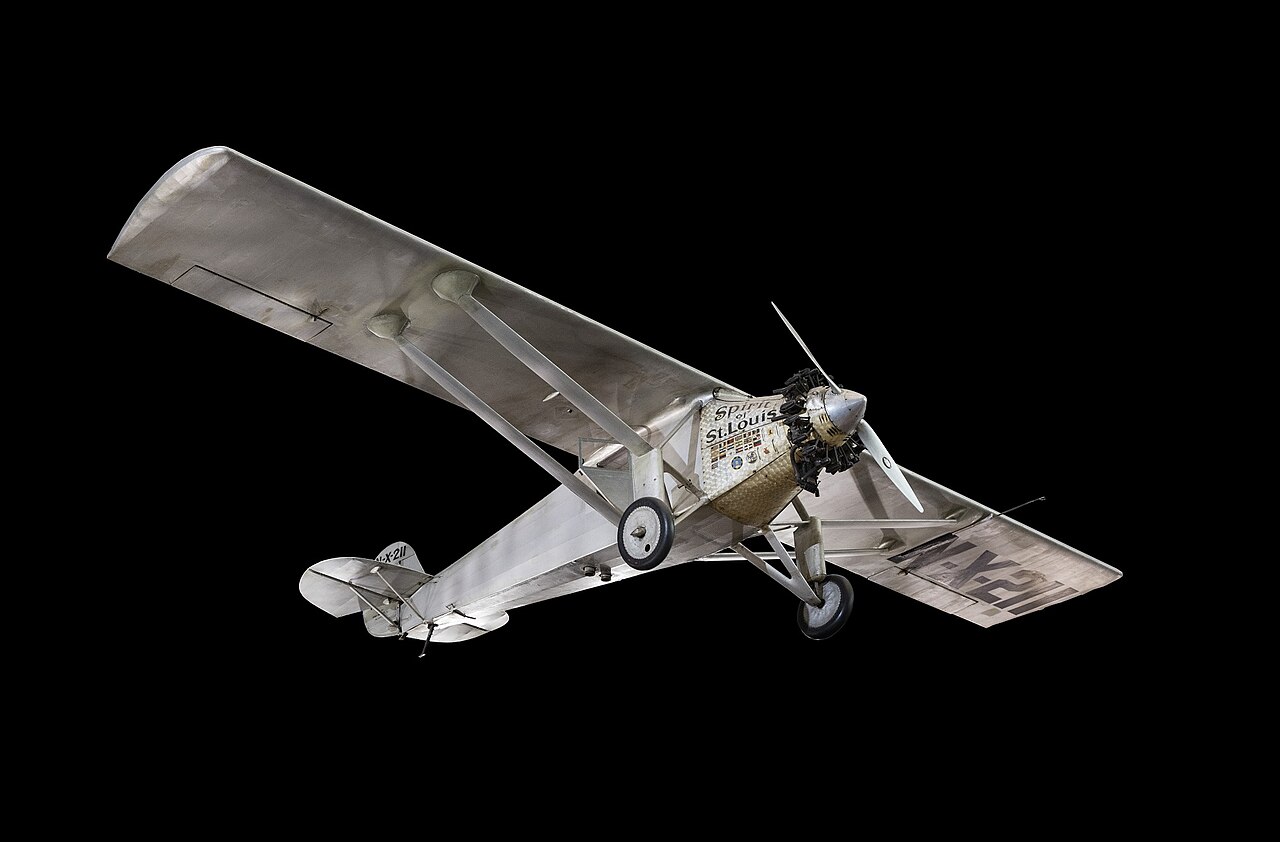
The Spirit of St. Louis is the Ryan NYP monoplane in which Charles Lindbergh made the first solo nonstop flight across the Atlantic, from Long Island to Paris, on 20–21 May 1927. It is now in the collection of the Smithsonian's National Air and Space Museum.[1]
The silver Ryan NYP Spirit of St. Louis, a single-engine high-wing monoplane.
Background: the Orteig prize and the St. Louis backers
In 1919 the hotel owner Raymond Orteig offered $25,000 to the first pilot to fly nonstop between New York and Paris, in either direction, as both PBS's American Experience and Lindbergh's own book We record.[3][5] According to PBS, the offer was set to last five years and was extended for another five in 1926.[5]
Lindbergh wrote in We that he first considered the flight in the autumn of 1926, while flying the mail, and that he found "a number of public spirited men in St. Louis sufficiently interested in aviation to finance such a project."[3] The Smithsonian's record says he was then an airmail pilot on the St. Louis–Chicago route and that in early 1927 several St. Louis men backed him.[1] The State Historical Society of Missouri's Historic Missourians names, among the early supporters, the pharmaceutical manufacturer and airfield owner Albert Bond Lambert, Lindbergh's employers William and Frank Robertson, and the civic leaders Earl Thompson, Harry Hall Knight and Harold M. Bixby.[4] We is dedicated, besides Lindbergh's mother, to eight men whose backing made the flight possible, among them Harry H. Knight, Bixby, Thompson and Lambert.[3]
Design and construction
Lindbergh decided on a single-engine monoplane, reasoning in We that it had less drag, and so a greater range, than a multi-engine aircraft, and that a modern air-cooled radial engine was reliable enough to accept the risk of an engine failure.[3] According to PBS, he had turned down a $15,000 single-engine aircraft from Columbia Aircraft, which did not include the engine, because its president wanted to choose the pilot. Ryan Airlines of San Diego then offered to build one for $6,000, also without the engine, and said it needed three months; Lindbergh required two.[5] Lindbergh gives the date of his order with Ryan as 28 February 1927.[3]
The Smithsonian's record describes the aircraft as a highly modified version of the standard Ryan M-2 strut-braced monoplane, designed by Donald A. Hall under Lindbergh's direct supervision.[1] The wingspan was increased by 10 feet, the fuselage was lengthened by 2 feet, and the structure was redesigned to carry a heavier fuel load.[1] The cockpit was moved back and the engine forward, which put the fuel tank at the aircraft's centre of gravity, ahead of the pilot.[1] A consequence was that Lindbergh could not see straight ahead: he could look forward only through a periscope or by turning the aircraft and looking out of a side window.[1]
The museum lists the engine as a 223-horsepower Wright J-5C, while Lindbergh's own account of his order calls it a 200-horsepower Wright Whirlwind J5-C; the two figures are given here as the sources give them.[1][3] The museum's dimensions are about 46 feet in span, 27 feet 8 inches in length and 9 feet 10 inches in height, with a takeoff weight of 5,135 pounds.[1]
Lindbergh chose not to carry a navigator and used the weight for extra fuel, which he said gave about 300 miles of additional range; he navigated by a great-circle course, changing heading about every hundred miles, and the aircraft carried an Earth Inductor Compass.[3] His emergency equipment included an inflatable raft, five tins of army emergency rations and two canteens of water.[3]
Lindbergh wrote that Ryan's workers laboured day and night during the two months of construction and that he gave the aircraft its first test flight on 28 April, sixty days after the order.[3] In the load tests at Camp Kearney near San Diego, it took off with 300 gallons of fuel in 20 seconds, or 1,026 feet.[3] The museum says the finished aircraft was painted silver.[1] On 10–12 May 1927 Lindbergh flew it from San Diego to New York with one stop, at St. Louis, in 21 hours 40 minutes, which the museum says set a transcontinental record.[1]
The name
According to Historic Missourians, Bixby suggested that Lindbergh name the aircraft the Spirit of St. Louis, and Lindbergh readily agreed.[4] Lindbergh's dedication in We thanks the St. Louis men who made the flight possible, using the name.[3]
The flight
Lindbergh took off from Roosevelt Field on Long Island at 7:52 a.m. on 20 May 1927, after a night without sleep and a delay caused by rain; the field was soft, and he wrote that he cleared a tractor by about 15 feet and a telephone line by about 20.[3] He flew very low over much of the route, sometimes within ten feet of the waves, crossed ice-covered water off Nova Scotia, passed icebergs after leaving Newfoundland, climbed to about 10,000 feet to avoid storm clouds after dark, and flew for nearly two hours entirely on instruments in fog.[3] The stretch of open water between Newfoundland and Ireland was about 1,850 miles of a total distance of 3,610 miles.[3]
He sighted the Irish coast near Cape Valentia and Dingle Bay, crossed southern England and the English Channel, and reached the lights of Paris a little before 10 p.m. local time, circling the Eiffel Tower before finding Le Bourget airfield to the northeast.[3] The Smithsonian gives the flight as 33 hours 30 minutes and 3,610 miles (5,810 kilometres), between 20 and 21 May, and records that a crowd of about 100,000 greeted him.[1][6] A Smithsonian curator's account gives the crowd as more than 150,000; the figures differ between the museum's pages.[2]
Souvenir hunters tore fabric from the wings, fuselage and tail before airport officials could cordon off the aircraft, and the French Air Force moved it to a hangar and patched it.[2] One spectator cut out the winged "R" of the Ryan company from the right side of the rudder, and the blank patch remains.[2] President Calvin Coolidge said of the flight, "Our messenger of peace and goodwill has broken down another barrier of time and space."[1] The museum adds that the world was not again as enthusiastic about an aviation event until the Apollo 11 Moon landing in 1969.[1]