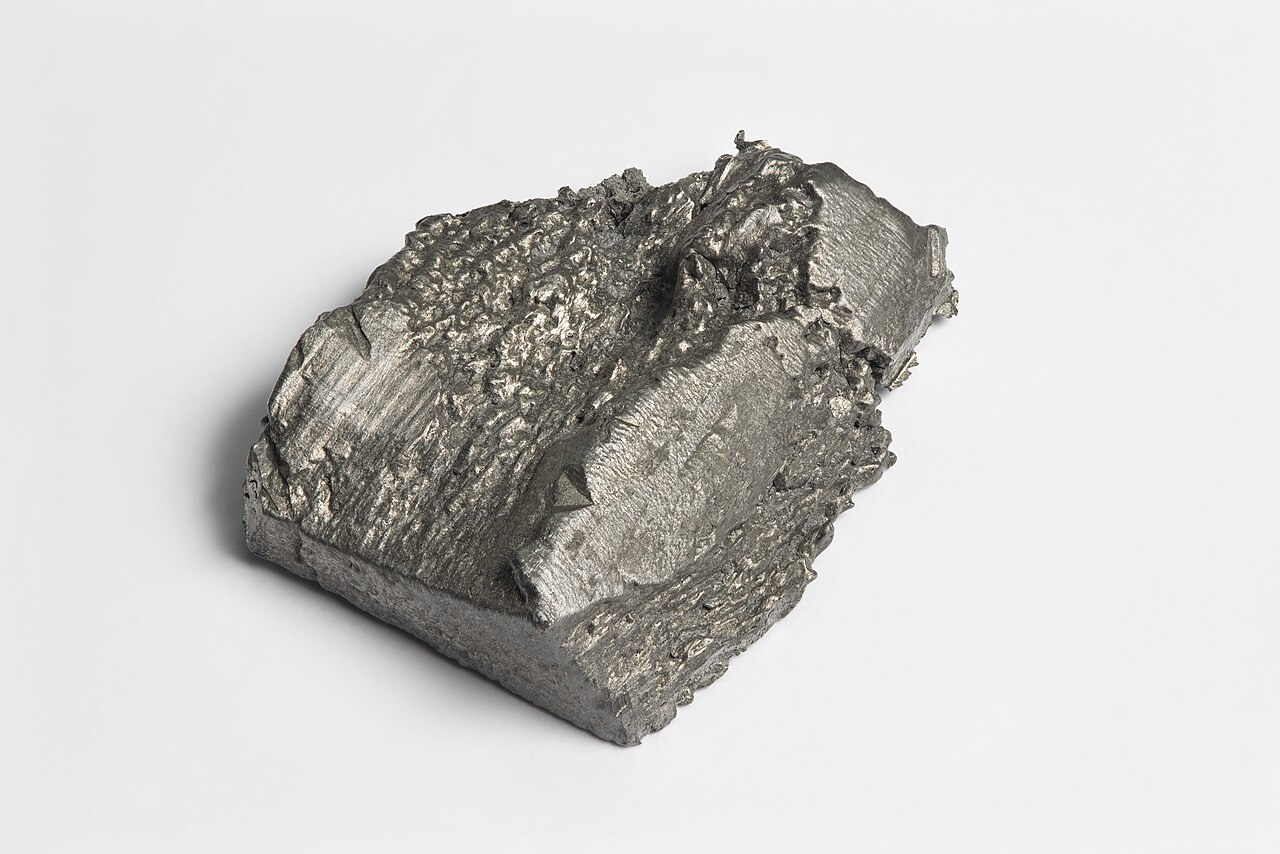
Yttrium is the chemical element with atomic number 39 and the symbol Y, a metal in group 3 of the periodic table, named after the Swedish village of Ytterby.[1][3]
This entry is about the element. Its relative atomic mass is 88.906, it is in group 3 of the periodic table, and it is a solid at room temperature.[1] For its place in the table and its basic facts, see the [periodic table page for Yttrium](/element/Q941/yttrium).
Properties
The Royal Society of Chemistry lists yttrium's melting point as 1522 °C (1795 K), its boiling point as 3345 °C (3618 K), and its density as 4.47 g/cm³.[1] It has a single stable isotope, yttrium-89, so its atomic weight is a single value, 88.905838(2) since 2021 according to the atomic weights commission of the International Union of Pure and Applied Chemistry; NIST gives 88.90584(2).[3][2]
Discovery and name
The Finnish chemist Johan Gadolin discovered yttrium in 1794 in the mineral ytterbite, according to the atomic weights commission. The Royal Society of Chemistry says that in 1787 Karl Arrhenius found a black rock at Ytterby, near Stockholm, and passed it to Gadolin, who announced in 1794 an "earth" making up 38 percent of the rock's weight. Friedrich Wöhler isolated the metal in 1828, and Carl Mosander found more oxides in the same material in 1843.[1][3]
Where it comes from
The Royal Society of Chemistry gives yttrium's crustal abundance as 33 parts per million. The metal is produced by reducing yttrium fluoride with calcium, the source mineral is xenotime from China and Malaysia, and China, Russia and Malaysia are listed as the top three producers, without a date.[1]
Uses
The Royal Society of Chemistry lists alloy additives for aluminium and magnesium, radar microwave filters, yttrium aluminium garnet lasers, white LEDs, camera-lens glass, superconductors and yttrium-90 for cancer treatment. It says yttrium has no known biological role and its soluble salts are mildly toxic.[1]