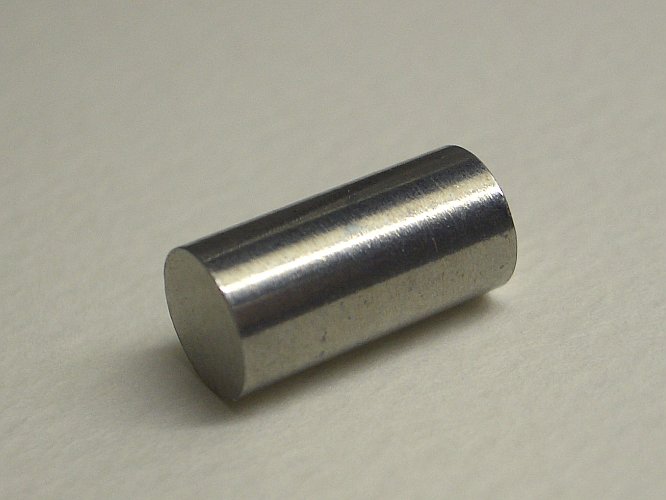
Molybdenum is the chemical element with atomic number 42 and the symbol Mo, a metal in group 6 of the periodic table that is used in steel alloys and as a lubricant.[1]
This entry is about the element. Its relative atomic mass is 95.95, it is in group 6 of the periodic table, and it is a solid at room temperature.[1] For its place in the table and its basic facts, see the [periodic table page for Molybdenum](/element/Q1053/molybdenum).
Properties
The Royal Society of Chemistry lists molybdenum's melting point as 2622 °C (2895 K), its boiling point as 4639 °C (4912 K), and its density as 10.2 g/cm³.[1] Its standard atomic weight is 95.95(1), unchanged since 2013 according to the atomic weights commission of the International Union of Pure and Applied Chemistry, which says the "g" annotation refers to anomalous occurrences at the Oklo natural nuclear reactor in Gabon; NIST gives the same value.[3][2]
Isotopes
Molybdenum has seven naturally occurring isotopes. The Royal Society of Chemistry gives their proportions as 14.53 percent for molybdenum-92, 9.15 percent for molybdenum-94, 15.8 percent for molybdenum-95, 16.67 percent for molybdenum-96, 9.6 percent for molybdenum-97, 24.39 percent for molybdenum-98 and 9.82 percent for molybdenum-100, and NIST gives the same figures as fractions.[1][2]
Discovery and name
The Swedish pharmacist and chemist Carl Wilhelm Scheele discovered molybdenum in 1778, according to the atomic weights commission. The Royal Society of Chemistry says the mineral molybdenite looked like graphite and was thought to be lead ore until Scheele showed it was neither, and that he passed the problem to Peter Jacob Hjelm, who produced the metal and announced it in the autumn of 1781.[1][3] The name comes from the Greek molybdos, "lead."[1][3]
Where it comes from
The Royal Society of Chemistry gives molybdenum's crustal abundance as 0.8 parts per million. Molybdenite is roasted to the oxide and reduced to the metal, world production is around 200,000 tonnes a year according to the page, without a date, and China, the United States and Chile are listed as the top three producers.[1]
Uses
The Royal Society of Chemistry lists steel alloys, heating elements, drills and saw blades, molybdenum disulfide as a lubricant and catalysts for petroleum. It says molybdenum is toxic in anything other than small quantities but is an essential element for animals and plants, and that about 50 enzymes contain it, including nitrogenase.[1]