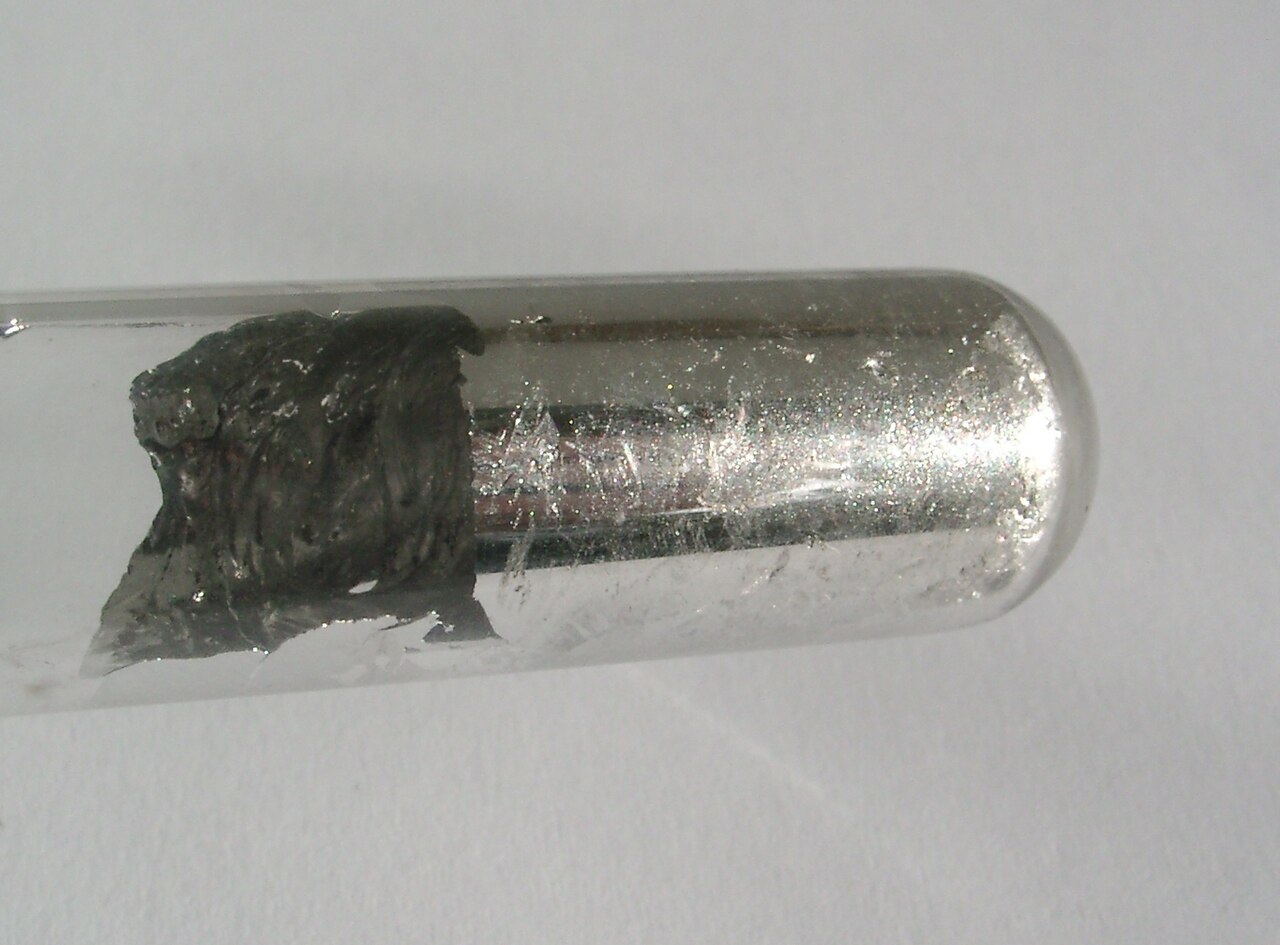
Indium is the chemical element with atomic number 49 and the symbol In, a metal in group 13 of the periodic table that is used, as indium tin oxide, in touch screens and flat-screen displays.[1]
This entry is about the element. Its relative atomic mass is 114.818, it is in group 13 of the periodic table, and it is a solid at room temperature.[1] For its place in the table and its basic facts, see the [periodic table page for Indium](/element/Q1094/indium).
Properties
The Royal Society of Chemistry lists indium's melting point as 156.60 °C (429.75 K), its boiling point as 2027 °C (2300 K), and its density as 7.31 g/cm³.[1] Its standard atomic weight is 114.818(1), unchanged since 2011 according to the atomic weights commission of the International Union of Pure and Applied Chemistry; NIST gives the same value.[3][2]
Isotopes
Indium has two naturally occurring isotopes. The Royal Society of Chemistry lists indium-115 at 95.71 percent, and NIST gives 0.0429(5) for indium-113 and 0.9571(5) for indium-115.[1][2] Indium-115 is radioactive, with a half-life of hundreds of quadrillions of years, too long to affect the atomic weight according to the commission.[3]
Discovery and name
The German physicist Ferdinand Reich and the German metallurgist Hieronymus Theodor Richter discovered indium in 1863 while examining zinc blende, according to the atomic weights commission, which says they isolated the metal in 1867. The Royal Society of Chemistry says Reich saw a violet line in the spectrum, and that the element was named from it.[1][3] The name comes from the Latin indicium, "violet" or "indigo" according to the Royal Society of Chemistry, and from the term indigo, for the indigo-blue line, according to the commission.[1][3]
Where it comes from
The Royal Society of Chemistry gives indium's crustal abundance as 0.052 parts per million and says it is commercially produced as a by-product of zinc refining. China, the Republic of Korea and Japan are listed as the top three producers, without a date.[1]
Uses
The Royal Society of Chemistry lists indium tin oxide for touch screens, flat-screen televisions and solar panels, semiconductors, mirror coatings, welders' goggles, ball bearings and a low-melting alloy for fire sprinklers. It says indium has no known biological role.[1]