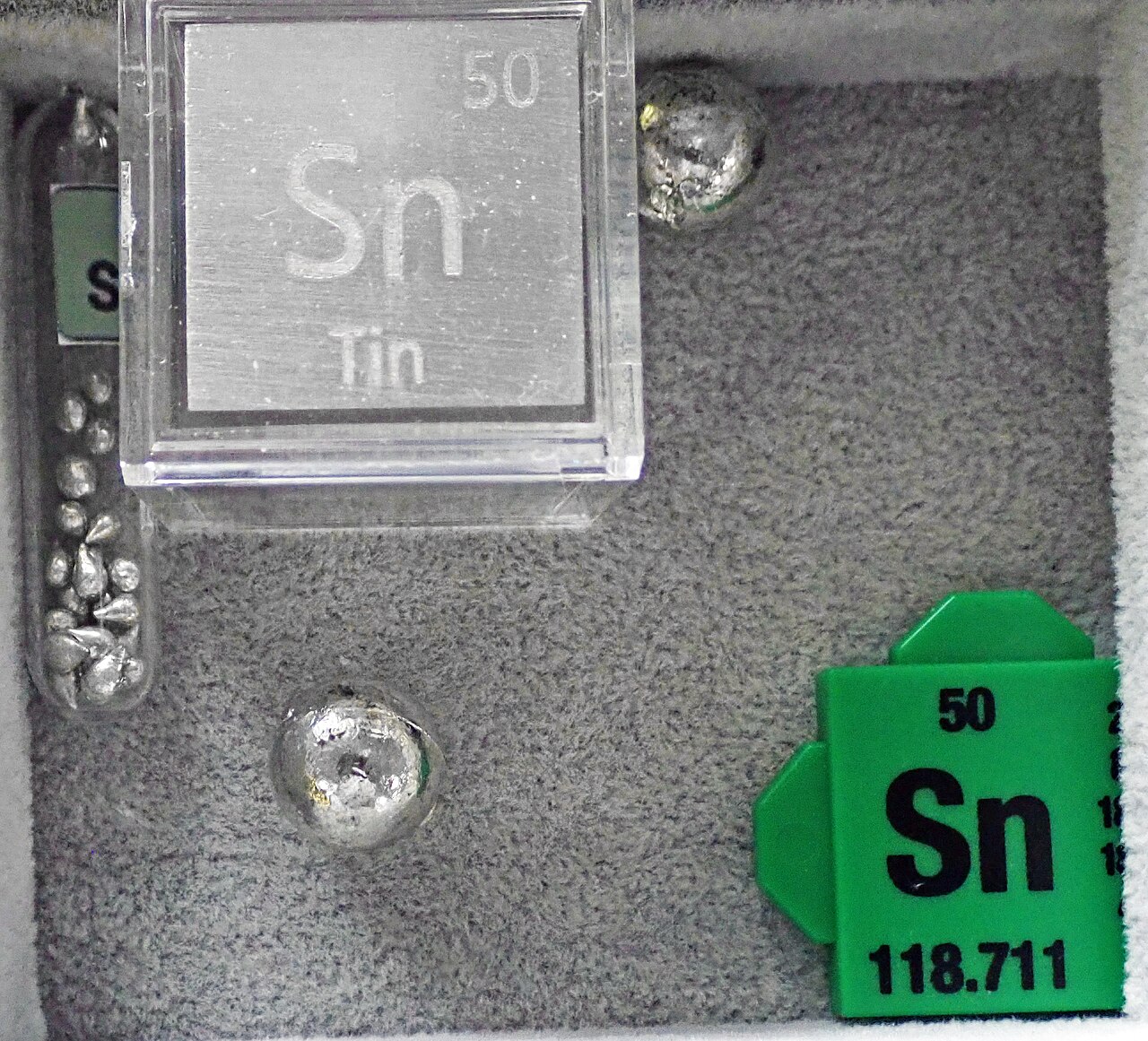
Tin is the chemical element with atomic number 50 and the symbol Sn, a metal in group 14 of the periodic table that has been known since prehistoric times and is used in solder, bronze and the coating of steel cans.[1][3]
This entry is about the element. Its relative atomic mass is 118.710, it is in group 14 of the periodic table, and it is a solid at room temperature.[1] For its place in the table and its basic facts, see the [periodic table page for Tin](/element/Q1096/tin).
Properties
The Royal Society of Chemistry lists tin's melting point as 231.928 °C (505.078 K), its boiling point as 2586 °C (2859 K), and its density as 7.287 g/cm³.[1] Its standard atomic weight is 118.710(7), unchanged since 1983 according to the atomic weights commission of the International Union of Pure and Applied Chemistry; NIST gives the same value.[3][2]
Isotopes
Tin has ten stable isotopes, the largest number of any element, according to the atomic weights commission. The Royal Society of Chemistry gives their proportions as 0.97 percent for tin-112, 0.66 percent for tin-114, 0.34 percent for tin-115, 14.54 percent for tin-116, 7.68 percent for tin-117, 24.22 percent for tin-118, 8.59 percent for tin-119, 32.58 percent for tin-120, 4.63 percent for tin-122 and 5.79 percent for tin-124, and NIST gives the same figures as fractions.[3][1][2]
History and name
The Royal Society of Chemistry dates tin's discovery to about 2100 BC, names no discoverer, and notes that copper alloyed with about 5 percent tin makes bronze, used from about 3000 BC, and that Chinese tin mining in Yunnan dates to about 700 BC. The commission says tin was known in prehistoric times.[1][3] The name comes from the Anglo-Saxon tin, of unknown origin, and the symbol Sn from the Latin stannum.[1][3]
Where it comes from
The Royal Society of Chemistry gives tin's crustal abundance as 1.7 parts per million. It is obtained commercially by reducing the ore, cassiterite, with coal in a furnace, and China, Indonesia and Peru are listed as the top three producers, without a date.[1]
Uses
The Royal Society of Chemistry lists tin coatings on steel cans, solder, pewter, bronze and phosphor bronze, niobium-tin superconducting magnets, float glass, tin(II) chloride as a reducing agent and mordant, tin(IV) oxide in ceramics and gas sensors, and anti-fouling paints, now banned in most countries. It says tin has no known biological role in humans, and that the metal is non-toxic but organotin compounds can be poisonous.[1]