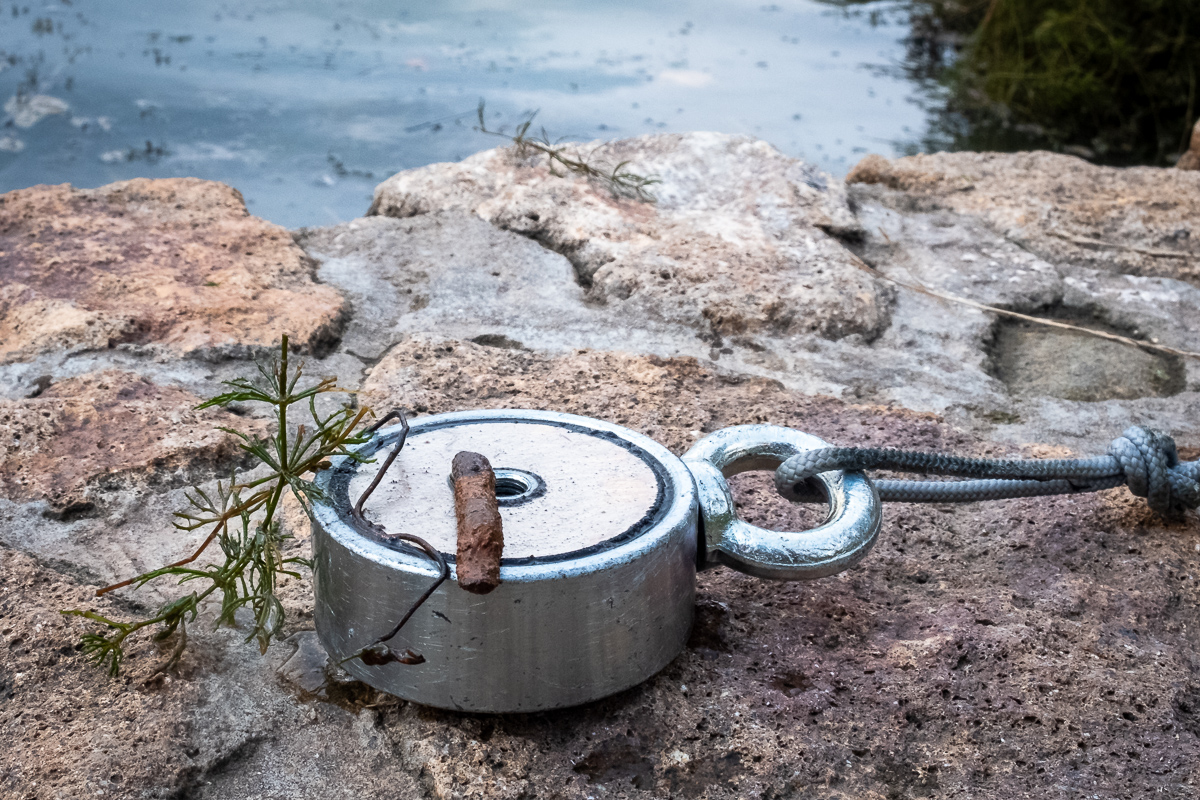
Neodymium is the chemical element with atomic number 60 and the symbol Nd, a metal in the lanthanide series that is used in neodymium-iron-boron permanent magnets.[1]
This entry is about the element. Its relative atomic mass is 144.242, it is one of the lanthanides in the periodic table, and it is a solid at room temperature.[1] For its place in the table and its basic facts, see the [periodic table page for Neodymium](/element/Q1388/neodymium).
Properties
The Royal Society of Chemistry lists neodymium's melting point as 1016 °C (1289 K), its boiling point as 3074 °C (3347 K), and its density as 7.01 g/cm³.[1] Its standard atomic weight is 144.242(3), unchanged since 2005 according to the atomic weights commission of the International Union of Pure and Applied Chemistry; NIST gives the same value.[3][2]
Isotopes
Neodymium has seven naturally occurring isotopes. The Royal Society of Chemistry gives their proportions as 27.2 percent for neodymium-142, 12.2 percent for neodymium-143, 23.8 percent for neodymium-144, 8.3 percent for neodymium-145, 17.2 percent for neodymium-146, 5.8 percent for neodymium-148 and 5.6 percent for neodymium-150, and NIST gives the same figures to more places. Neodymium-144 and neodymium-150 are radioactive with half-lives of about 2 quadrillion and 130 quintillion years.[1][2]
Discovery and name
The Swedish surgeon and chemist Carl Gustav Mosander discovered a substance called didymium in 1841, according to the atomic weights commission; the Royal Society of Chemistry dates his extraction of it to 1839. In 1885 the Austrian chemist Carl Auer, Baron von Welsbach, separated didymium into two elements, one of which he called neodymium, and the Royal Society of Chemistry credits Auer with the discovery. A pure sample of the metal was first produced in 1925.[1][3] The name comes from the Greek neos, "new," and didymos, "twin."[1][3]
Where it comes from
The Royal Society of Chemistry says neodymium is extracted from monazite and bastnaesite by ion exchange and solvent extraction, and the metal is obtained by reducing the anhydrous chloride or fluoride with calcium.[1]
Uses
The Royal Society of Chemistry lists neodymium-iron-boron permanent magnets for mobile phones, loudspeakers and wind turbines, didymium glass for welding and glassblowing goggles, glass for tanning booths, neodymium glass lasers and catalysts for polymerisation. It says neodymium has no known biological role and is moderately toxic and irritating to the eyes.[1]