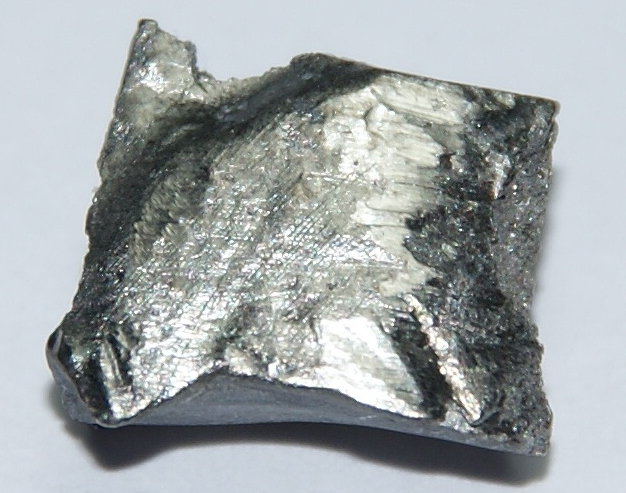
Terbium is the chemical element with atomic number 65 and the symbol Tb, a metal in the lanthanide series that is named after the Swedish village of Ytterby.[1][3]
A sample of terbium metal.
Via Wikimedia Commons: Terbium-2 by Unknown author Unknown author, CC BY 3.0.
This entry is about the element. Its relative atomic mass is 158.925, it is one of the lanthanides in the periodic table, and it is a solid at room temperature.[1] For its place in the table and its basic facts, see the [periodic table page for Terbium](/element/Q1838/terbium).
Properties
The Royal Society of Chemistry lists terbium's melting point as 1359 °C (1632 K), its boiling point as 3230 °C (3503 K), and its density as 8.23 g/cm³.[1] It has a single stable isotope, terbium-159, so its atomic weight is a single value, 158.925354(7) since 2021 according to the atomic weights commission of the International Union of Pure and Applied Chemistry; NIST gives 158.92535(2).[3][2]
Discovery and name
The Swedish surgeon and chemist Carl Gustav Mosander discovered terbium in 1843, in an yttrium salt, according to the atomic weights commission. The Royal Society of Chemistry says he separated a yellow terbium oxide and a rose-pink erbium oxide from yttrium oxide; the commission says the original names given to the terbium and erbium samples were later switched.[1][3] The name comes from Ytterby, the Swedish village where the mineral ytterbite was first found.[1][3]
Where it comes from
The Royal Society of Chemistry gives terbium's crustal abundance as 0.3 parts per million. It is recovered from monazite and bastnaesite and from the mineral euxenite, and the metal is usually produced by reducing the anhydrous fluoride or chloride with calcium under vacuum; China, Russia and Malaysia are listed as the top three producers, without a date.[1]
Uses
The Royal Society of Chemistry lists the doping of calcium fluoride, calcium tungstate and strontium molybdate for solid-state devices, low-energy and mercury lamps, improving the image quality of medical X-rays, laser devices, and Terfenol-D, an alloy of terbium, dysprosium and iron used in speakers. It says terbium has no known biological role and low toxicity.[1]