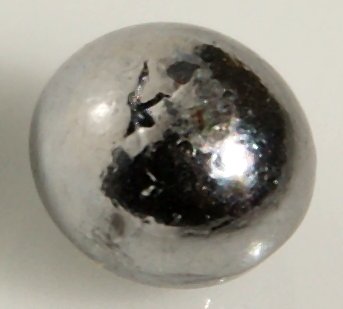
Rhenium is the chemical element with atomic number 75 and the symbol Re, a metal in group 7 of the periodic table that melts at 3185 °C and is used in alloys for turbine blades.[1]
This entry is about the element. Its relative atomic mass is 186.207, it is in group 7 of the periodic table, and it is a solid at room temperature.[1] For its place in the table and its basic facts, see the [periodic table page for Rhenium](/element/Q737/rhenium).
Properties
The Royal Society of Chemistry lists rhenium's melting point as 3185 °C, its boiling point as 5590 °C, and its density as 20.8 g/cm³.[1] Its standard atomic weight is 186.207(1), unchanged since 1973 according to the atomic weights commission of the International Union of Pure and Applied Chemistry, which says no isotopic variation has been found in natural rhenium; NIST gives the same value.[3][2]
Isotopes
Rhenium has two naturally occurring isotopes. The Royal Society of Chemistry gives their proportions as 37.4 percent for rhenium-185, which is stable, and 62.6 percent for rhenium-187, which is radioactive, and NIST gives 0.3740(2) and 0.6260(2). The Royal Society of Chemistry gives the half-life of rhenium-187 as 41.6 billion years and the commission as 42.3 billion.[1][2][3]
Discovery and name
The German chemists Walter Noddack, Ida Tacke and Otto Berg discovered rhenium by X-ray spectroscopy in 1925, according to the atomic weights commission, and the Royal Society of Chemistry says they isolated it from the mineral gadolinite in Berlin. Masataka Ogawa had reported finding it in thorianite in 1905 but was discounted.[1][3] The name comes from the Latin Rhenus, the Rhine.[1][3]
Where it comes from
The Royal Society of Chemistry says rhenium makes up about 0.001 parts per million of Earth's crust and is produced commercially from molybdenum smelter flue dusts. It lists Chile, the United States and Poland as the top three producers, without a date.[1]
Uses
The Royal Society of Chemistry lists additives to tungsten and molybdenum alloys for oven filaments and X-ray machines, electrical contact material, hydrogenation catalysts and nickel alloys for single-crystal turbine blades. It says rhenium has no known biological role.[1]