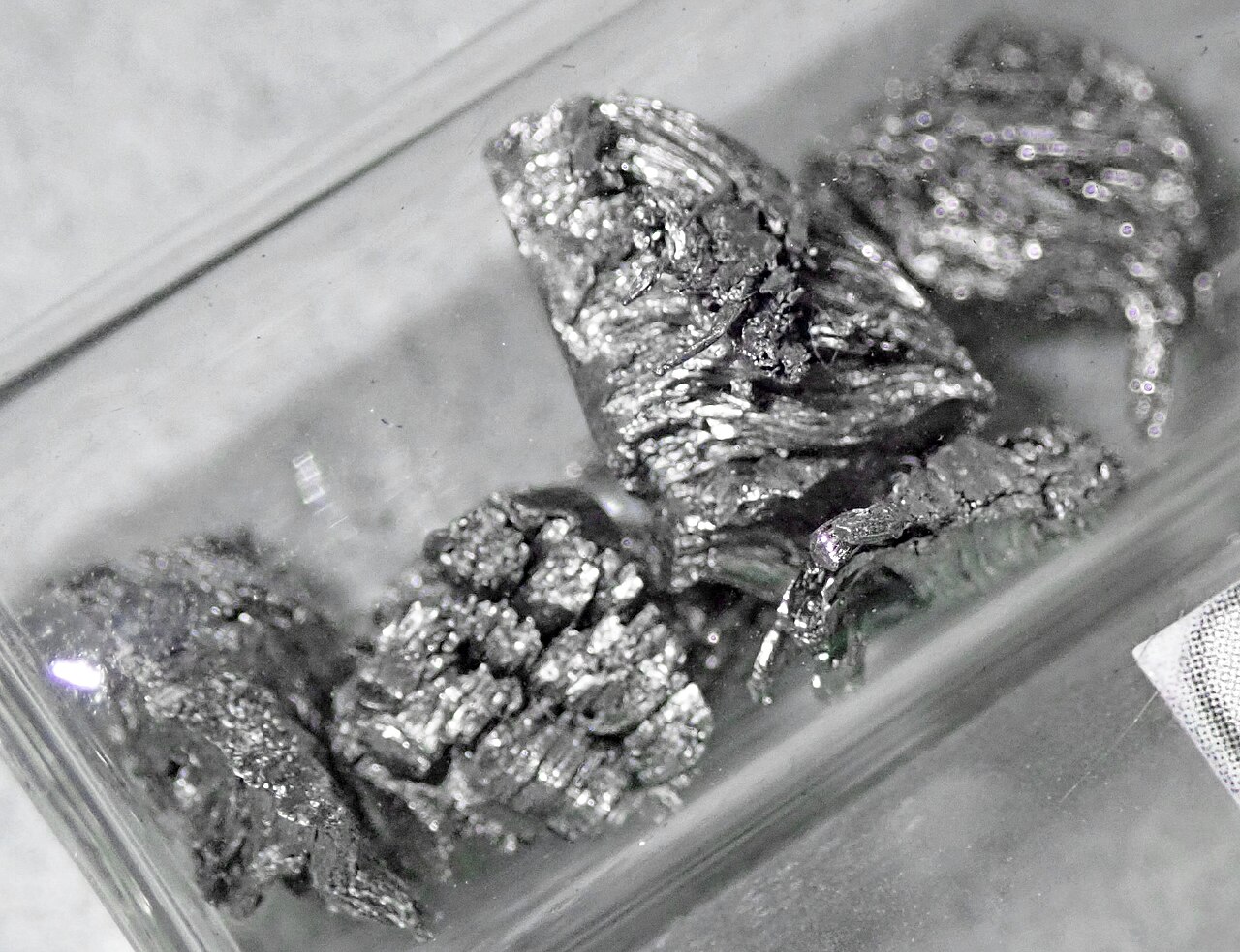
Thulium is the chemical element with atomic number 69 and the symbol Tm, a metal in the lanthanide series that is named after Thule, the ancient name for the northernmost part of the known world.[1][3]
This entry is about the element. Its relative atomic mass is 168.934, it is one of the lanthanides in the periodic table, and it is a solid at room temperature.[1] For its place in the table and its basic facts, see the [periodic table page for Thulium](/element/Q1853/thulium).
Properties
The Royal Society of Chemistry lists thulium's melting point as 1545 °C, its boiling point as 1950 °C, and its density as 9.32 g/cm³.[1] It has a single stable isotope, thulium-169, so its atomic weight is a single value, 168.934219(5) since 2021 according to the atomic weights commission of the International Union of Pure and Applied Chemistry; NIST gives 168.93422(2).[3][2]
Discovery and name
The Swedish chemist Per Theodor Cleve discovered thulium in 1879, at the University of Uppsala.[1][3] The atomic weights commission says the American chemist Charles James first isolated it in 1911; the Royal Society of Chemistry notes that in the same year the American chemist Theodore William Richards carried out 15,000 recrystallisations of thulium bromate to fix its atomic weight.[1][3] The name comes from Thule.[1][3]
Where it comes from
The Royal Society of Chemistry says thulium occurs principally in monazite, at about 20 parts per million, and is extracted by ion exchange and solvent extraction. The metal is made by reducing the anhydrous fluoride with calcium or the oxide with lanthanum.[1]
Uses
The Royal Society of Chemistry says an irradiated isotope of thulium emits X-rays and is used in a portable medical X-ray device, and that thulium is used in surgical lasers. It says thulium has no known biological role and is non-toxic.[1]