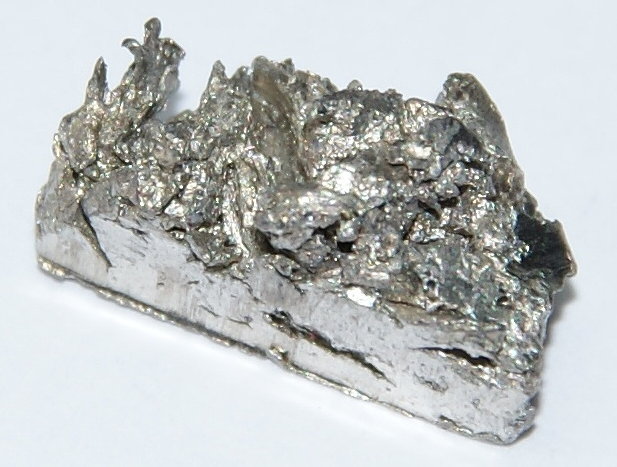
Ytterbium is the chemical element with atomic number 70 and the symbol Yb, a metal in the lanthanide series that is named after the Swedish village of Ytterby.[1][3]
This entry is about the element. Its relative atomic mass is 173.045, it is one of the lanthanides in the periodic table, and it is a solid at room temperature.[1] For its place in the table and its basic facts, see the [periodic table page for Ytterbium](/element/Q1855/ytterbium).
Properties
The Royal Society of Chemistry lists ytterbium's melting point as 824 °C, its boiling point as 1196 °C, and its density as 6.90 g/cm³.[1] The atomic weights commission of the International Union of Pure and Applied Chemistry revised its recommended atomic weight in 2015 to 173.045(10), which matches the Royal Society of Chemistry's figure; NIST's page still lists 173.054(5), the commission's earlier 2007 value.[3][1][2]
Isotopes
Ytterbium has seven naturally occurring isotopes, and the proportions published for several of them differ slightly between the Royal Society of Chemistry, NIST and the commission. The Royal Society of Chemistry gives 0.12 percent for ytterbium-168, 2.98 percent for ytterbium-170, 14.09 percent for ytterbium-171, 21.68 percent for ytterbium-172, 16.10 percent for ytterbium-173, 32.03 percent for ytterbium-174 and 13.00 percent for ytterbium-176.[1][2][3]
Discovery and name
The Swiss chemist Jean-Charles Galissard de Marignac discovered ytterbium in 1878, according to the atomic weights commission. The Royal Society of Chemistry says he heated erbium nitrate, extracted the residue and obtained a white oxide he named ytterbia, which was later shown to contain lutetium in 1907; an impure metal was made in 1937 and a pure sample in 1953.[1][3] The name comes from Ytterby.[1][3]
Where it comes from
The Royal Society of Chemistry says ytterbium occurs principally in the mineral monazite and is extracted by ion exchange and solvent extraction.[1]
Uses
The Royal Society of Chemistry lists memory devices, tuneable lasers and an industrial catalyst that is increasingly replacing more toxic ones. It says ytterbium has no known biological role and low toxicity.[1]