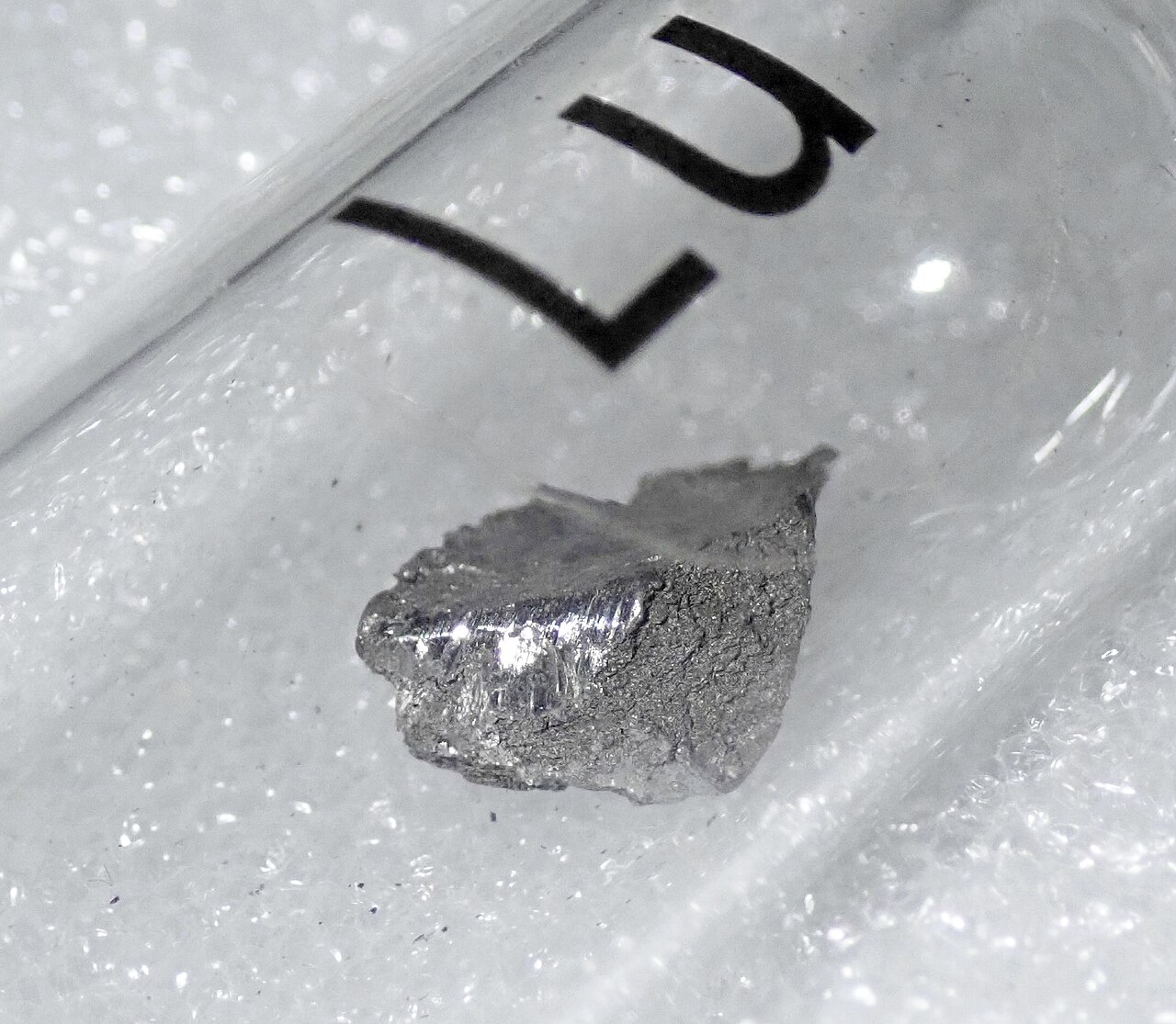
Lutetium is the chemical element with atomic number 71 and the symbol Lu, a metal that closes the lanthanide series and is named after Lutetia, the Latin name for Paris.[1][3]
This entry is about the element. Its relative atomic mass is 174.967, it is one of the lanthanides in the periodic table, and it is a solid at room temperature.[1] For its place in the table and its basic facts, see the [periodic table page for Lutetium](/element/Q1857/lutetium).
Properties
The Royal Society of Chemistry lists lutetium's melting point as 1663 °C, its boiling point as 3402 °C, and its density as 9.84 g/cm³.[1] The atomic weights commission of the International Union of Pure and Applied Chemistry recommended an atomic weight of 174.96669 ± 0.00005 in 2024, which rounds to the Royal Society of Chemistry's 174.967; NIST lists 174.9668(1).[3][1][2]
Isotopes
Lutetium has two naturally occurring isotopes. The Royal Society of Chemistry gives their proportions as 97.40 percent for lutetium-175, which is stable, and 2.60 percent for lutetium-176, which is radioactive; the commission gives 97.414 and 2.586 percent. The commission puts the half-life of lutetium-176 at 35.7 billion years, and the Royal Society of Chemistry at 37.3 billion.[1][2][3]
Discovery and name
The French chemist Georges Urbain discovered lutetium in 1907, according to the atomic weights commission, which says the Austrian chemist Carl Auer, Baron von Welsbach, had separated it earlier and independently and called it cassiopeium, a name that was not adopted. The Royal Society of Chemistry credits Urbain in Paris and, independently, Charles James in New Hampshire, who had extracted much of the metal but delayed publishing, and says the pure metal was not made until 1953.[1][3] The name comes from Lutetia, the Latin name for Paris.[1][3]
Where it comes from
The Royal Society of Chemistry says lutetium occurs principally in the mineral monazite and that the metal is made by reducing the anhydrous fluoride with calcium.[1]
Uses
The Royal Society of Chemistry says lutetium is little used outside research, and that its oxide is used as a catalyst for cracking hydrocarbons in oil refineries. It says lutetium has no known biological role and low toxicity.[1]