George Washington (1732–1799) commanded the Continental Army in the American Revolutionary War, presided over the 1787 Constitutional Convention, and served as the first president of the United States from 1789 to 1797.[1][4][5]
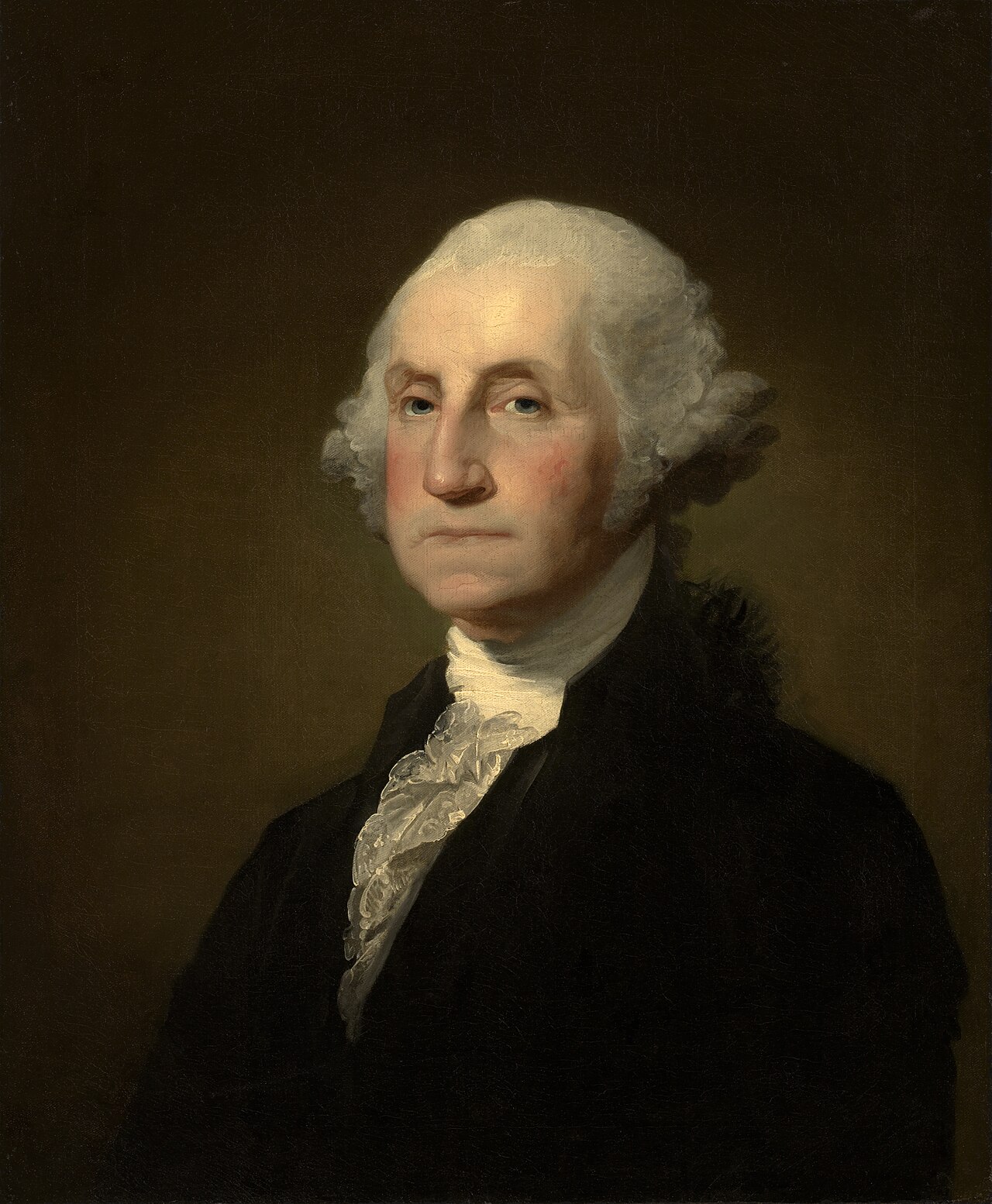
A portrait painting of George Washington by Gilbert Stuart.
Washington was born on February 22, 1732, at his family's plantation on Popes Creek in Westmoreland County, Virginia, the son of Augustine and Mary Ball Washington.[1] The date is the one reckoned under the modern calendar. The British Empire changed its official calendar by 11 days in 1752 to match the rest of Europe, and before the change his birthday had fallen on February 11, 1731.[2] His father died suddenly when George was 11, and his older half-brother Lawrence became a major influence on him.[2] He became a land surveyor to earn money, and in 1749 he was appointed official surveyor of Culpeper County.[2]
In 1753, Lieutenant Governor Robert Dinwiddie of Virginia sent the 21-year-old Washington on a mission into the Ohio Country to confront the French; his account of the journey made him a celebrity on both sides of the Atlantic.[3] In 1754 his surprise attack on a small French force at Jumonville Glen, followed by his surrender to French forces at Fort Necessity, helped to start the French and Indian War.[3] The National Park Service calls Fort Necessity the first major event of his military career and says it was the only time he ever surrendered to an enemy.[12] In 1755 he accompanied Major General Edward Braddock on the march on Fort Duquesne, serving as an aide-de-camp when Braddock's forces were defeated at the Battle of the Monongahela.[3] Mount Vernon's account says he learned military lessons in this war that he later used in the Revolution.[3]
The Revolutionary War
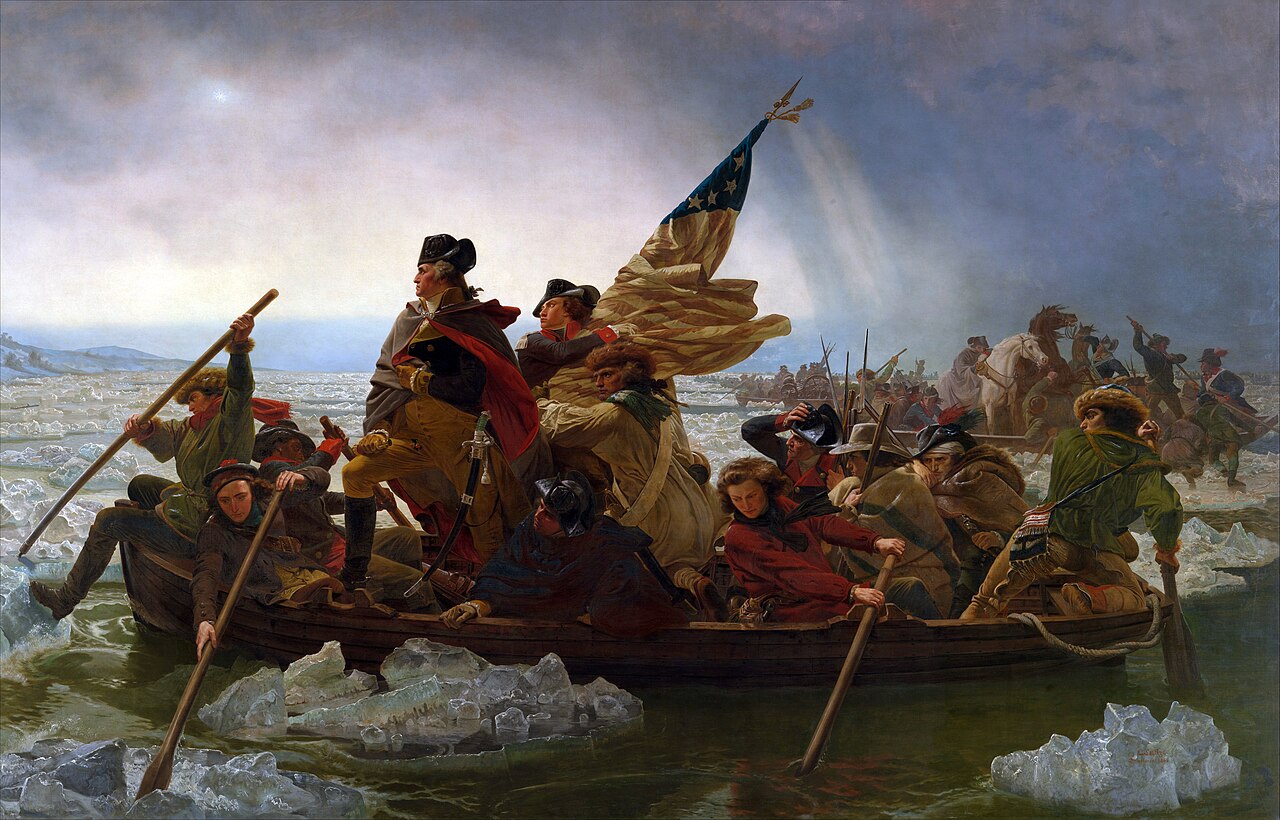
In June 1775 Congress commissioned Washington to take command of the Continental Army, which was then besieging the British in Boston.[1][14] The command kept him away from Mount Vernon for more than eight years.[1] The British left Boston in March 1776, but a larger British army under Sir William Howe arrived that June to take New York City.[1] Washington's army lost on Long Island in August and at Kip's Bay a few weeks later, and the defense of the city ended on November 16, 1776, with the surrender of Fort Washington and about 2,800 men.[1] His remaining forces crossed the Delaware River into Pennsylvania on December 7.[1] On Christmas night his troops crossed the river again and forced the garrison at Trenton to surrender, and a few days later he outmaneuvered the force sent against him and struck the British at Princeton.[1]
The army's winter encampment at Valley Forge, Pennsylvania, began on December 19, 1777, and the troops marched out on June 19, 1778.[11] The National Park Service notes that no battle was fought there, and that disease killed nearly 2,000 people during the encampment.[11]
An alliance with France brought a French army under the Comte de Rochambeau in July 1780.[1] Together the allied commanders decided that an attack on New York could not succeed and turned instead on the British army under Lord Cornwallis at Yorktown, Virginia.[1] Supported by the French army and navy, Washington's forces defeated Cornwallis, and on October 19, 1781, Washington accepted the surrender of his army.[1][10] Mount Vernon says the victory led directly to the peace negotiations that ended the war in 1783.[10] On December 23, 1783, Washington appeared before Congress in Annapolis, Maryland, and resigned his commission, then went home to Mount Vernon.[1]
A large painting of Washington standing in a boat crossing the icy Delaware River with his troops.
By 1787 the union among the states was unraveling, and delegates from 12 states met in Philadelphia, with Washington presiding, to create a new form of government.[4] The convention ran from May 14 to September 17, 1787; 55 delegates attended and 39 signed the Constitution.[4]
In 1789 Washington was elected the first president, and Mount Vernon and the White House Historical Association both record that the vote was unanimous.[5][14] The National Archives says he took the oath of office at Federal Hall in New York.[13] His first term (1789–1793) was occupied mainly with organizing the executive branch; he appointed Alexander Hamilton as Secretary of the Treasury, Thomas Jefferson as Secretary of State and Henry Knox as Secretary of War.[1] His cabinet had four original members: Jefferson, Hamilton, Knox and Randolph.[5] During that term the government adopted a series of measures proposed by Hamilton to resolve the debt crisis and designated a site on the Potomac River for the permanent capital.[1] Leaders of the emerging Republican party, including Jefferson and James Madison, opposed Hamilton's financial program, and Washington was concerned about the growing partisanship in his own government.[1] His second term (1793–1797) was dominated by foreign affairs and marked by deepening partisanship.[1]
The Farewell Address
In 1796 Washington decided to retire from public life; Mount Vernon says he was influenced by attacks from an increasingly hostile press.[6] He turned to Hamilton to put his ideas into words. Four years earlier he had asked Madison to draft a farewell address, and Hamilton wrote a new one, borrowing only a few paragraphs from Madison's draft; Washington sent his reactions and edits by personal courier because he suspected the mail was being monitored.[6] On September 16, 1796, his secretary Tobias Lear brought the Philadelphia newspaper publisher David Claypoole to Washington, who told him he wanted the address printed in Claypoole's American Daily Advertiser in three days' time.[6] It appeared under the heading "To the PEOPLE of the UNITED STATES."[6] The address urged Americans to forswear party spirit and sectional differences.[13][15] The U.S. Senate reads it aloud each year on Washington's birthday, a practice Mount Vernon traces to February 22, 1862.[6][15] Washington did not seek a third term, although many people encouraged him to.[13][14]
Slavery
Mount Vernon's account says that George and Martha Washington's lives depended on the labor of the estate's enslaved community.[7] In 1799 there were 317 enslaved men, women and children on Mount Vernon's five farms, which covered 8,000 acres; they made up more than 90 percent of the estate's population.[7] The White House Historical Association says Washington was a slave owner for 56 years and that at least ten enslaved people worked at his houses in New York City and Philadelphia during his presidency.[14]
Mount Vernon says that as a young planter Washington accepted slavery without apparent concern, began questioning it during the Revolutionary War, and afterward felt burdened by his entanglement in it and uneasy about its effect on the nation.[7] According to the same account, he repeatedly voiced opposition to slavery in private letters and privately noted support for a gradual end to it by law, but as a public figure he did not make abolition a cause.[7]
His will, dated July 9, 1799, directed that "all the Slaves which I hold in my own right" be freed after his wife's death.[8] It also freed his former valet William Lee immediately and gave him a $30 annual pension.[8] It ordered his executors to set up a permanent fund to clothe and feed freed people too old or sick to support themselves, directed that young children without parents be taught to read and write and apprenticed to a "useful occupation," and forbade the sale or removal from the state of any enslaved person before the freedoms took effect.[8]
The provision covered only some of the people at Mount Vernon. It applied to 123 of the 317, because the others belonged to the Custis estate, from Martha Washington's first marriage, and passed to her grandchildren; Mount Vernon says neither George nor Martha Washington had the legal authority to free them.[8] Many enslaved people had married and formed families across the two groups, and Mount Vernon says that separation from loved ones tainted the celebration of freedom for them.[8] Mount Vernon states that Washington was the only founding father to enact a large-scale manumission in his will.[8] Short summaries, such as the National Archives', say simply that he emancipated his slaves in his will.[13] Richard Allen, the formerly enslaved founder of the African Methodist Episcopal Church, praised the provision in a eulogy delivered on December 29, 1799.[8]
Death
Washington died on the evening of December 14, 1799, at Mount Vernon, of a throat infection.[9][14] Mount Vernon gives the time as 10 to 11 p.m., his age as 67, and the cause as acute bacterial epiglottitis, and records that he was buried four days later in the family vault at Mount Vernon.[9]
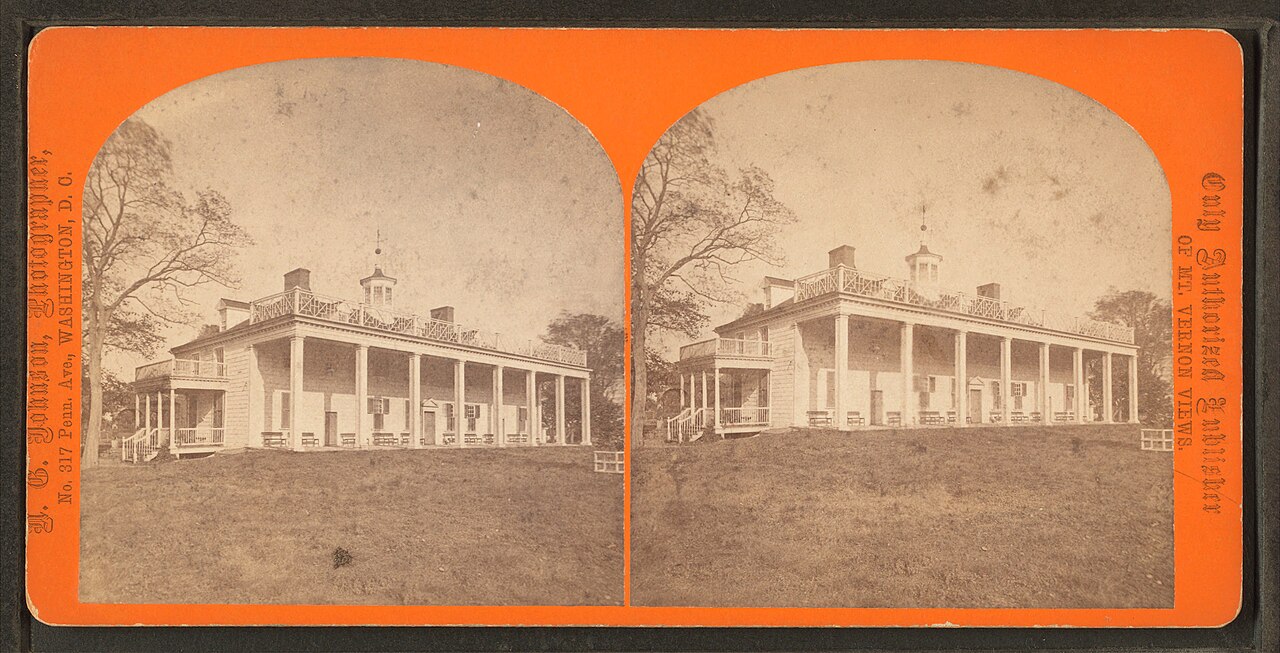
The mansion at Mount Vernon, Washington's home in Virginia.