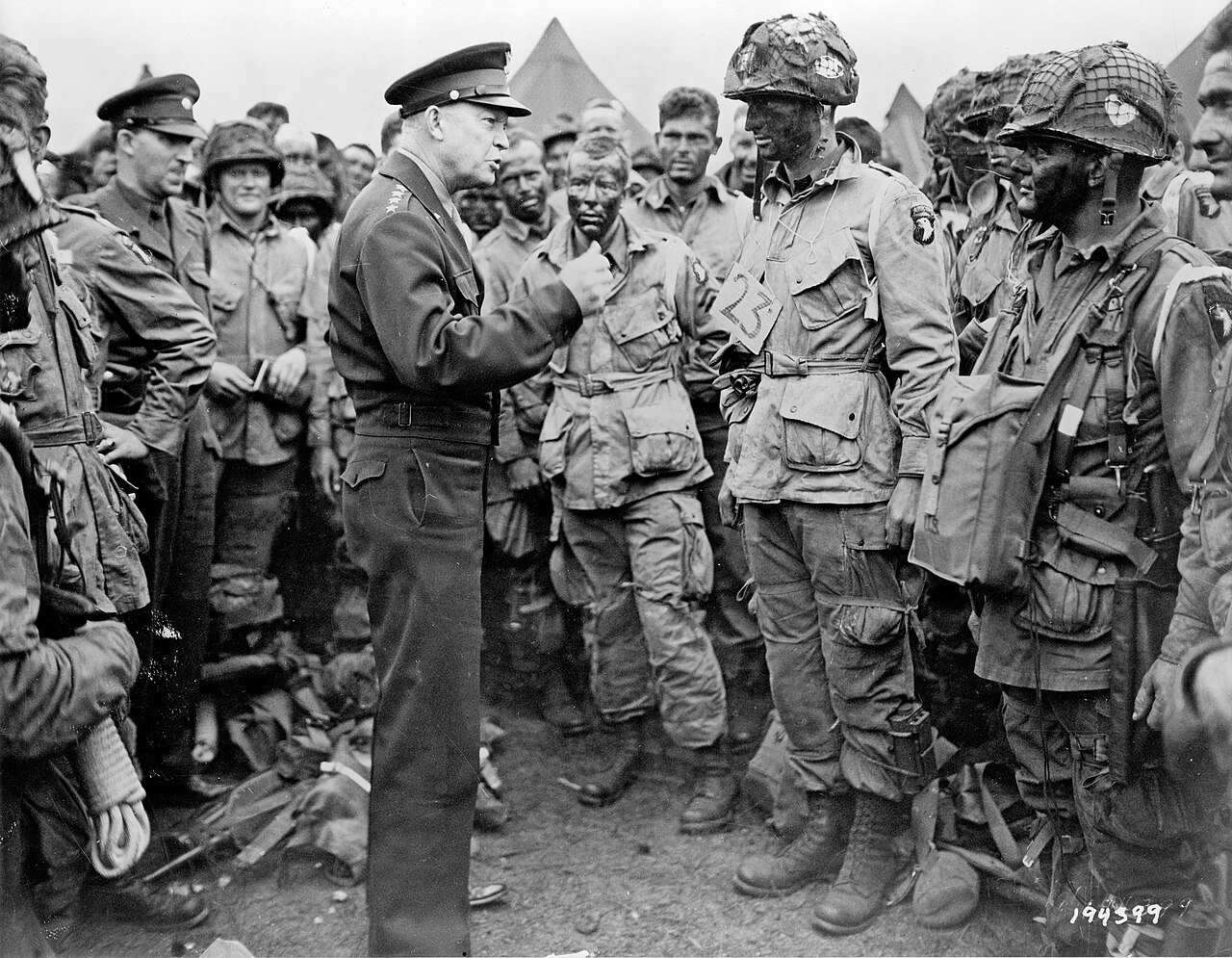
D-Day was June 6, 1944, the day Allied forces landed on the beaches of Normandy, France, as the first stage of Operation Overlord, the Allied invasion of German-occupied Western Europe during World War II.[7]
General Eisenhower speaking with paratroopers of the 101st Airborne Division on June 5, 1944.
Via Wikimedia Commons: Eisenhower d-day by Unknown U.S. Army photographer, public domain.
The National WWII Museum says Overlord required two years of planning, and that the landings were made by American, British and Canadian forces on five beaches code-named Utah, Omaha, Gold, Juno and Sword.[1][4][9]
The plan and the weather delay
The invasion was initially set for June 5, 1944 and was postponed because of poor weather.[2] The Museum says that on the morning of June 4 meteorologists predicted foul weather, which led General Dwight D. Eisenhower to postpone the attack for 24 hours, and it quotes his decision on the morning of June 5 as "O.K. We'll go."[4][1] The National Archives says he decided before dawn on June 5 to proceed.[8] The Archives also holds a note Eisenhower drafted in case the invasion failed; the Eisenhower Library says it is mistakenly dated "July" 5 instead of "June" 5.[7][9]
The forces
The numbers differ by source, and the National WWII Museum quotes the historian Stephen Ambrose's caution that no exact figures are possible.[1] The Museum says about 160,000 Allied troops were ashore by nightfall, counting those who parachuted or glided in as well as those who came by sea; the National Archives gives 155,000 Allied troops ashore, in control of 80 square miles; and the National D-Day Memorial says more than 150,000 American, British, Canadian and French ground troops took part, with forces from twelve Allied nations in all.[4][8][12] The Museum says the invasion fleet included over 7,000 naval vessels, among them 4,000 landing craft and 1,200 warships, and the Eisenhower Library says 7,000 ships and landing craft were manned by more than 195,000 naval personnel from eight Allied countries.[1][9] The Museum adds that the German defensive wall along the coast included about 6.5 million mines.[4]
The night before: airborne landings
The first troops to land were paratroopers. The Museum's timeline says that minutes after midnight the American 101st Airborne Pathfinders jumped into Normandy, and that the British 6th Airborne Division's Operation Tonga began with glider landings at 12:16 a.m.[3] The Museum says 13,400 American paratroopers boarded C-47 transport aircraft on June 5, that there were four glider assaults on D-Day, and that 2,499 American paratroopers became casualties on D-Day.[5] It puts the airborne force at 23,400 troops.[1]
The five beaches
The Eisenhower Library says the five naval assault divisions delivered the troops to the beaches Utah, Omaha, Gold, Juno and Sword. The Museum says the Americans landed at Utah and Omaha, and the British and Canadians at Gold, Juno and Sword.[9][4] At H-hour, 6:30 in the morning, the American 1st and 29th Infantry Divisions landed at Omaha; the Museum says that about 34,000 Americans came ashore there that day and that over 2,400 of them were killed, wounded or missing.[3][4] The 3rd Canadian Infantry Division landed on Juno Beach at 7:45 a.m.; the Museum says it lost 90 of its 306 landing craft and that 21,400 troops landed at Juno by the end of the day.[3][6] By the end of D-Day 25,000 troops had landed on Gold Beach, and at Sword the British 3rd Infantry Division came ashore, with commandos reaching the bridges over the Orne.[6]
The cost
The Museum says D-Day produced over 10,300 casualties, killed, wounded and missing; the Eisenhower Library gives 10,300 Allied casualties during the landing; and the National Archives estimates 10,000 killed, wounded or missing, over 6,000 of them American.[1][9][8] The National D-Day Memorial gives a figure for those killed, 4,436, made up of 2,519 Americans and 1,917 Allies from seven nations, while noting that precise record-keeping was not the priority in the heat of battle.[12]
The Order of the Day
Eisenhower's printed message to the Allied Expeditionary Force, dated June 6, 1944 by the National Archives, opens: "You are about to embark upon the Great Crusade, toward which we have striven these many months." It tells the troops that "your task will not be an easy one," that "this is the year 1944," and closes: "Good Luck! And let us all beseech the blessing of Almighty God upon this great and noble undertaking."[7][10]
After D-Day
By June 30 more than 850,000 men, 148,000 vehicles and 570,000 tons of supplies had landed, according to the Eisenhower Library.[9] The Museum says American forces captured Cherbourg by June 27, British and Canadian forces secured the city of Caen by July 20, and Operation Cobra, launched by American forces on July 24 and 25, marked the end of the Normandy campaign.[2] The National D-Day Memorial says Allied forces had liberated Paris by August 25, and that other Allied landings began on France's Mediterranean coast on August 15.[12]
Remembered
The American Battle Monuments Commission says the Normandy American Cemetery holds the graves of 9,389 American military dead, most of whom died in the D-Day landings and the operations that followed, and lists 1,557 more as missing in action. The U.S. First Army established its original cemetery there on June 8, 1944.[11]