"Atomic bombings of Hiroshima and Nagasaki." Micwyn Encyclopedia, 20 Nov. 2026, micwyn.com/t/2866/atomic-bombings-of-hiroshima-and-nagasaki. Accessed 20 Nov. 2026.
APA
Atomic bombings of Hiroshima and Nagasaki. (2026, November 20). In Micwyn Encyclopedia. https://micwyn.com/t/2866/atomic-bombings-of-hiroshima-and-nagasaki
Chicago
"Atomic bombings of Hiroshima and Nagasaki." Micwyn Encyclopedia. November 20, 2026. https://micwyn.com/t/2866/atomic-bombings-of-hiroshima-and-nagasaki.
BibTeX
@misc{atomic_bombings_of_hiroshima_and_nagasak_2026,
  title = {Atomic bombings of Hiroshima and Nagasaki},
  howpublished = {Micwyn Encyclopedia},
  year = {2026},
  month = nov,
  url = {https://micwyn.com/t/2866/atomic-bombings-of-hiroshima-and-nagasaki},
  urldate = {2026-11-20}
}
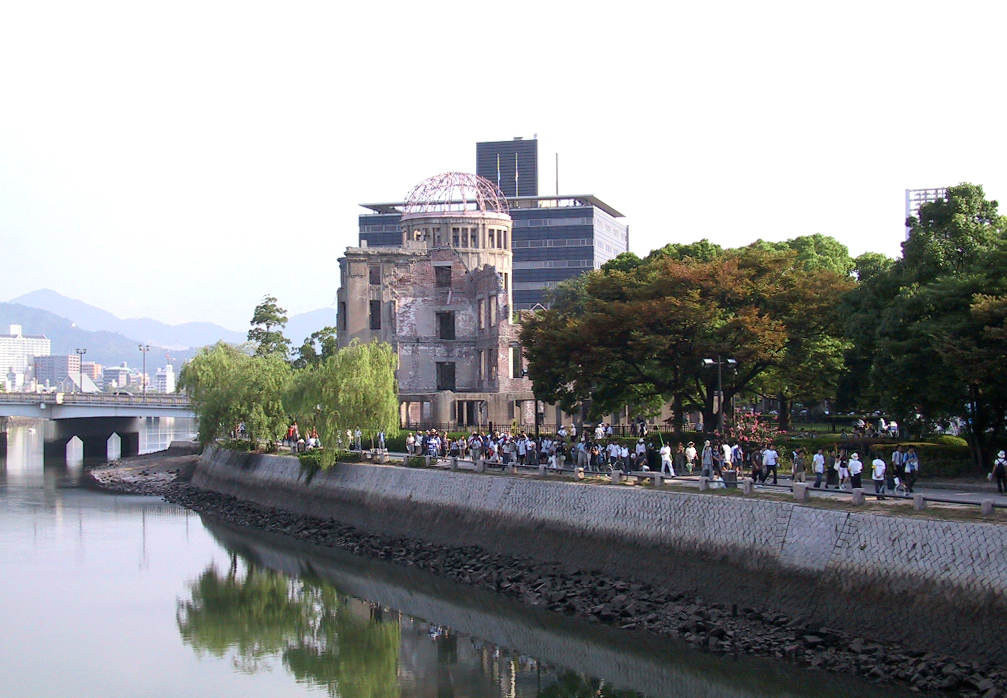
The atomic bombings of Hiroshima and Nagasaki were the first and, so far, only uses of nuclear weapons in war: the United States dropped one bomb on Hiroshima, Japan, on August 6, 1945 and a second on Nagasaki on August 9, in the closing days of World War II.[4][5]
The total number of people killed is not known precisely. The research foundation that studies the survivors says so, and gives estimates for deaths within two to four months of the bombings: 90,000 to 166,000 at Hiroshima and 60,000 to 80,000 at Nagasaki.[10] This entry reports the figures each source publishes, and the period each covers. It does not cover the debate over the decision to use the bombs.
The test and the ultimatum
The first atomic device was detonated on July 16, 1945, at the Trinity test site at 5:30 a.m.; it was a plutonium implosion device with a yield of 21 kilotons.[2] The State Department's history of the Potsdam Conference, which ran from July 17 to August 2, 1945, says the United States had successfully detonated the first atomic bomb on July 16.[7] An ultimatum to Japan was issued from Potsdam on July 26.[1][3] The State Department says it was released by the United States, Great Britain and China, and that the Soviet Union did not sign because it had not yet declared war on Japan; the Energy Department's history names Truman, Stalin and Attlee as issuing it.[7][3] The Energy Department's account says that on July 25 the 509th Composite Group was ordered to attack Hiroshima, Kokura, Niigata or Nagasaki, in that order of preference, and that Japan rejected the declaration on July 29.[3]
Hiroshima, August 6
The Energy Department says a B-29 bomber named Enola Gay took off from the island of Tinian carrying "Little Boy," a 9,700-pound uranium gun-type bomb. At approximately 8:15 a.m. Hiroshima time it released the bomb, which detonated 43 seconds later 1,900 feet above the city; the research foundation gives the altitude as 600 meters. The yield was later estimated at 15 kilotons, and radio and telegraph communications with Hiroshima ended at 8:16 a.m.[4][10]
President Truman's statement, released in Washington on August 6, began: "Sixteen hours ago an American airplane dropped one bomb on Hiroshima." It said the bomb "had more power than 20,000 tons of T.N.T." and that "it is an atomic bomb."[1] Radio stations began playing the prepared statement at 11:00 a.m. Washington time.[4]
Nagasaki, August 9
The Energy Department says a B-29 named Bock's Car, called Bockscar in the city's own account, commanded by Major Charles W. Sweeney, lifted off from Tinian at 3:47 a.m. on August 9, carrying "Fat Man," a plutonium implosion bomb. The primary target was the Kokura Arsenal, which the crew could not see; the secondary target was Nagasaki, where cloud cover meant the bomb was dropped using radar.[5][8] The bomb exploded at 11:02 a.m. at an altitude of 1,650 feet, according to the Energy Department; the research foundation gives 503 meters.[5][10] Its yield was later estimated at 21 kilotons.[5][9] The Nagasaki city website gives the weights as about 4.5 tons for the Nagasaki bomb and 4 tons for the Hiroshima bomb.[9]
How many died
The sources give different figures for different periods.
Hiroshima: the Energy Department says some 70,000 people probably died from the initial blast, heat and radiation, that the death toll was probably over 100,000 by the end of 1945, and that the five-year total may have reached or exceeded 200,000, adding that "no one will ever know for certain how many died."[4] The research foundation puts the population at 340,000 to 350,000 and the acute deaths at 90,000 to 166,000.[10]
Nagasaki: the Energy Department's best estimate is 40,000 dead initially and 60,000 injured, with deaths approaching 70,000 by January 1946 and perhaps twice that within five years.[5] The city of Nagasaki officially adopted a figure of "more than 70,000" deaths, based on a July 1950 estimate by a committee that reported 73,884 killed and 74,909 injured, and says there is still no accurate data.[8] The research foundation puts the population at 250,000 to 270,000 and the acute deaths at 60,000 to 80,000.[10]
The end of the war
The Energy Department says Japan offered to surrender on August 10, 1945, that the emperor's broadcast announcing the surrender was heard by radio across Japan on August 15, and that the formal surrender ceremony took place on the deck of the USS Missouri on September 2, 1945.[6] The emperor's broadcast referred to the enemy having begun to employ "a new and most cruel bomb."[6]
Survivors
The Radiation Effects Research Foundation, which studies the health effects of the radiation, says about 94,000 people were selected from 280,000 survivors alive at the 1950 census for its long-term study, and that as of 2018 about 23 percent of the study population was still living.[10]