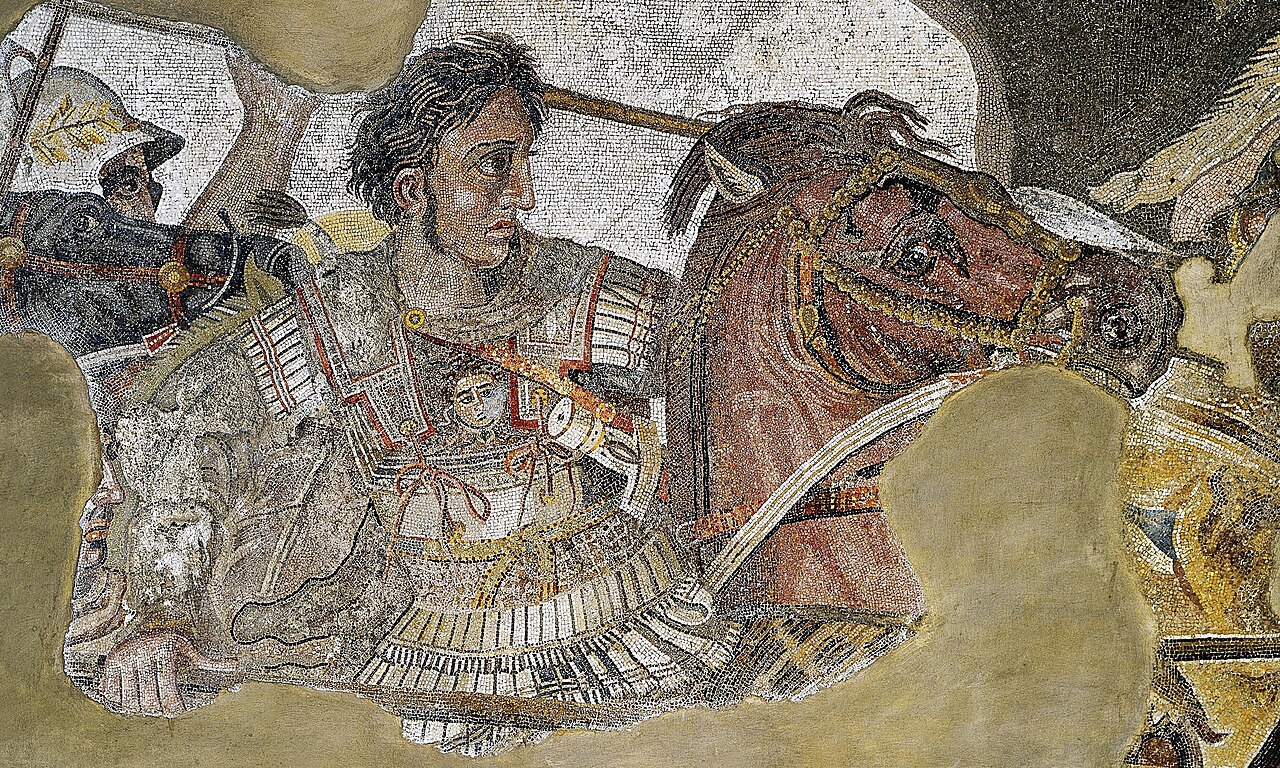
Alexander III of Macedon, called Alexander the Great, was the king who conquered the Persian Empire between 334 and 330 BC, pushed on to the Punjab, and died in Babylon in June 323 BC.[1][2]
Alexander the Great in the Alexander Mosaic from Pompeii
The dates below come mostly from Jona Lendering's Alexander series on Livius.org, which draws on the ancient accounts of Arrian, Plutarch and others. Where those accounts or the page itself leave a date uncertain, this entry says so.
Youth and accession
Alexander was born in the summer of 356 BC, probably in Pella, the son of Philip II, who ruled Macedonia from 360 to 336.[2] Philip was murdered in the theatre at Aegae in October 336 BC, and Alexander came to the throne.[2]
In the spring of 335 BC he campaigned in the Balkans. Thebes then rose against Macedonian rule and was stormed. The same page notes that the Athenian orator Demosthenes had told the Greeks that Alexander was dead.[3]
The conquest of the Persian Empire
Alexander crossed into Asia in the spring of 334 BC and fought the Persians at the river Granicus in early June of that year.[1] The page on Anatolia has the Macedonians at Gordium in April 333, where Alexander is said to have cut the Gordian knot with his sword.[4] The battle of Issus against the Persian king Darius III followed in November 333, on the 5th or 6th by Livius's reckoning.[1]
Alexander then turned south. His siege of Tyre began in January 332 BC and the city fell in July; Gaza fell in October.[5] He reached Egypt late in 332 BC. Livius places the decision to found Alexandria in January 331 and the founding on 7 April 331, though one of its overview pages gives "early 331" for the arrival in Egypt, which disagrees with its other pages.[1][6]
The decisive battle with Darius was fought at Gaugamela on 1 October 331 BC.[1] In January 330 the Macedonian army stood in Persepolis.[7] The palace there was later burnt. The ancient writers disagree about how: Arrian, drawing on Ptolemy, is sober about it, while Plutarch, Curtius and Diodorus tell a story involving the courtesan Thais, and the Livius page gives no date for the fire.[7] Darius was killed in July 330 BC, about 17 July by the page's chronology.[7]
Central Asia and India
Alexander spent the next years in Bactria and Sogdiana, founding cities such as Alexandria Eschate there in July 329.[8] He married Roxane in 327, and Livius places the introduction of the Persian custom of bowing before the king in the same summer.[8] Clitus was killed in the autumn of 328 BC.[8]
In May 326 BC he defeated the Indian king Porus at the river Hydaspes. At the end of July his army refused to go further east, at the river Hyphasis, and the advance stopped there.[9]
The last years
Back in Persia, Alexander held mass weddings at Susa in March 324 BC.[10] The army mutinied at Opis in the summer of 324; Livius's chronology puts it in August.[10] His close friend Hephaestion fell ill at Ecbatana in the autumn and died a week later.[10]
Death
In February 323 BC the army marched to Babylon.[11] Alexander fell ill in Babylon and died in the afternoon of 11 June 323 BC.[11] Livius gives no total number of days for the illness, saying only that he was ill the next morning and declined rapidly over the following days. Arrian also describes a fever.[11][12]
The cause of death is not known. Arrian reports a rumour that Alexander was poisoned, and no source read for this entry settles it.[12] This entry does not decide it.
After Alexander
The generals met the day after his death and divided the satrapies. Under the settlement preserved in Photius's excerpt of Arrian, Antipater held Europe, Craterus was protector, Perdiccas was chiliarch, Ptolemy took Egypt, Lysimachus Thrace, and Antigonus Pamphylia, Lycia and Phrygia.[13] The rival generals fell to war, and in 321 BC the rebels cemented their alliance, after Perdiccas had sent Alexander's body towards Aegae in December 322.[14] The generals who fought over the empire are called the Diadochi.[14]