New York City is the American city made up of five boroughs (Manhattan, Brooklyn, Queens, the Bronx and Staten Island) that were joined in their present form on 1 January 1898.[1]
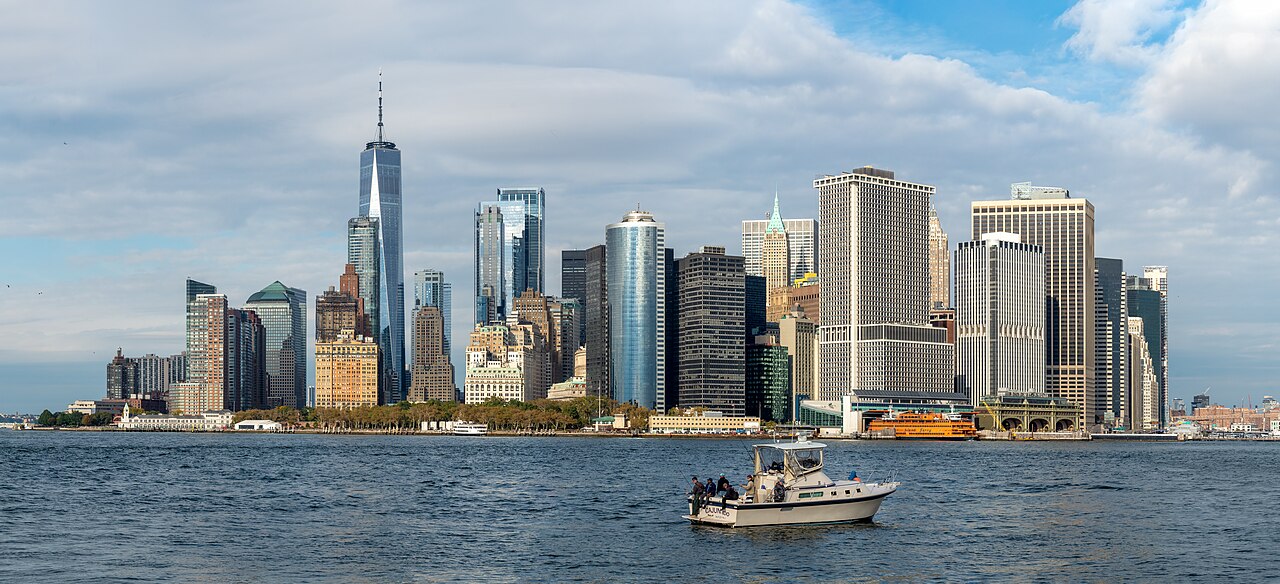
The skyline of Lower Manhattan seen from the water
History.com's 2025 update says more than 8 million people live in the five boroughs, more than one-third of them born outside the United States.[2] This entry gives no more precise count, because the census figures could not be read.
Early history
History.com says the first native New Yorkers were the Lenape, an Algonquin people who hunted, fished and farmed between the Delaware and Hudson rivers.[2] Giovanni da Verrazzano passed through the area, but, the same article says, no Europeans settled there until 1624, when the Dutch West India Company sent about 30 families to a settlement on Noten Island, today's Governors Island, that they called New Amsterdam.[2] In 1626 the settlement's governor, Peter Minuit, bought Manhattan Island from the native people for 60 guilders in trade goods.[2] amNY adds that in 1609 Robert Juet, who travelled with Henry Hudson, referred to the island as Manna-hata, and that the Dutch named the lower part of the island New Amsterdam in 1624.[3]
In 1664 the British seized New Amsterdam and renamed it New York, in honour of the Duke of York.[2][3] History.com says that in 1760 the city, with a population of 18,000, passed Boston to become the second-largest city in the American colonies, and that in 1830 its population was 202,589.[2]
The first capital
George Washington took the oath of office as the first President at Federal Hall in New York; the National Park Service says the site served as the nation's first capitol, home to the first Congress, the first Supreme Court and the earliest offices of the Executive Branch.[4] History.com says the city was the capital from 1785 to 1790; the park service page gives no years.[2][4]
Growth, canal and immigration
History.com says work began on a 363-mile canal from the Hudson River to Lake Erie, and the Erie Canal was completed in 1825.[2] It also records the Commissioners' Plan grid in 1811, the start of the Croton Aqueduct in 1837 and the creation of the New York City Police Department about eight years later.[2]
The Ellis Island immigration station formally opened in 1892, with Annie Moore of Ireland the first person processed; a fire destroyed its wooden buildings on 14 June 1897, and a new fireproof main building opened on 17 December 1900.[5] The park service says 1.2 million people were examined there in 1907, the peak year, and that more than 12 million immigrants entered the United States through Ellis Island from 1892 to 1954.[5][6] The National Origins Act of 1924 required immigrants to obtain visas at American consulates, and the last detained people were removed on 12 November 1954.[5] (One NPS page says a federal station opened in 1882; the NPS chronology and the same page's 1892 to 1954 range point to 1892, so that looks like a typo and is not used here.[5][6])
The Statue of Liberty arrived in New York on 17 June 1885 in 214 wooden cases and was dedicated on 28 October 1886.[6]
The five boroughs
The New York Genealogical and Biographical Society says the present five-borough city came into existence on 1 January 1898.[1] In 1874 New York annexed what is now the western Bronx from Westchester County and in 1895 the eastern Bronx; in an 1894 vote only 50.1 percent of Kings County voters favoured consolidation.[1] History.com says that when consolidation took effect the city had an area of 360 square miles and about 3.5 million people.[2]
amNY gives the borough names: the Bronx for the Swedish sea captain Jonas Bronck, who settled there in 1639, and the river that took his name; Brooklyn for the Dutch settlement of the 1630s, which became a city in 1834; Queens for Queen Catherine of Braganza; and Staten Island, named Staten Eylandt by Hudson in the early 1600s and renamed in 1975 from the Borough of Richmond.[1][3]
The twentieth century and after
The 1920 Wall Street bombing killed thirty people, and the stock market crash came on Black Thursday, 24 October 1929, and Black Tuesday, 28 October.[2] On 11 September 2001 New York suffered what History.com calls the deadliest terrorist attack in the history of the United States, in which nearly 3,000 people were killed.[2]
Still needs a source
These points have not been checked against a page we could read, so the entry makes no claims about them:
The 2020 census population and the city's land area.
The opening of the subway in 1904 and the size of the transit system.
The Brooklyn Bridge, the Empire State Building and the United Nations headquarters.
The Stonewall uprising of June 1969.
An independent source for the Erie Canal's completion date and for the 1789 inauguration date.