Ganymede is the largest moon in the Solar System, bigger than the planet Mercury, and the only moon known to have its own magnetic field. It orbits Jupiter and is the third of the four large Galilean moons in distance from the planet.[1][2]
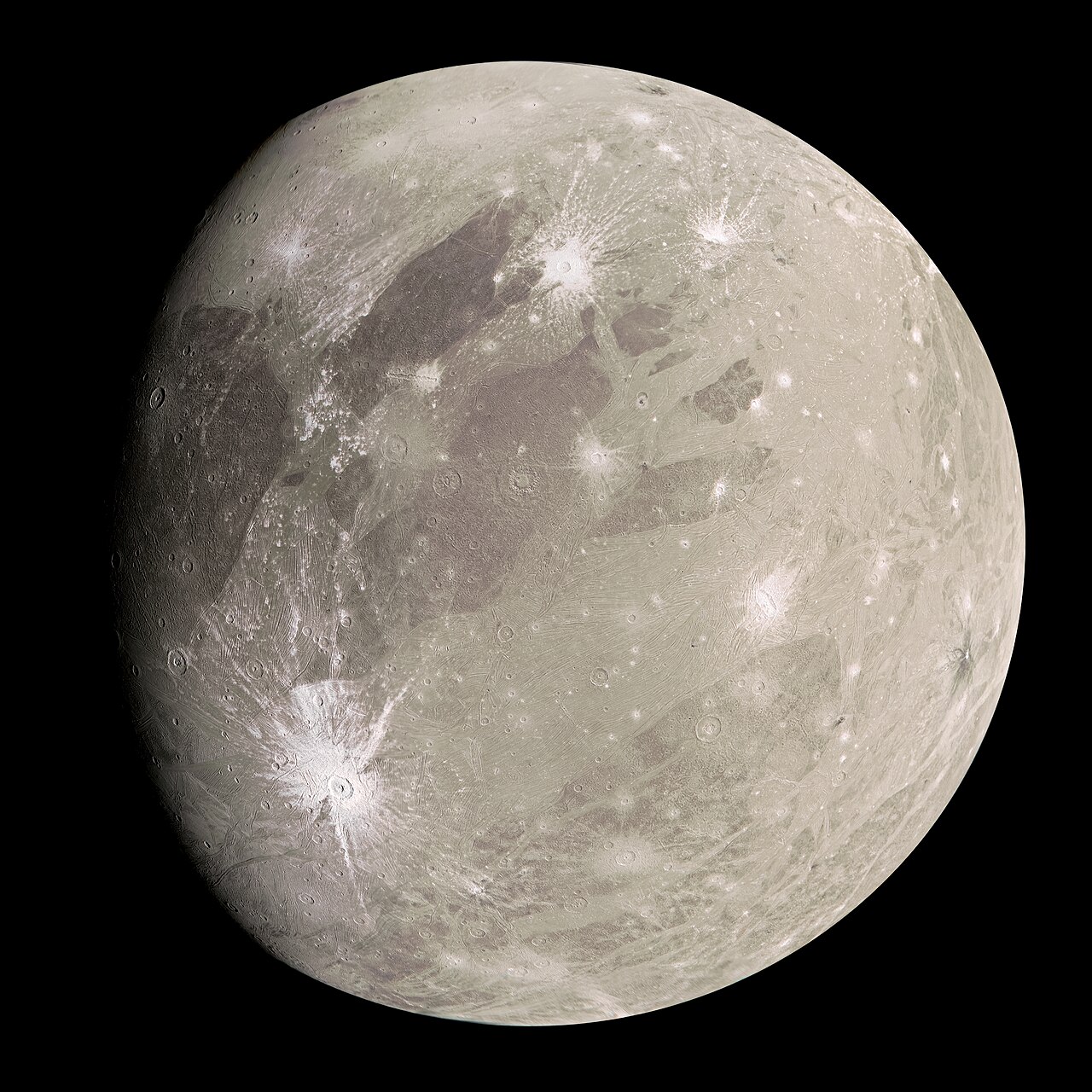
Ganymede, Jupiter's largest moon, in an image from NASA's Juno spacecraft.
Ganymede's diameter is about 5,260 kilometres, larger than Mercury and the dwarf planet Pluto.[1] NASA's Jovian satellite fact sheet lists a radius of 2,631.2 kilometres, a mean density of 1,940 kilograms per cubic metre and an orbital period of 7.155 days at a distance of about 1.07 million kilometres from Jupiter.[4] Before NASA's Voyager probes reached Jupiter in 1979, astronomers thought Saturn's moon Titan was the largest moon, and NASA says Voyager measurements showed Ganymede is bigger.[3]
Ganymede is tidally locked, always showing the same face to Jupiter.[1] Ganymede, Europa and Io are in an orbital resonance: each time Ganymede orbits Jupiter once, Europa orbits twice and Io four times. NASA says the resonance keeps their orbits slightly elliptical, and that Callisto is not part of it, seemingly because it was too far from Jupiter early in the moons' history.[1] Ganymede has no moons and no rings.[1]
Structure and the ocean
NASA says Ganymede has a metallic iron core, a rocky mantle and a thick shell of mostly ice, and that computer models suggest it might have ice and oceans stacked in several layers "like a club sandwich".[1] Scientists first suspected an underground ocean in the 1970s, and NASA says Hubble Space Telescope observations of Ganymede's auroras gave the best evidence yet. The aurorae rock back and forth as Jupiter's magnetic field changes, and the amount of rocking suggests a subsurface saltwater ocean.[1] The ocean is estimated to be about 100 kilometres thick, beneath an ice crust about 150 kilometres thick, and is thought to hold more water than all of Earth's surface water.[1]
Magnetic field
NASA's Galileo spacecraft discovered in 1996 that Ganymede has its own magnetic field and magnetosphere, a region of charged particles that had never before been found around a moon, and recorded whistling and static caused by it.[1][3] The field produces auroras in rings around the moon's poles. Because Ganymede is close to Jupiter, its field lies inside Jupiter's much larger field.[1]
Surface
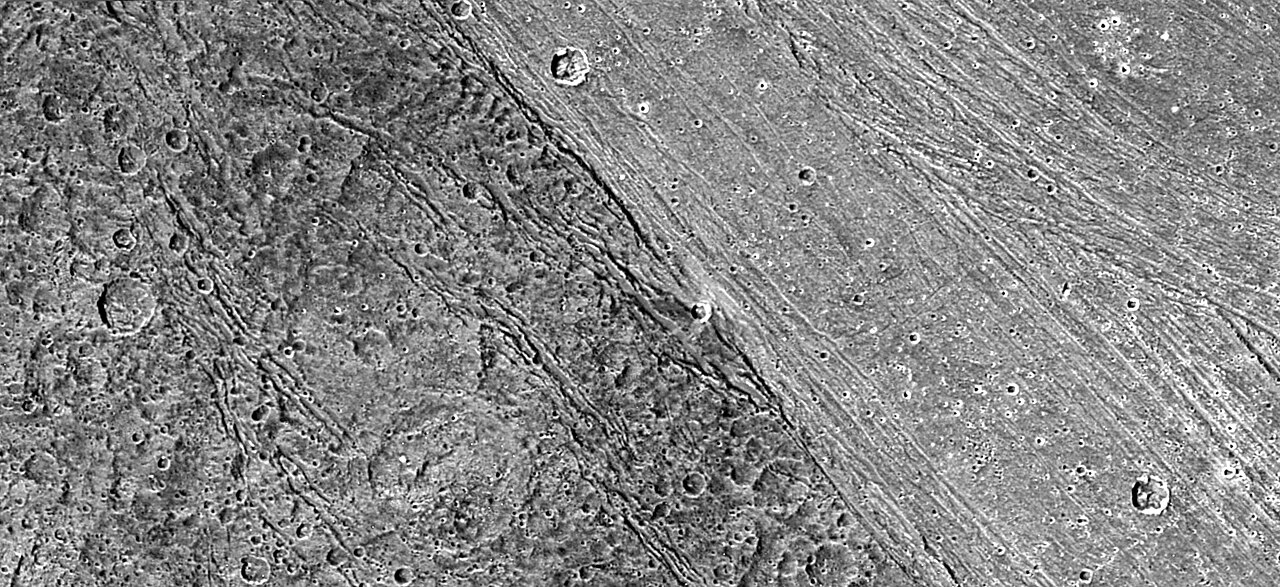
Ganymede has two types of terrain: about 40% is dark, heavily cratered regions, and about 60% is lighter grooved terrain that forms intricate patterns across the moon. Some groove ridges are as high as 700 metres, and the grooves run for thousands of kilometres.[1] NASA says the pattern suggests Ganymede's crust has been under tension from global tectonic processes.[1] The large craters are mostly flat, probably because they settled into the soft icy surface, and bright and dark rays of ejecta surround many craters.[1]
The cratered and grooved surface of Ganymede.
Via Wikimedia Commons: Ganymede terrain by NASA/JPL/DLR, public domain.
NASA reports that in 2004 scientists discovered irregular lumps beneath Ganymede's icy surface, which may be rock formations that the icy shell has supported for billions of years.[1] NASA's Juno mission observed mineral salts and organic compounds on the surface using its infrared spectrometer during a close flyby on 7 June 2021, and the findings were published on 30 October 2023 in Nature Astronomy.[1]
Atmosphere and temperature
Hubble observations found evidence of a thin oxygen atmosphere, which researchers think comes from the icy surface.[1] Daytime surface temperatures range from about −183 °C to −113 °C (90 to 160 kelvin), because Jupiter and its moons receive less than one-thirtieth of the sunlight Earth does and Ganymede has no dense atmosphere to trap heat.[1]
Potential for life
NASA says a 2014 computer model of Ganymede's interior supported the idea that primitive life might be possible there, because it indicated that the moon's rocky seafloor might be in contact with salt water, and scientists think water and rock interacting are key to the development of life.[1] No life has been found.
Discovery and name
Galileo Galilei discovered Ganymede on 7 January 1610, with three other large moons of Jupiter, the first time moons were found orbiting a planet other than Earth.[1][3] NASA says the German astronomer Simon Marius may have observed the moons at about the same time, but Galileo is credited with the discovery.[3] The names in use today, Io, Europa, Ganymede and Callisto, were proposed by Marius on the suggestion of Johannes Kepler.[3] In mythology, Ganymede was a beautiful young boy carried to Olympus by Zeus, disguised as an eagle, who became the cupbearer of the gods.[1]
Exploration
NASA's Pioneer 10, with its closest approach to Jupiter on 3 December 1973, took the first close-up images of Ganymede, Callisto and Europa.[3] Pioneer 11 passed within about 692,200 kilometres of Ganymede in 1974 and detected a high electron current at its orbit.[3] Voyager 1 and 2 revealed its cratered and grooved terrain in 1979.[3] Galileo, the first spacecraft to orbit Jupiter, flew within about 835 kilometres of Ganymede and returned images showing ancient cratered ice fields next to younger ice plains, ridged ice mountains and deep furrows.[3]
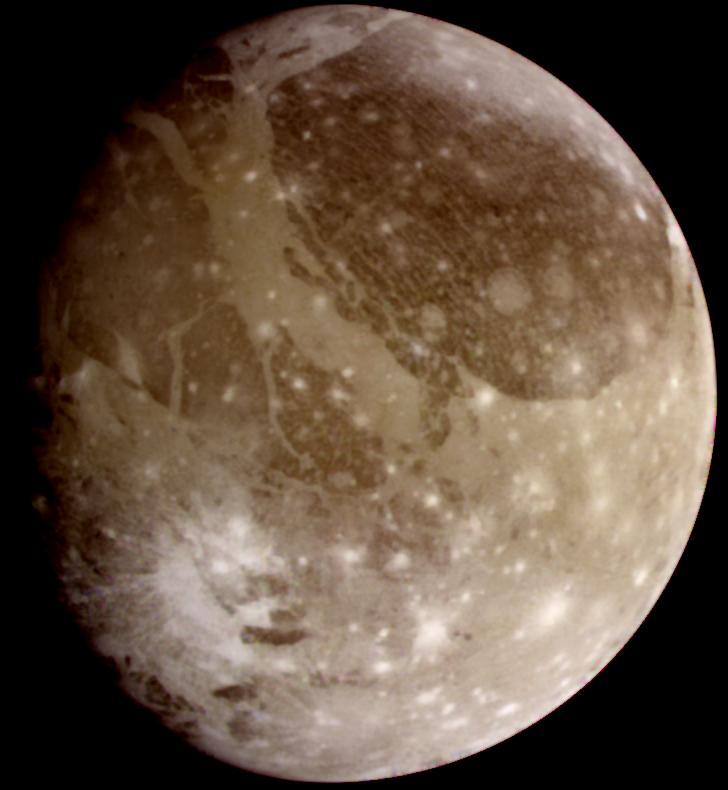
A natural-color image of Ganymede from NASA's Galileo spacecraft.
Via Wikimedia Commons: Ganymede g1 true by NASA/JPL, public domain.
The European Space Agency's Juice (Jupiter Icy Moons Explorer), launched on 14 April 2023, is due to reach Jupiter in July 2031. It will fly by Europa, Ganymede and Callisto and finally conduct an orbital tour of Ganymede, to characterize it as a planetary object and possible habitat.[5]