Lysithea is a small outer moon of Jupiter and, according to NASA, the second smallest member of the Himalia group, with a mean radius of about 18 kilometres.[1] It was discovered on 6 July 1938 by Seth Barnes Nicholson with the 100-inch Hooker telescope at Mount Wilson Observatory in California.[1]
Size and orbit
NASA gives Lysithea a mean radius of 18 kilometres (11.1 miles), assuming an albedo of 0.04.[1] NASA's Jovian Satellite Fact Sheet lists a radius of 12 kilometres, a mass of about 0.0008 × 10²⁰ kilograms and an albedo of 0.06, so the two NASA sources differ substantially on radius.[2] The entry does not reconcile them; the radius estimates depend on the albedo assumed.
Lysithea orbits Jupiter at a mean distance of about 11.7 million kilometres (7.2 million miles) and takes about 259 Earth days to complete one orbit.[1] The fact sheet gives a semi-major axis of 11,717 thousand kilometres (163.9 Jovian radii), a period of 259.22 days, an inclination of 28.30 degrees to Jupiter's equator and an eccentricity of 0.112.[2] The orbit is prograde, in the same direction as Jupiter's rotation.[1]
The Himalia group
NASA says Lysithea belongs to the Himalia group, a family of Jovian moons with similar orbits and appearance that are therefore thought to share a common origin. The other members are Himalia (the largest), Elara and Leda.[1] Because Lysithea reflects only about 4 percent of the light it receives, NASA suggests it may be a chunk of a C- or D-class asteroid that broke apart in a collision, either before or after Jupiter's gravity captured it.[1] See Himalia and Elara for the group's two largest members.
NASA adds that a fifth candidate, S/2000 J11, with a radius of about 2 kilometres, was lost before its orbit could be determined, and may have crashed into Himalia, perhaps creating a faint, temporary ring of Jupiter near Himalia's orbit.[1] The fact sheet lists an object named Dia (S/2000 J11), so the two NASA sources differ on whether that moon is still tracked.[2]
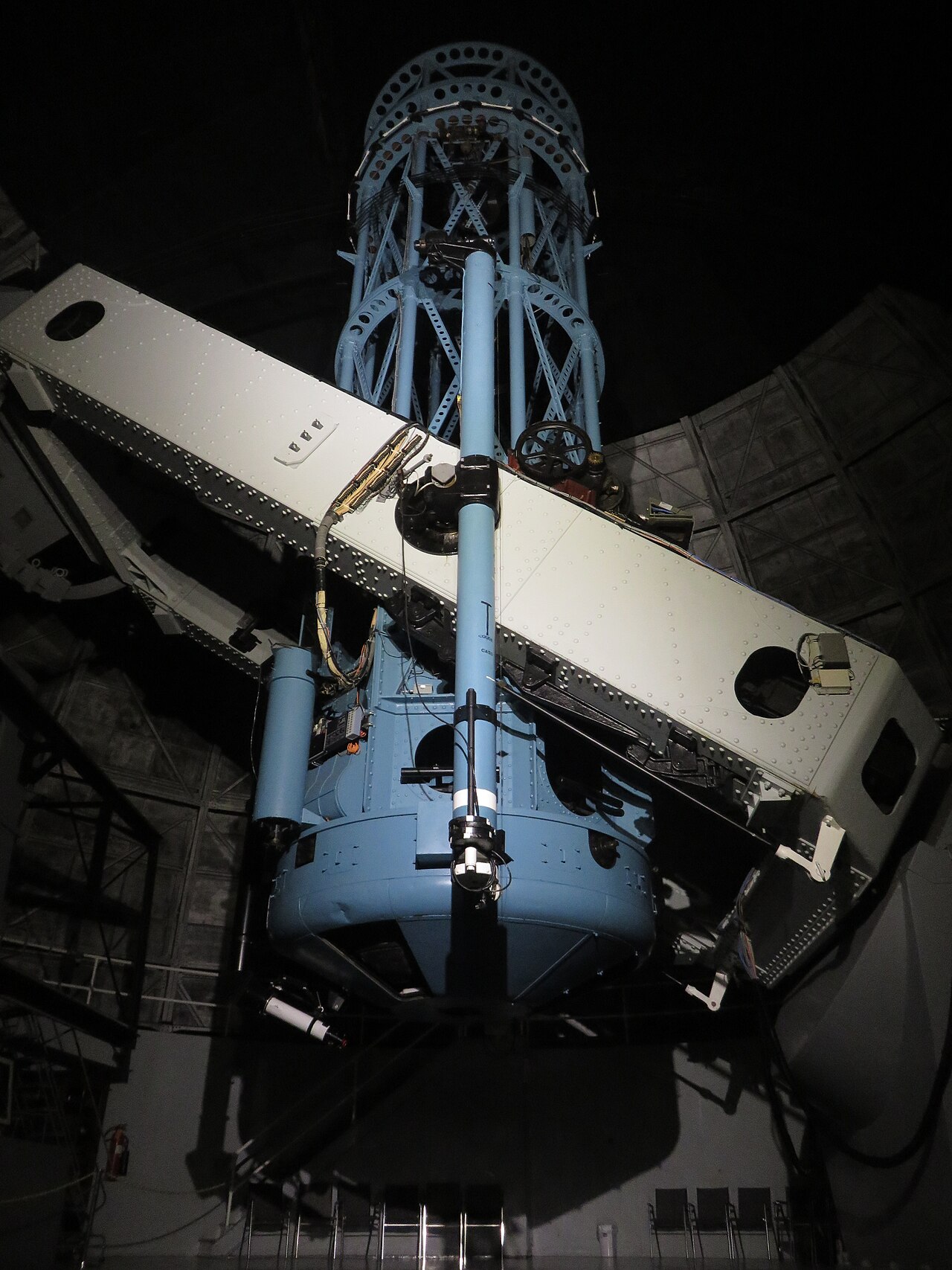
The 100-inch Hooker telescope at Mount Wilson Observatory.
Nicholson found Lysithea in July 1938 with the 100-inch (2.5-metre) Hooker telescope at Mount Wilson Observatory.[1] The discovery listing of NASA's Jet Propulsion Laboratory gives the same year and discoverer.[3]
Lysithea is named for one of the lovers of Zeus, the Greek equivalent of the Roman god Jupiter. NASA recounts an account in which Hera tricked Lysithea into asking Zeus to come to her as he had come to Hera, and Lysithea died of fright; Zeus saved the child she carried, who was Dionysus.[1] A name ending in "a" follows the International Astronomical Union's policy for Jupiter's prograde outer moons.[1]