Version 1
Nov 23, 2026. Compare with the current version · Version history
Titan is the largest moon of Saturn and the second largest moon in the solar system, and it is the only moon known to have a substantial atmosphere.[1][2] NASA calls it the only place besides Earth known to have liquids on its surface, in the form of rivers, lakes and seas of methane and ethane.[1][2]
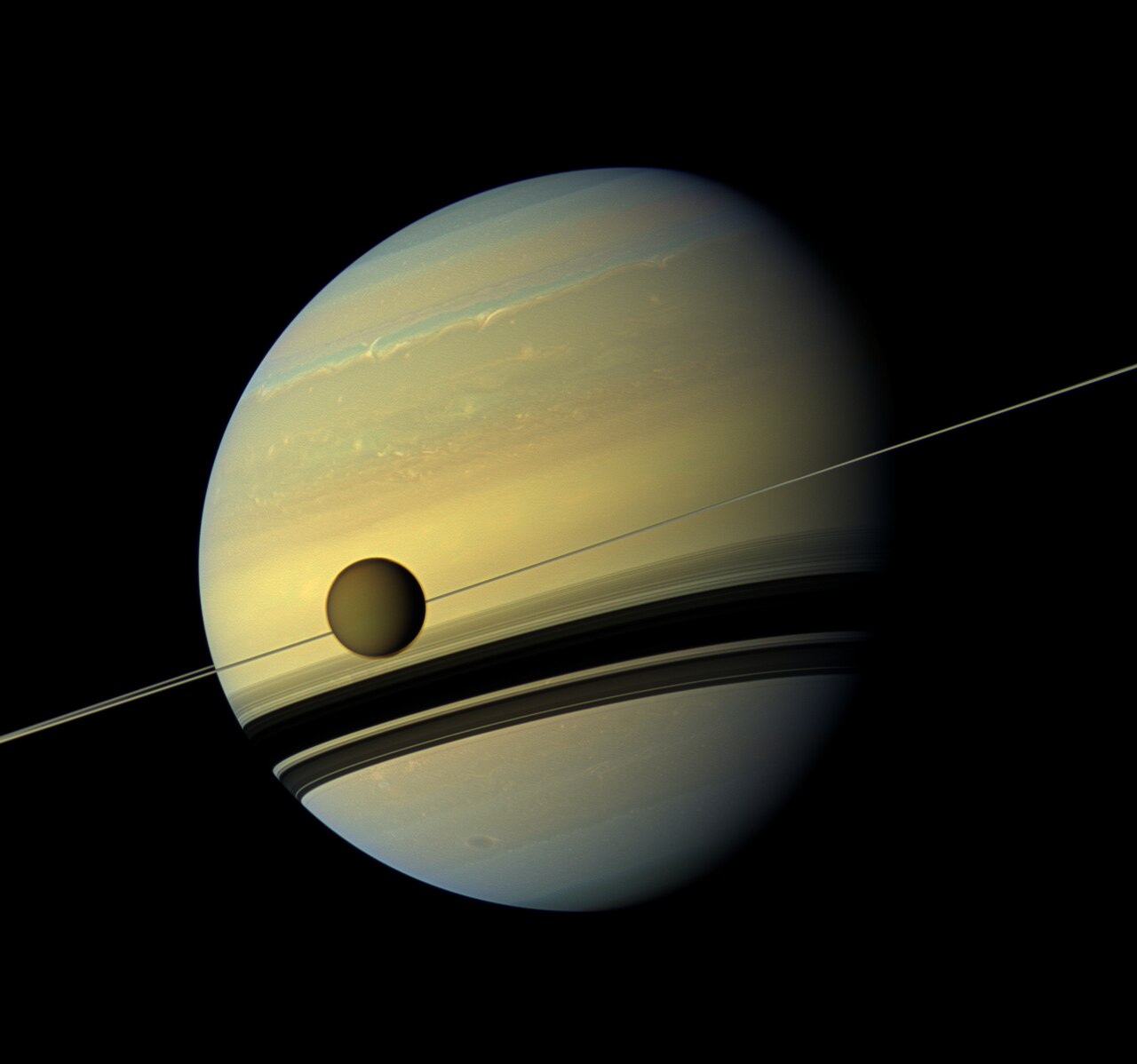
Via Wikimedia Commons: Titan in front of the ring and Saturn by Produced By: Cassini Imaging Team, Image Credit: NASA/JPL-Ca, public domain.
Size and orbit
Titan has a radius of about 2,575 kilometres (1,600 miles), nearly 50 percent wider than Earth's Moon, and is larger than the planet Mercury.[2][3] NASA states that only Jupiter's moon Ganymede is larger, by just 2 percent.[2] The Saturnian Satellite Fact Sheet gives Titan a mass of 1,345.5 × 10²⁰ kilograms, a mean density of 1,880 kilograms per cubic metre and a visual geometric albedo of 0.22.[3] NASA's overview page for Titan calls it Saturn's largest moon, which is correct for Saturn's moons and consistent with the Facts page's note that Ganymede is larger.[1][2]
Titan orbits about 1.2 million kilometres (759,000 miles) from Saturn.[2] The fact sheet gives a semi-major axis of 1,221.87 thousand kilometres, an orbital period of 15.945 days, an inclination of 0.33 degrees and an eccentricity of 0.0292.[3] NASA's Facts page gives the period as 15 days and 22 hours and says Titan is tidally locked, always showing the same face to Saturn.[2] Because Titan orbits roughly along Saturn's equatorial plane, its seasons follow Saturn's schedule, each lasting more than seven Earth years in a Saturnian year of about 29 Earth years.[2]
Discovery and name
The Dutch astronomer Christiaan Huygens discovered Titan on 25 March 1655 and called it "Luna Saturni", Latin for Saturn's moon.[2] The name Titan came from John Herschel, son of the astronomer William Herschel, and refers to the Titans of Greek mythology.[2]
Atmosphere
NASA describes Titan's surface as completely obscured by a golden, hazy atmosphere.[2] The atmosphere is about 95 percent nitrogen and 5 percent methane, with small amounts of other carbon-rich compounds.[2] At the surface the pressure is about 60 percent greater than on Earth, and because Titan has less mass than Earth the atmosphere extends about 10 times higher, nearly 600 kilometres into space.[2] Sunlight and high-energy particles split methane and nitrogen molecules high in the atmosphere, and the pieces recombine into organic chemicals that form a thick orange smog. Some of the heavy compounds settle onto the surface as the "sand" of Titan's dunes, and methane condenses into clouds that occasionally drench the surface with methane storms.[2]
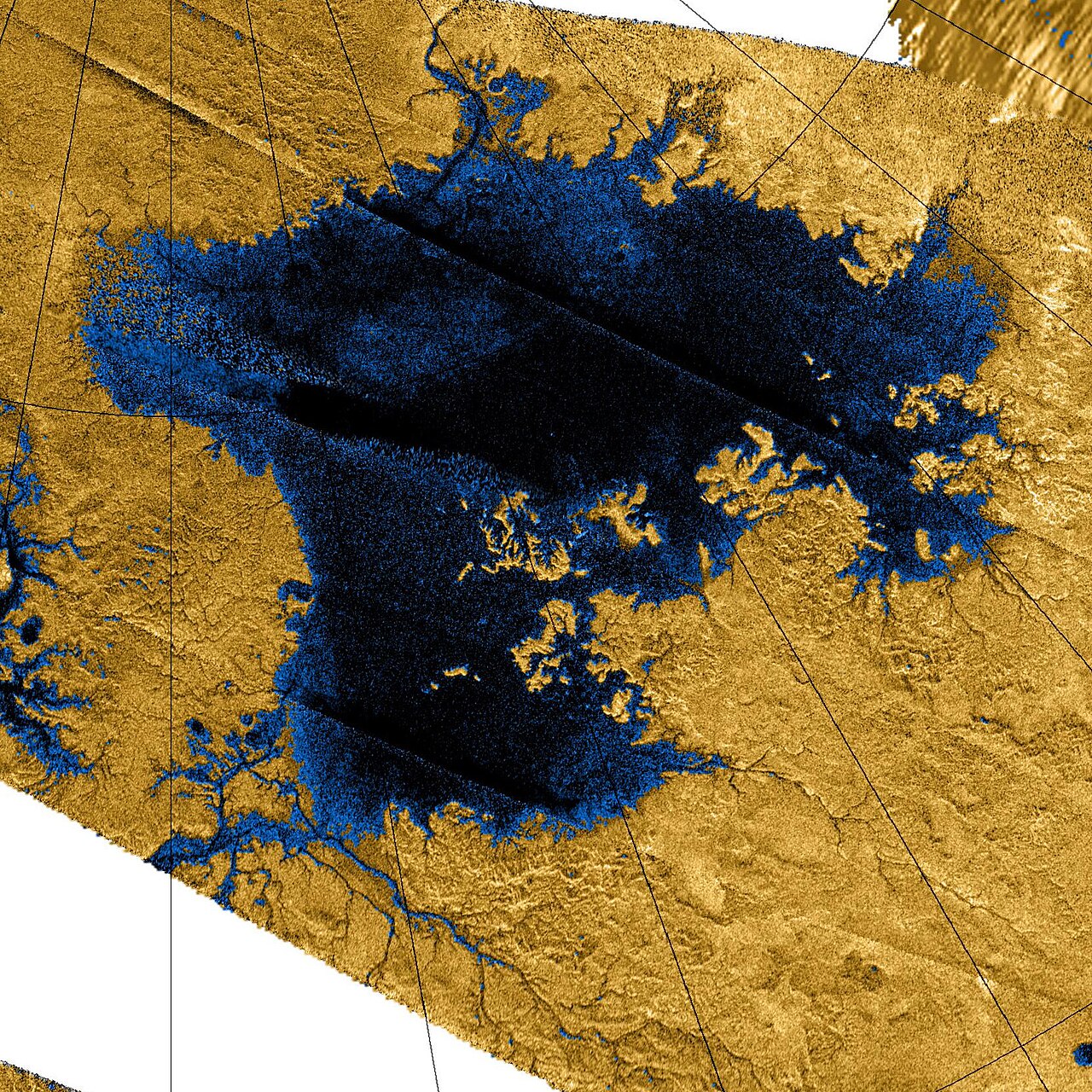
Via Wikimedia Commons: PIA10008 Ligeia Mare crop by NASA / Jet Propulsion Lab / USGS, public domain.
Surface
NASA says Titan's surface is among the most Earthlike in the solar system, at vastly colder temperatures and with different chemistry: it is about −179 °C, cold enough that water ice plays the role of rock.[2] Flowing methane and ethane carve river channels and fill lakes, and NASA says no other world except Earth has liquid activity of this kind on its surface.[2] Vast regions of dark dunes lie mainly around the equator; their grains are dark hydrocarbons thought to look something like coffee grounds, and the tall linear dunes resemble those of the Namib desert.[2] Titan has few visible impact craters, which NASA reads as a sign that its surface is relatively young. Tectonic forces appear to be at work, though without evidence of plates like Earth's, and Titan may have cryovolcanism, in which water takes the place of molten rock.[2]
Interior
NASA says Titan's interior is not fully known. One model from the Cassini-Huygens mission suggests five layers: a core of water-bearing silicate rock about 4,000 kilometres across, a shell of high-pressure water ice, a layer of salty liquid water, an outer crust of water ice, and a surface coated with organic molecules from the atmosphere.[2] Gravity measurements from the Cassini spacecraft indicated an underground ocean of liquid water, and radio signals measured during the descent of the European Space Agency's Huygens probe in 2005 strongly suggested an ocean 55 to 80 kilometres below the icy ground.[2] NASA has also published a study suggesting Titan may not have a global ocean, and its Cassini page lists the article's headline; this entry does not weigh the two findings, and the article itself was not read for this entry.[4]
Habitability and open questions
Sunlight continuously breaks down methane in Titan's atmosphere, so some source must replenish it; NASA says researchers suspect cryovolcanism but are not certain.[2] NASA says that Titan could have environments suitable for life as we know it, in the subsurface ocean, and perhaps for life as we do not know it, in the surface hydrocarbons, but that there is so far no evidence of life there.[2] On origin, instruments on Cassini-Huygens found that Titan's nitrogen isotope ratio most resembles that of comets from the Oort Cloud, which NASA says suggests Titan's building blocks formed in the cold disk of gas and dust that formed the Sun, not in the warmer disk around Saturn.[2]
Exploration
NASA says the first spacecraft to explore Titan was Pioneer 11, which flew through the Saturn system on 1 September 1979.[1] The Cassini orbiter and the Huygens probe studied it in detail after Cassini reached Saturn in 2004.[2][4]
NASA's Dragonfly mission, a rotorcraft, is planned to fly between sites on Titan, collecting samples to study prebiotic chemistry and habitability. NASA's Titan page says it will launch in 2028 and spend three years making multiple landings,[1] while the Dragonfly mission page gives a launch no earlier than July 2028, an arrival in late 2034 and a planned mission of 3.3 years, with one flight every one to two Titan days (a Tsol lasts about 16 Earth days).[5] Dragonfly was selected in 2019 as the fourth mission of NASA's New Frontiers program.[5] As of 22 November 2026 NASA lists it as a future mission.[5]
Sources
- NASA Science. "Titan." science.nasa.gov/saturn/moons/titan/ (read 22 November 2026)
- NASA Science. "Titan Facts." science.nasa.gov/saturn/moons/titan/facts/ (read 22 November 2026)
- NASA NSSDCA. "Saturnian Satellite Fact Sheet." nssdc.gsfc.nasa.gov/planetary/factsheet/saturniansatfact.html (read 22 November 2026)
- NASA Science. "Cassini-Huygens." science.nasa.gov/mission/cassini/ (read 22 November 2026)
- NASA Science. "Dragonfly." science.nasa.gov/mission/dragonfly/ (read 22 November 2026)
