Tethys is Saturn's fifth largest moon, an icy world about 533 kilometres in mean radius that is dominated by a giant impact crater called Odysseus and a huge valley called Ithaca Chasma.[1] It was discovered by Giovanni Cassini on 21 March 1684.[1]
NASA gives Tethys an irregular shape with a mean radius of 533 kilometres (331 miles) and dimensions of 1,076.8 × 1,057.4 × 1,052.6 kilometres.[1] NASA's Saturnian Satellite Fact Sheet lists radii along three axes of 538 × 528 × 526 kilometres and a mass of 6.18 × 10²⁰ kilograms, with a mean density of 985 kilograms per cubic metre.[2] NASA's page gives the density as 0.97 times that of liquid water, which suggests to NASA that Tethys is composed almost entirely of water ice plus a small amount of rock.[1]
The two NASA sources disagree on reflectivity: the page gives a visual albedo of 1.229, and the fact sheet gives 0.8.[1][2] Both agree that Tethys is highly reflective and made largely of water ice, which at the average temperature of about −187 °C behaves like rock. NASA says many crater floors are bright, and that the E ring's water-ice particles from geysers on Enceladus also raise the reflectivity.[1]
Tethys orbits Saturn at about 295,000 kilometres (183,000 miles) and takes 45.3 hours to circle the planet.[1] The fact sheet gives a semi-major axis of 294.66 thousand kilometres, a period of 1.8878 days (about 45.3 hours), an inclination of 1.86 degrees and an eccentricity of essentially zero, with synchronous rotation.[2] NASA says Tethys is tidally locked, like all but two of the major Saturnian moons, with the same side always facing Saturn.[1]
Companions
NASA says Tethys has gravitationally locked two smaller moons into its own subsystem, Telesto and Calypso, which sit at its Lagrangian points L4 and L5. The three moons move around Saturn as a unit, spaced at 60-degree intervals: first Telesto, then Tethys, then Calypso. NASA says that the existence of such companions around Tethys and other Saturnian moons implies that their Lagrangian points have been stable against outside influences for millions of years.[1]
Surface
NASA says Tethys is similar to its sister moons Dione and Rhea but less heavily cratered than they are, which NASA suggests may be because its closeness to Saturn caused more tidal warming that kept it partly molten for longer, erasing or dulling more of the early terrain.[1] Tethys appeared as a tiny dot to astronomers until the Voyager encounters of 1980 and 1981, which showed a major impact crater and a great chasm, and NASA says Cassini added detail, including a variety of colours at small scales that suggest materials not seen elsewhere.[1]
The northern hemisphere is lighter coloured and heavily reworked by bombardment, while nearer the equator the terrain is darker with fewer craters, which NASA reads as a sign of past internal activity and resurfacing. A band of slightly darker material wraps around the equator on the leading side, and scientists suspect it may be less contaminated ice with differently sized grains than at higher latitudes.[1]
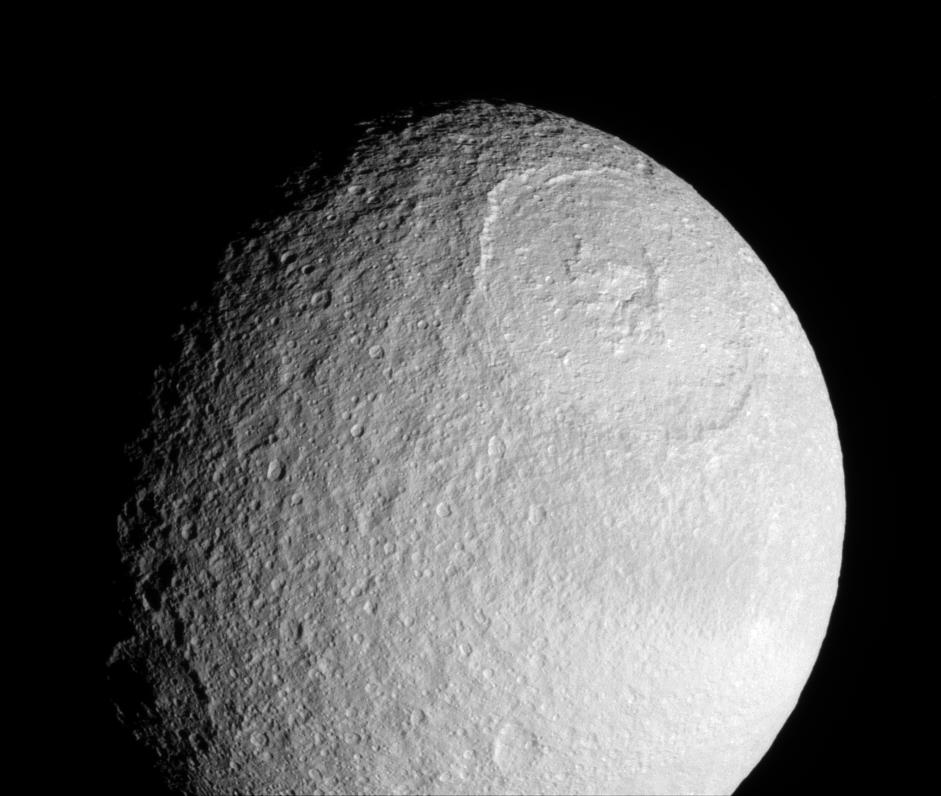
Tethys in a black-and-white spacecraft image, with a large, shallow, partly collapsed crater near the top; this is probably Odysseus Crater, but the image is not confirmed here to show it.
Odysseus Crater dominates the western hemisphere. NASA gives its diameter as about 400 kilometres, nearly two-fifths the diameter of Tethys itself, and says such an impact could have shattered a solid body, which suggests that Tethys was still partly molten when it formed. The crater's rim and central peak have largely collapsed, leaving a shallow crater, which NASA also reads as a sign that the terrain was elastic enough to change shape.[1]
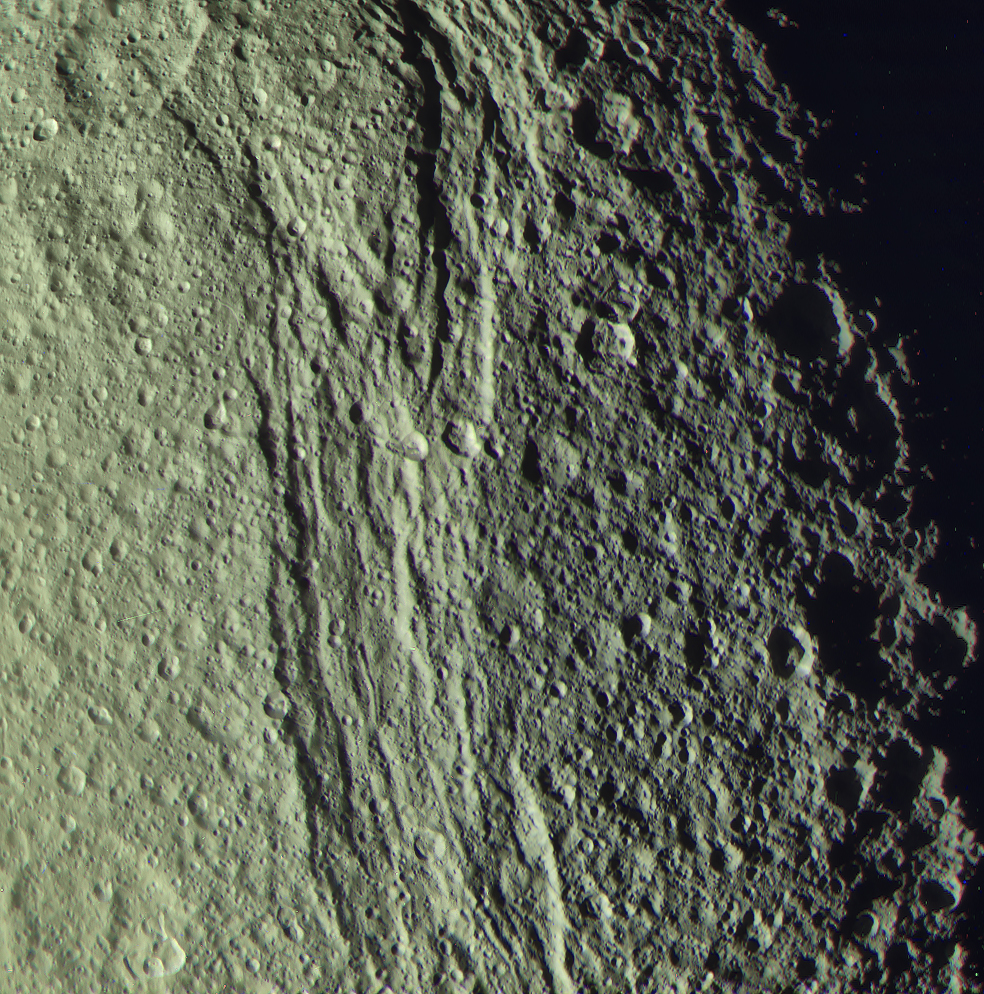
Ithaca Chasma is a valley that runs roughly from the north pole to the south pole. NASA gives its size as about 100 kilometres wide, 3 to 5 kilometres deep and 2,000 kilometres long.[1] NASA offers two ideas for its origin: expansion of internal liquid water as it froze after the surface had already frozen, or forces from the impact that made Odysseus, which fits with the chasm lying on the opposite side of Tethys. The chasm and the area around it are heavily cratered, which indicates it formed long ago.[1]
Ridged and cratered terrain in a color-enhanced image returned by a search for Ithaca Chasma; the image is not confirmed here to show the chasm.
Giovanni Cassini discovered Tethys on 21 March 1684.[1] He referred to it as one of the four Sidera Lodoicea, the Stars of Louis, after King Louis XIV, together with Iapetus, Dione and Rhea, and other astronomers called it Saturn III. John Herschel suggested naming Saturn's moons for the brothers and sisters of Kronos, the Greek equivalent of Saturn.[1]
Tethys is named for the Greek goddess, or Titan, Tethys, the daughter of Uranus and Gaea, sister of Kronos and wife of Oceanus, said to be the mother of the chief rivers and of three thousand daughters called the Oceanids. Features on Tethys generally take their names from Homer's "Odyssey".[1]