Hyperion is the largest of Saturn's irregular, nonspherical moons, a potato-shaped body about 270 kilometres across on average that tumbles chaotically as it orbits.[1] Its surface is deeply pitted, giving it a look that NASA compares to a sponge or a wasp nest.[1]
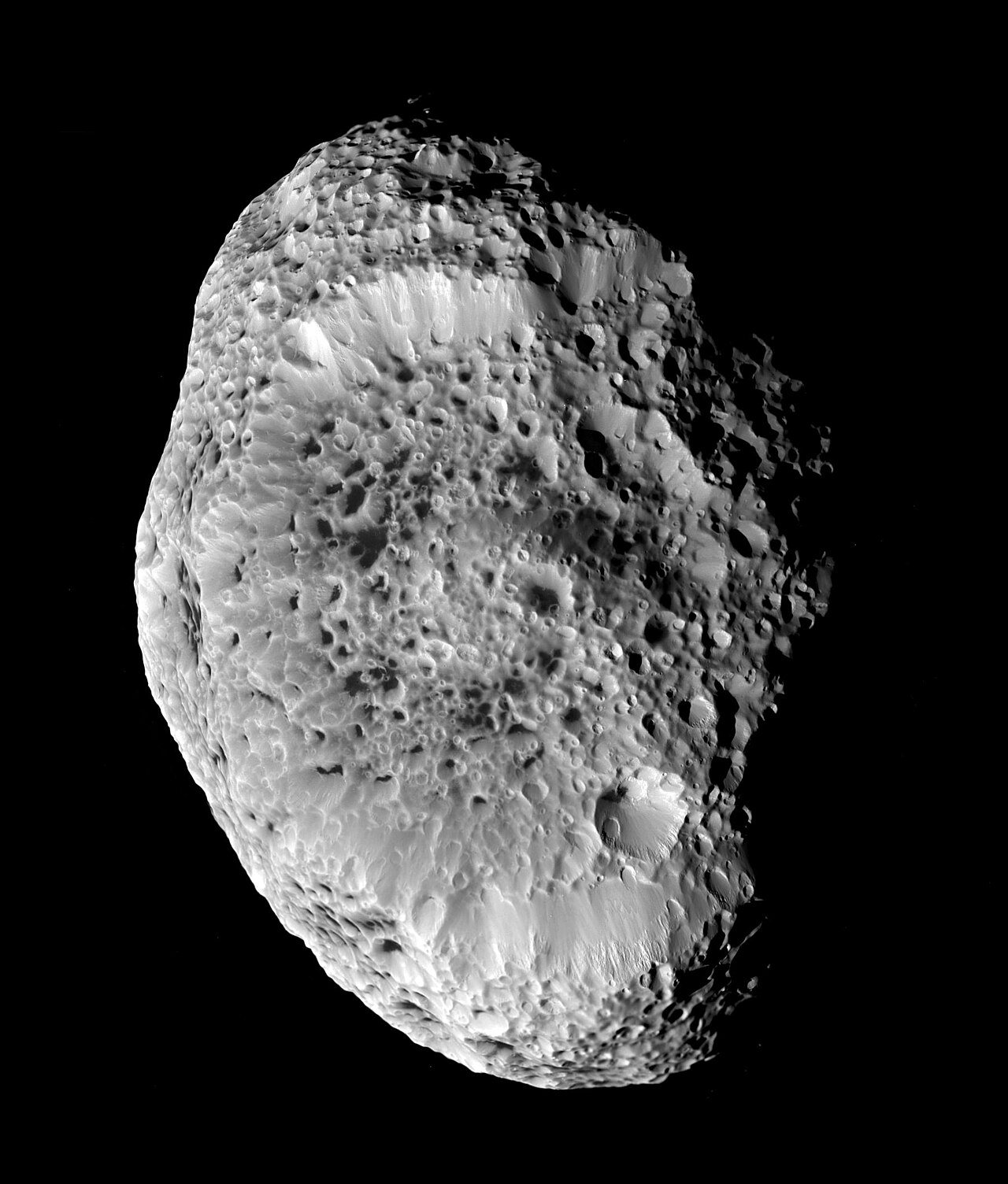
Hyperion in black and white, showing its deep, closely spaced craters and bright crater walls.
Via Wikimedia Commons: PIA07761 by NASA/JPL/Space Science Institute, public domain.
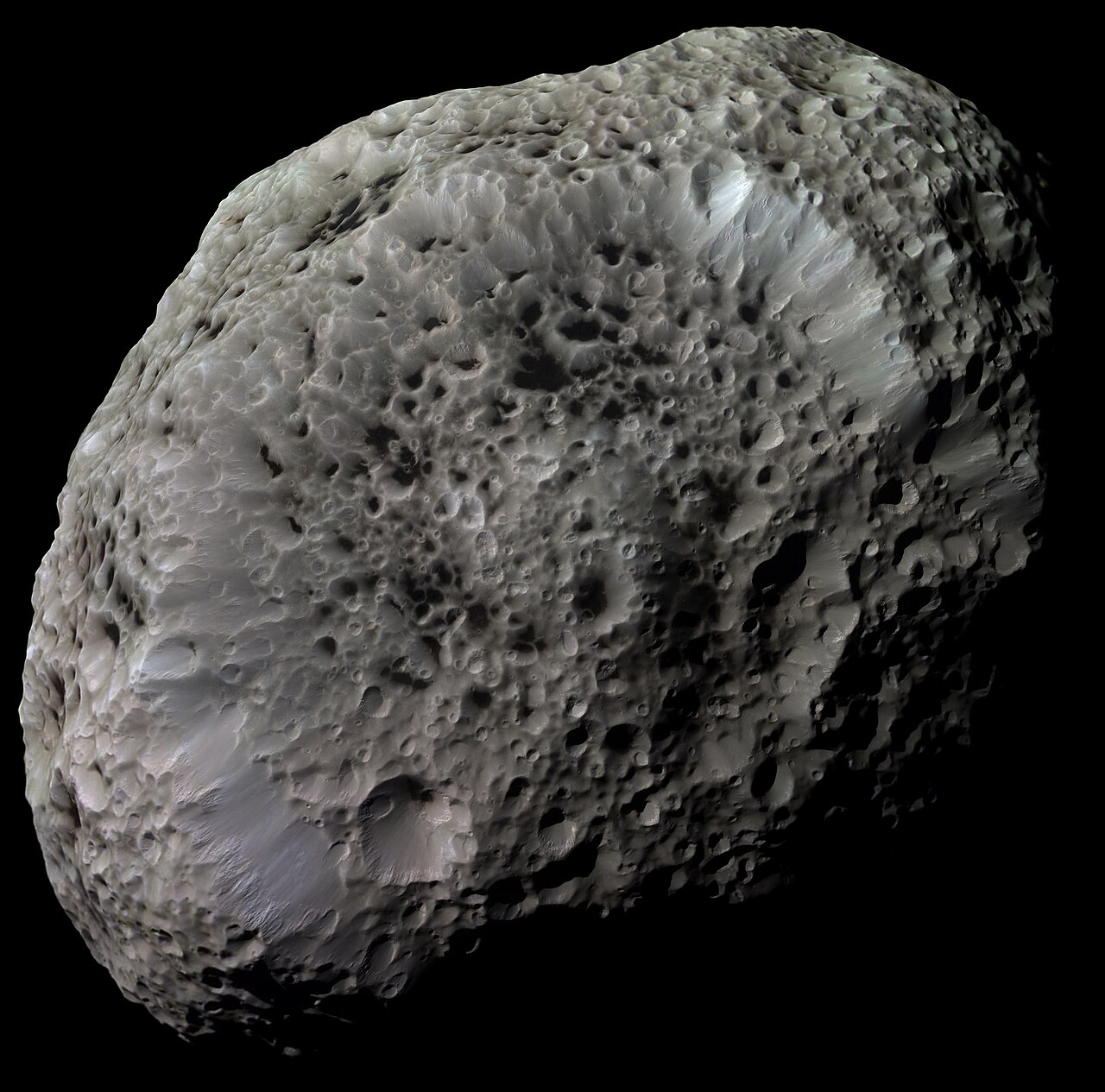
Hyperion in a colour-enhanced spacecraft image; the colours exaggerate real surface differences.
Via Wikimedia Commons: Hyperion false color by The original uploader was Tablizer at English Wikipedia . La, public domain.
Size, shape and density
NASA gives Hyperion a mean radius of 135 kilometres (83.9 miles) and says its shape can be described by its diameters along three axes, 410 × 260 × 220 kilometres.[1] NASA's Saturnian Satellite Fact Sheet lists radii along three axes of 180 × 133 × 103 kilometres, a mass of 0.056 × 10²⁰ kilograms, a mean density of 550 kilograms per cubic metre and an albedo of 0.3.[2] The two NASA sources do not quite agree: 410 × 260 × 220 kilometres as diameters implies semi-axes of about 205, 130 and 110 kilometres, against the fact sheet's 180, 133 and 103 kilometres, and the entry does not reconcile them.[1][2]
NASA considers it probable, given the odd shape, that Hyperion is a remnant of a larger moon destroyed by a major impact.[1] Its density is slightly more than half that of water, which NASA says could mean water ice with gaps (porosity) of more than 40 percent, with lighter materials such as frozen methane or carbon dioxide perhaps making up part of it. That fits the idea that Hyperion built up from many smaller bodies of ice and rock without enough gravity to compact them, making it something like a large rubble pile.[1]
Orbit and chaotic rotation
Hyperion orbits Saturn at a mean distance of about 1.5 million kilometres (933,000 miles) in an eccentric orbit and takes about 21 days to circle it.[1] The fact sheet gives a semi-major axis of 1,500.93 thousand kilometres, a period of 21.28 days, an inclination of 0.43 degrees and an eccentricity of 0.1042, and marks its rotation as chaotic.[2]
NASA says Hyperion rotates chaotically, tumbling unpredictably through space. The eccentric orbit contributes, and a stronger effect, according to NASA, is a resonance with Saturn's largest moon, Titan: the two speed up and slow down as they pass each other. Because Hyperion is much smaller, its rotation and orbit are affected far more than Titan's, and NASA says Titan apparently keeps Hyperion's orbit eccentric. The great distance from Saturn and the resonance have kept Hyperion from becoming tidally locked, so it rotates roughly every 13 days during its 21-day orbit.[1]
A punched-in surface
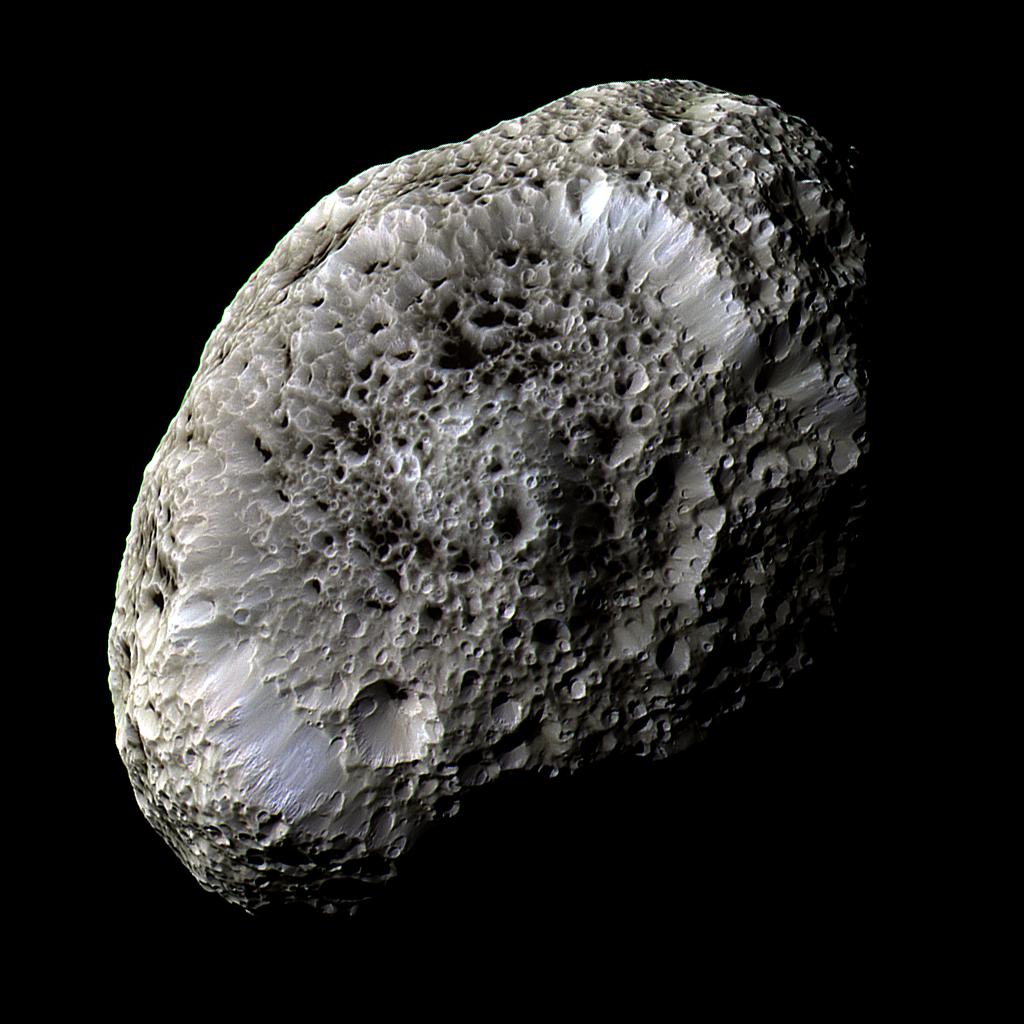
NASA says the most noticeable feature is the deeply cratered surface. Hyperion and its sister outer moons Phoebe and Iapetus all show extensive cratering because they are Saturn's most distant moons and have had little tidal warming to blur or erase earlier features.[1] Hyperion's craters are particularly deep and lack significant rays of ejecta, though there appears to have been slumping or landslides inside many of the bigger ones. The result is a curiously punched-in look, somewhat like a sponge or a wasp nest, and planetary geologists have theorized that Hyperion's high porosity and low density make it crater more by compression than by excavation.[1]
A second colour-enhanced view of Hyperion with its sponge-like pitted surface.
Via Wikimedia Commons: Hyperion PIA07740 by NASA/JPL, public domain.
NASA reports that many crater walls are bright, which suggests abundant water ice, while crater floors are mostly the darkest and reddest areas. It suggests that the average temperature of roughly −180 °C may be close to the point at which volatile materials sublimate, leaving darker material to accumulate on crater floors, which fits with some newer crater floors being bright water ice.[1] NASA's image caption notes that colour differences in a false-colour Cassini view from the flyby of 26 September 2005 could reflect differences in the composition of surface materials.[1]
Discovery and name
NASA says William Lassell discovered Hyperion in 1848 and that in the same year William Cranch Bond, with his son George Phillips Bond, independently discovered it, so all three are credited jointly.[1]
John Herschel suggested naming Saturn's moons for the brothers and sisters of Kronos, the Greek equivalent of Saturn. Hyperion was a Titan, a son of Uranus and Gaia, brother of Kronos and husband of Thea, and the father of Helios (the sun), Eos (the dawn) and Selene (the Moon).[1]