Ariel is the brightest of the five largest moons of Uranus and has the youngest-looking surface of them, crossed by fault-bounded valleys.[1] A 2025 modeling study suggests it may once have had a large subsurface ocean.[3]
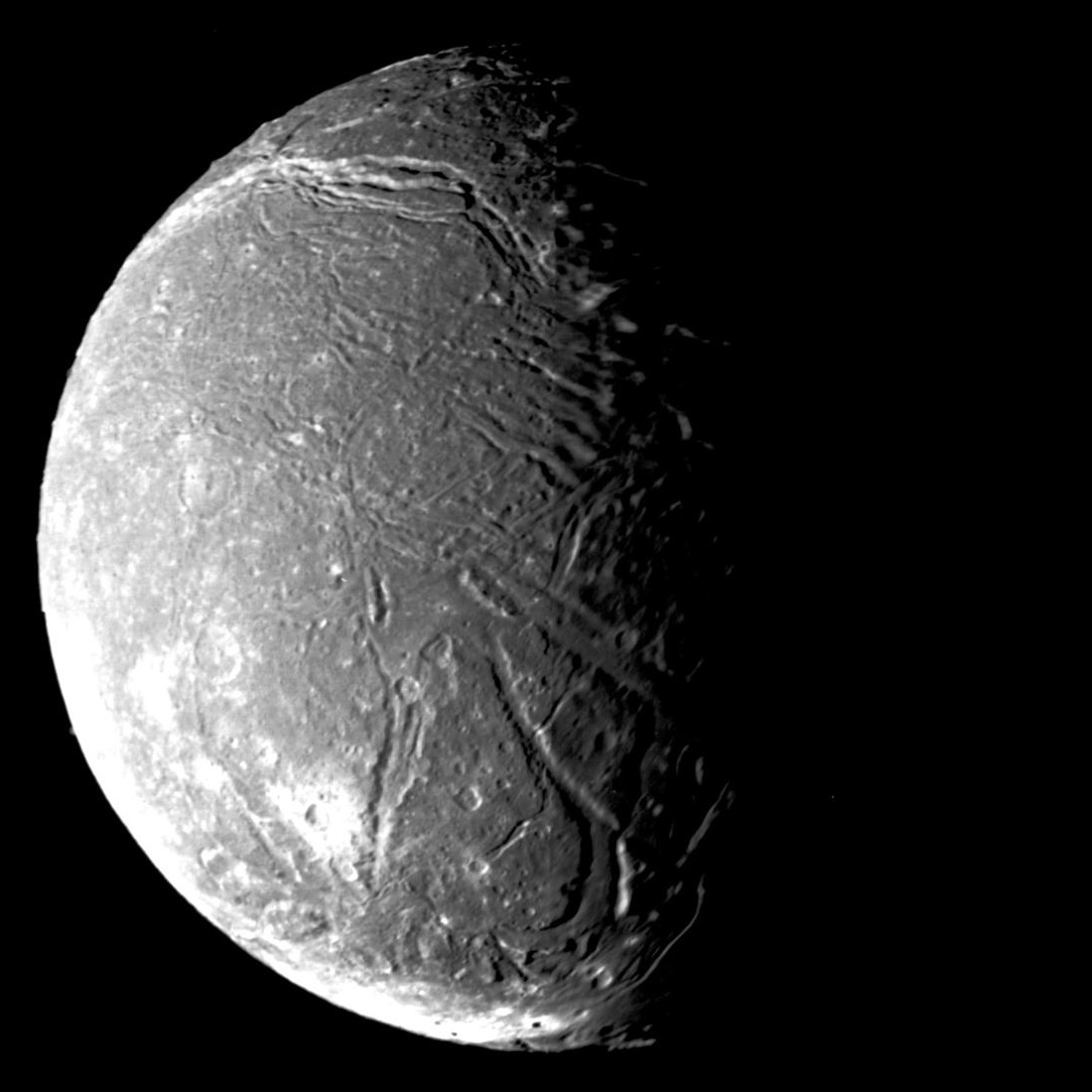
Via Wikimedia Commons: Ariel (moon) by NASA/JPL, public domain.
Orbit and size
The NASA Uranian Satellite Fact Sheet lists Ariel at 190,900 kilometres from Uranus, or 7.469 Uranian radii, with an orbital period of 2.520379 days, an inclination of 0.04 degrees and an eccentricity of 0.0012. Its rotation is synchronous, so it always shows the same face to Uranus.[2] The sheet gives radii along three axes of 581.1, 577.9 and 577.7 kilometres, a mass of 12.9 × 10²⁰ kilograms, a mean density of 1,590 kilograms per cubic metre and a visual geometric albedo of 0.39.[2] An Eos article gives the moon's size as about 1,160 kilometres across, about a third the size of Earth's Moon.[3] NASA describes the orbit as prograde, with low inclination and eccentricity, which it calls a regular orbit.[1]
Surface and makeup
NASA says all of Uranus's larger moons, Ariel included, are thought to consist mostly of roughly equal amounts of water ice and silicate rock, and that carbon dioxide has also been detected on Ariel.[1] Its surface appears to be the youngest of all the Uranian moons, with few large craters and many small ones, which NASA reads as a sign that fairly recent low-impact collisions wiped out the large craters left by earlier, bigger strikes. NASA also says Ariel is thought to have had the most recent geologic activity of Uranus's larger moons, and that it is transected by grabens, fault-bounded valleys.[1]
NASA says Ariel has the brightest surface of the five largest Uranian moons, but none reflects more than about a third of the sunlight that strikes it, which suggests carbonaceous material has darkened their surfaces. The fact sheet's albedo of 0.39 for Ariel is slightly above a third; the sources read do not say whether the two figures measure the same thing.[1][2] Ariel brightens dramatically at opposition, which NASA takes to show a porous surface that casts reflectivity-reducing shadows at other angles. Its surface temperature also rises and falls quickly with sunlight, without a thermal-inertia lag, which supports that picture. NASA suggests eons of micrometeorite strikes tilling the soil as a possible cause.[1]
NASA adds that, in an earlier time, Ariel appears to have been heated enough to differentiate, with heavier material sinking toward the core, and that tidal interactions with Uranus may have been an important heat source.[1]
A possible past ocean
An Eos article of 24 October 2025 reports a study published in Icarus in September 2025 by Caleb Strom and colleagues. They mapped ridges, fractures and craters on Ariel from Voyager 2 images, then modeled how a crust over an ocean would deform under tidal stress from Uranus and its nearby moons, varying the crust and ocean thickness and the strength of the stress to match the Voyager-based maps.[3]
According to Eos, the models indicate that a crust less than 30 kilometres thick would have fractured under moderate tidal stress and produced the features seen today. The team suggests that, in the past one to two billion years, an orbital resonance with the nearby moon Miranda stretched Ariel's orbit about 4 percent from circular and fractured the surface. With a core 740 kilometres across and a 30-kilometre crust, the ocean would have been about 170 kilometres deep and about 55 percent of the moon's volume.[3] Strom cautioned that a past ocean does not mean one exists now: the moon is small and does not keep heat well, and any ocean that remained would likely be much thinner.[3] Richard Cartwright, who was not part of the study, called the prospect exciting and said the results track with other studies suggesting that Ariel's surface geology offers clues to recent activity.[3] NASA's Ariel page does not mention this result and says only that tidal heating may have been an important source of heat.[1]
Discovery and name
NASA says William Lassell discovered Ariel on 24 October 1851, and describes him as one of England's grand amateur astronomers, who used a fortune made in the brewery business to finance his telescopes.[1] Ariel is the name of a character in both Shakespeare's The Tempest and Pope's poem "The Rape of the Lock". NASA says Sir John Herschel named the moon at Lassell's request.[1] In The Tempest, Ariel is a spirit who serves Prospero, and both Prospero and Sycorax, who had imprisoned Ariel in a tree, were later used as names of other Uranian moons.[1]
Voyager 2
When Voyager 2 flew through the Uranus system in 1986, scientists were surprised to see that Ariel's icy surface was relatively young and geologically complex, with some signs of cryovolcanism, according to Eos. The article says a Voyager 2 image taken on 24 January 1986 remains the highest-resolution image of this moon.[3]
See also
Uranus describes the planet and its moon system; the other large moons are Titania, Oberon and Umbriel.
Via Wikimedia Commons: Ariel (moon) by NASA/JPL, public domain.
Sources
- NASA Science. "Ariel," Uranus Moons. science.nasa.gov/uranus/moons/ariel/ (read 22 November 2026)
- NASA Space Science Data Coordinated Archive. "Uranian Satellite Fact Sheet." Updated 11 March 2023. nssdc.gsfc.nasa.gov/planetary/factsheet/uraniansatfact.html (read 22 November 2026)
- Cartier, K. M. S. "Tiny Uranian Moon Likely Had a Massive Subsurface Ocean." Eos (AGU), 24 October 2025. eos.org/articles/tiny-uranian-moon-likely-had-a-massive-subsurface-… (read 22 November 2026)
