Version 2 (current)
Nov 23, 2026. Version history
A near-Earth object is an asteroid or comet whose orbit brings it into Earth's neighbourhood, with a closest approach to the Sun of less than 1.3 times Earth's distance from the Sun.[1][2] Most are asteroids, and NASA says thousands have been discovered.[1]
Definition
NASA says near-Earth objects are asteroids and comets that the gravity of nearby planets has nudged into orbits that let them enter Earth's neighbourhood, with a closest approach to the Sun of less than 1.3 times Earth's distance from it.[1] NASA also describes them as orbiting within 30 million miles (48 million kilometres) of Earth's orbit, about one-third of the distance between Earth and the Sun.[1] NASA says the vast majority are asteroids, ranging from a few feet across to several miles wide.[1] Asteroids that actually cross Earth's orbital path are called Earth-crossers.[1]
Potentially hazardous asteroids
NASA says an asteroid is considered a potentially hazardous asteroid when its orbit comes within 4.6 million miles (7.5 million kilometres) of Earth's orbit and it has an estimated diameter of 460 feet (140 metres) or more, and that this means only that there is a possibility of a threat, not that it will hit.[1] NASA's Center for Near Earth Object Studies at the Jet Propulsion Laboratory tracks asteroids and comets, calculates their orbits and judges whether any are hazardous, and NASA says its scientists consider it highly unlikely that an asteroid large enough to cause widespread damage will hit Earth in the next 100 years or more.[1]
How many are known
On 2 April 2026 the Vera C. Rubin Observatory announced 33 previously unknown near-Earth objects in an early batch of data submitted to the Minor Planet Center, none a threat, the largest about 500 metres across.[2] The release says only about 40 percent of near-Earth objects larger than 140 metres had been identified, that once Rubin operates fully it is expected to reveal nearly 90,000 additional near-Earth objects, and that it should raise the share of known ones larger than 140 metres to around 70 percent.[2] NASA says its NEOWISE space telescope, which spent more than 11 years as a "planetary defender" and discovered 215 near-Earth objects before its mission ended on 31 July 2024, is to be followed by the NEO Surveyor, the first space telescope designed specifically to hunt hazardous asteroids and comets, and that ground-based observatories such as Pan-STARRS and the Catalina Sky Survey, and planetary radar, also contribute.[1]
Impacts, past and possible
NASA says very small objects, a few metres across, reach Earth's atmosphere a few times a year without causing damage, that an asteroid about 10 metres across hits about once a decade with a very bright fireball and sonic boom, that one about 50 metres across hits about every 1,000 years with local devastation, and that one about 140 metres across hits about every 20,000 years, making a crater 1 to 2 kilometres wide.[1] It lists larger, rarer impacts, including an object about 1 kilometre across about every 700,000 years and one about 10 kilometres across about every 100 million years, and describes the 2013 airburst over Chelyabinsk, Russia, the 50,000-year-old Barringer Crater in Arizona and the Chicxulub crater.[1] See the Asteroid entry.
Two well-known cases
NASA says the near-Earth asteroid Apophis, discovered on 19 June 2004 by Roy Tucker, David Tholen and Fabrizio Bernardi at Kitt Peak National Observatory, once appeared to threaten an impact, but astronomers tracked it and NASA is now confident there is no risk of it impacting Earth for at least 100 years. It will pass close on 13 April 2029, about 20,000 miles (32,000 kilometres) from Earth's surface, closer than many geosynchronous satellites, and NASA says it has redirected a spacecraft, OSIRIS-APEX, to study it.[3]
NASA says that when asteroid 2024 YR4 was first discovered it appeared to have a very small chance of hitting Earth on 22 December 2032, but that after more observations NASA concluded it poses no significant impact risk to Earth in 2032 and beyond. NASA says Webb Space Telescope data collected on 18 and 26 February, analysed by NASA's Center for Near-Earth Object Studies, ruled out any chance of a lunar impact on 22 December 2032, and that Webb images indicated the asteroid is about the size of a 15-story building.[4] NASA's page mentions an earlier estimate of a 4.3 percent chance of a lunar impact, which was later ruled out.[4]
Defending Earth
NASA says its Planetary Defense Coordination Office manages efforts to find, track and understand hazardous near-Earth objects, and is responsible for notifying the White House, Congress and other agencies if a hazardous object is found to have a 1 percent or greater chance of impacting Earth in the next 50 years.[1] NASA says its Double Asteroid Redirection Test, led by the Johns Hopkins University Applied Physics Laboratory, intentionally struck the asteroid moonlet Dimorphos on 26 September 2022 and successfully altered its orbit and shape.[1]
See also
The Asteroid belt entry describes where most asteroids live, the Earth and Moon entries describe the bodies near-Earth objects approach, and the Solar System entry puts them in context.
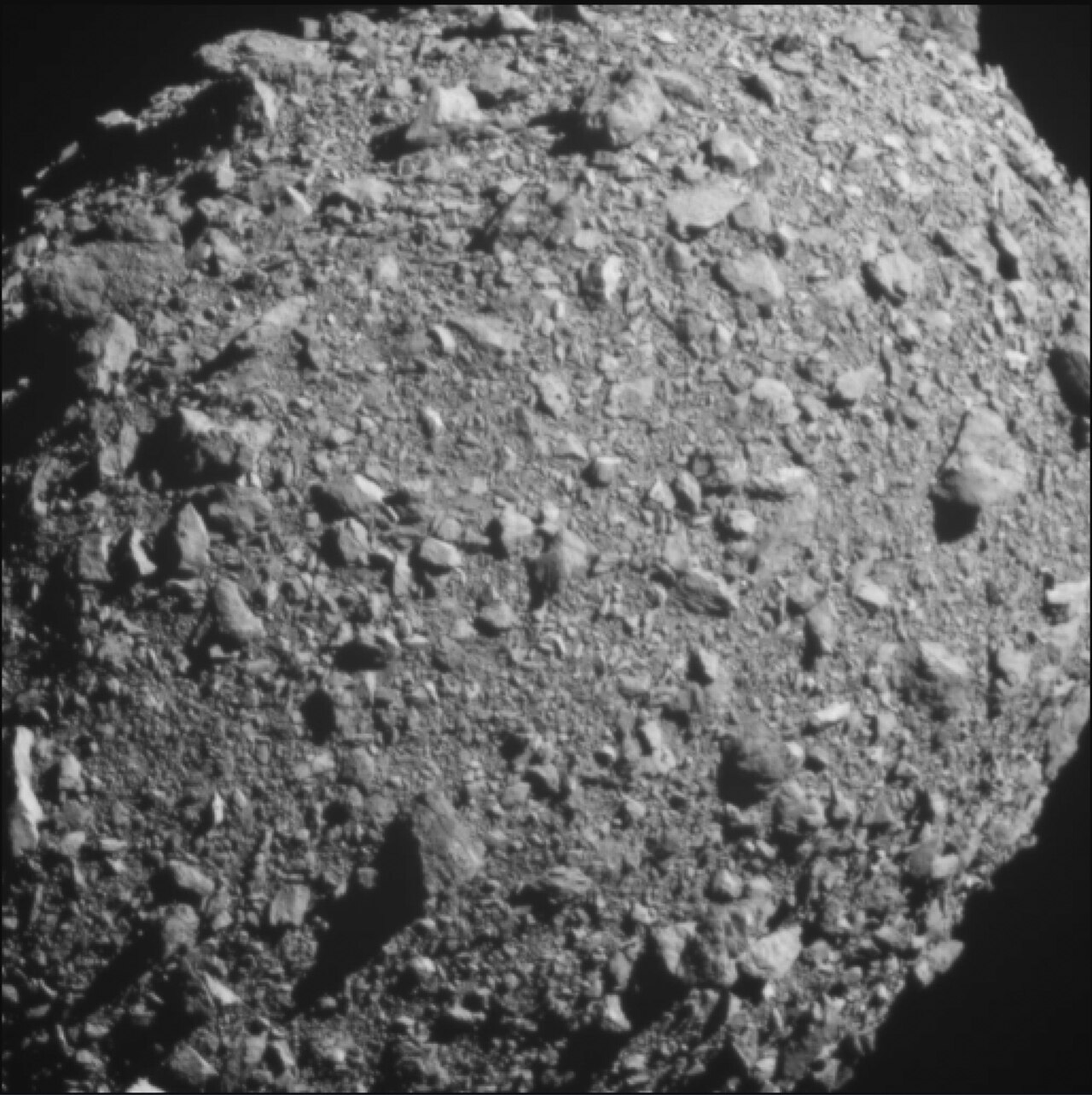
Via Wikimedia Commons: Dimorphos from DART aprox. 3 sec before impact by NASA/Johns Hopkins APL, public domain.
Sources
- NASA Science. "Asteroid Facts." science.nasa.gov/solar-system/asteroids/facts/ (read 23 November 2026)
- NSF–DOE Vera C. Rubin Observatory. "Early Data from NSF–DOE Vera C. Rubin Observatory Reveals Over 11,000 New Asteroids." 2 April 2026. rubinobservatory.org/news/11000-new-asteroids (read 23 November 2026)
- NASA Science. "Apophis." science.nasa.gov/solar-system/asteroids/apophis/ (read 23 November 2026)
- NASA Science. "2024 YR4." science.nasa.gov/solar-system/asteroids/2024-yr4/ (read 23 November 2026)
