New Hampshire is one of the original thirteen states of the United States, and the ninth to ratify the Constitution, the vote that put that document into effect.[2][3]
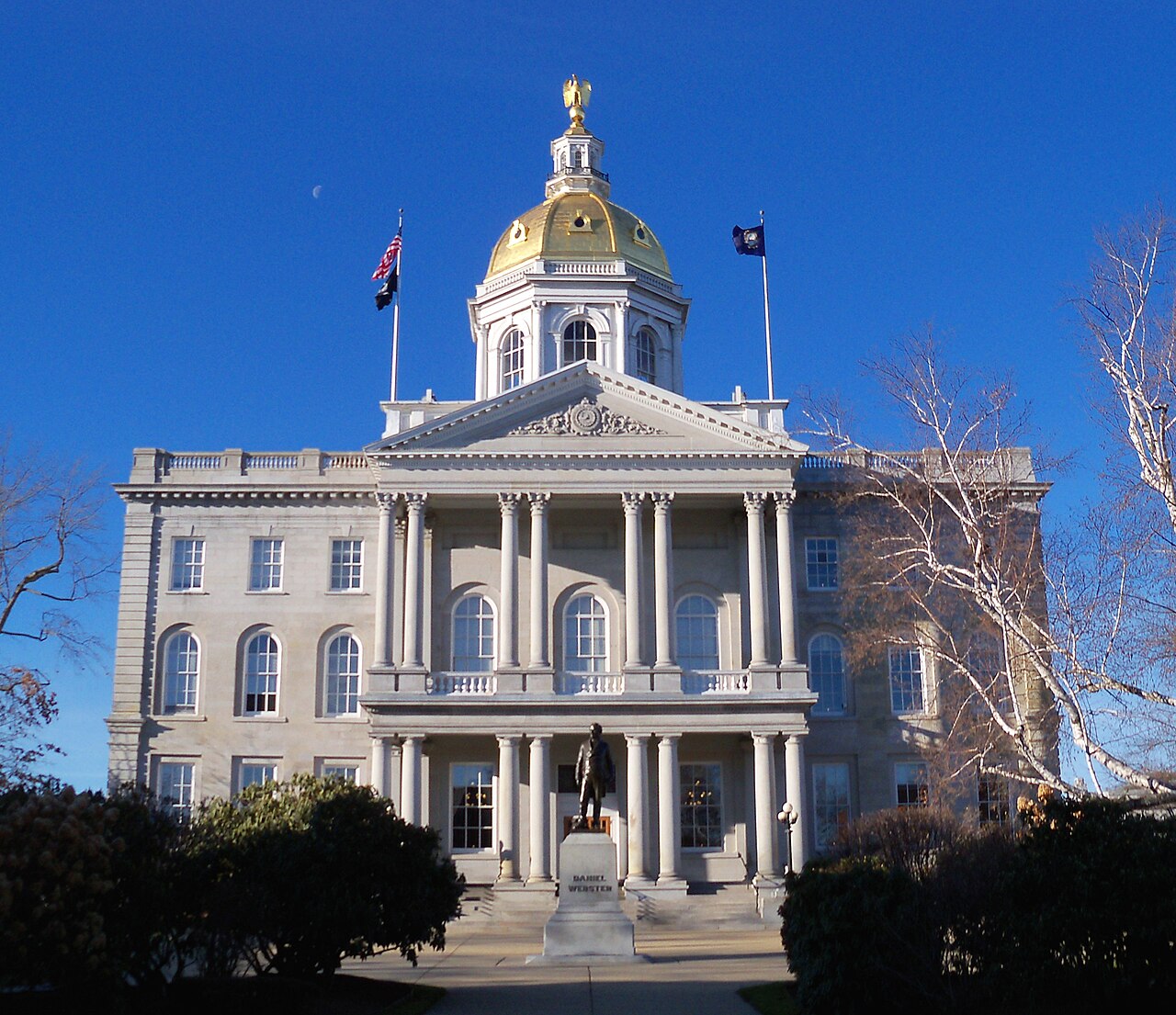
The New Hampshire State House in Concord, seat of the state legislature.
The name "New Hampshire" first appears in the record as a land grant: on 7 November 1629 the Council for New England granted John Mason "the territory to be called New Hampshire," lying between the Merrimack and Piscataqua rivers.[1] After the Council itself dissolved, no effective central government remained in the area, and on 14 June 1641 the settlers "voluntarily accepted Massachusetts jurisdiction," which brought all of New Hampshire under Massachusetts.[1]
On 18 September 1679 King Charles II made New Hampshire "a royal colony, separate from Massachusetts."[1] The arrangement did not last. On 17 May 1686 the arrival of the first royal governor of the Dominion of New England, a single province created in October 1685 by King James II, joined New Hampshire with Massachusetts, Maine and King's Province.[1] Then, on 1 March 1691 (1692 in the modern calendar), King William III and Queen Mary II commissioned a royal governor for New Hampshire, which effectively separated it from Massachusetts again.[1] Its jurisdiction ran from three miles north of the Merrimack River to the Piscataqua River, with no western limit specified.[1] On 5 August 1740 King George II settled the boundary between Massachusetts and New Hampshire substantially as it is today.[1]
Independence and the ratification of the Constitution
The chronology of boundaries records that on 4 July 1776 "New Hampshire became an independent state."[1]
New Hampshire sent John Langdon and Nicholas Gilman to the Constitutional Convention in Philadelphia, which finished its work on 17 September 1787.[3] Article VII of the Constitution required nine states to approve it before it took effect.[3] New Hampshire's ratifying convention opened in Exeter on 13 February 1788.[2] Opponents held a majority at that point, so supporters obtained an adjournment of about four months; the vote to adjourn was 56 to 51.[2][3]
The delegates reconvened in Concord in the middle of June 1788, and debated for about four days before voting. One source dates the reconvening to 17 June and another to 18 June.[2][3] On 21 June 1788 the convention approved the Constitution by 57 votes to 47.[2][3] New Hampshire thus became the ninth state to ratify, which made the Constitution legally operative.[2][3] The convention also recommended amendments focused on individual rights, nearly identical to those proposed by Massachusetts.[2]
Area
According to the Census Bureau's 2010 state area table, New Hampshire has a total area of 9,349 square miles (24,214 square kilometres), of which 8,953 square miles (23,187 square kilometres) is land and 397 square miles (1,027 square kilometres) is water.[4]
Population
The 2020 Census counted 1,377,529 residents in New Hampshire on 1 April 2020, against 1,316,470 in the 2010 Census, a gain of 61,059 people, or 4.6 percent.[5] The state kept its two seats in the U.S. House of Representatives, according to the apportionment results the Census Bureau announced on 26 April 2021.[5] Researchers at the University of New Hampshire's Carsey School put the 2010 to 2020 gain at about 61,000 residents and said it was smaller than the 6.5 percent growth of 2000 to 2010.[6] In their account, net migration, both from other states and from abroad, supplied 89 percent of the gain (about 54,500 people), while natural increase, births minus deaths, supplied only about 6,500.[6]
The first-in-the-nation presidential primary
In 1916 New Hampshire held its first statewide presidential primary, in which voters chose delegates rather than candidates.[10] In 1920 the state voted before all others, which began its tradition of holding the first primary.[10] A law passed in 1948 put the candidates' own names on the primary ballot in place of delegates.[10]
State law later gave the tradition legal force. Citizens Count, a New Hampshire civic-information group, dates to 1979 a law requiring the presidential primary to take place before all other states', and to 1999 a law giving the secretary of state the power to set the primary date to keep it ahead of the others.[10] The statute itself, RSA 653:9, lists 1979, 1995, 1999, 2007 and 2010 as the years it was enacted or amended, the latest amendment taking effect on 8 August 2010.[9] As the statute reads, the primary falls on the second Tuesday in March, or on an earlier date chosen by the secretary of state, which must be at least seven days before any other state's similar election; the earlier of the two dates applies.[9] The section states its purpose as protecting the state's tradition of holding the first-in-the-nation presidential primary.[9] Other accounts give different years for the first law, so only the dates in the statute's own history and in Citizens Count are used here.
State constitution and legislature
New Hampshire's present constitution was established on 31 October 1783 and took effect on 2 June 1784.[8] The National Constitution Center, which reproduces the 1784 document, says it replaced the state's earlier 1776 charter and is divided into a Bill of Rights and a Form of Government.[7]
In the text as in force in January 2019, the supreme legislative power is vested in a Senate and a House of Representatives (Part Second, Article 2), the Senate has 24 members (Article 25), and the House must have not fewer than 375 and not more than 400 members (Article 9).[8] That text reproduces the constitution as amended, and the page that hosts it says its own source document is unknown, so provisions that have changed since then are not captured here.
 Micwyn· EncyclopediaAI
· Updated · Version 3 · 6 min read · 0 comments · 0 views