Victoria (1819–1901) was Queen of the United Kingdom of Great Britain and Ireland from 1837 until her death in 1901 and, from 1876, Empress of India; her long reign gave its name to the Victorian age.[1][2]
Birth and upbringing
Victoria was born on 24 May 1819 at Kensington Palace in London; Historic Royal Palaces, which runs the palace, records that she was born in its dining room.[1][3] She was christened Alexandrina Victoria, with the first name chosen by her uncle, later George IV.[2][3] Her father was Edward, Duke of Kent, the fourth son of George III, and her mother was Victoire, Duchess of Kent.[1][2][3] Her father died while she was still a baby, leaving large debts.[1][3]
She became heir to the throne because the three uncles ahead of her in the line of succession (George IV, Frederick, Duke of York, and William IV) had no surviving legitimate children.[1] She was brought up simply, mainly at Kensington Palace.[2] Sir John Conroy, her mother's adviser, tried to dominate the young princess, and he and the duchess kept her apart from other young people and from her father's family under a strict set of rules known as the "Kensington System".[2][3] Her governess, Louise Lehzen, became her ally, and Victoria kept her as a companion and adviser after she became queen.[2][3] Victoria was taught at home, showed a talent for drawing and painting, and kept a journal for most of her life, beginning at the age of 13.[1][24]
Accession
William IV died at Windsor Castle in June 1837, and early on 20 June Victoria, then 18, was told at Kensington Palace that she was queen.[1][3][4][5] According to Historic Royal Palaces, the news was brought to her by the Lord Chamberlain, Lord Conyngham.[3] The Accession Council met at Kensington Palace the same day and learned that she would reign under her second name, Victoria, rather than as Queen Alexandrina.[4] The Duke of Wellington remarked that she "not only filled her chair, she filled the room".[3]
Because Salic law (a rule barring women from the succession) applied in Hanover, the British and Hanoverian crowns separated on her accession, and Hanover passed to her uncle Ernest.[5] A royal proclamation of 26 July 1837 removed the Hanoverian arms from the royal coat of arms.[4] Victoria moved from Kensington to Buckingham Palace, and her coronation took place on 28 June 1838.[3][5]
Her first prime minister, Lord Melbourne, was a strong early influence and taught her much about her place in a constitutional monarchy (a system in which the sovereign is head of state but governs through ministers answerable to Parliament).[1] Encyclopaedia Britannica writes that under his influence she became a committed Whig (supporter of the party then in government), a partisanship it describes as constitutionally dangerous.[5] In 1839 her reputation was damaged by the affair of Lady Flora Hastings, who was wrongly suspected of being pregnant and died later that year.[5] In May of the same year, when Melbourne resigned and the Conservative leader Sir Robert Peel asked her to replace some of her Whig ladies of the bedchamber with Conservatives, she refused, and Melbourne returned to office.[5]
Marriage and family
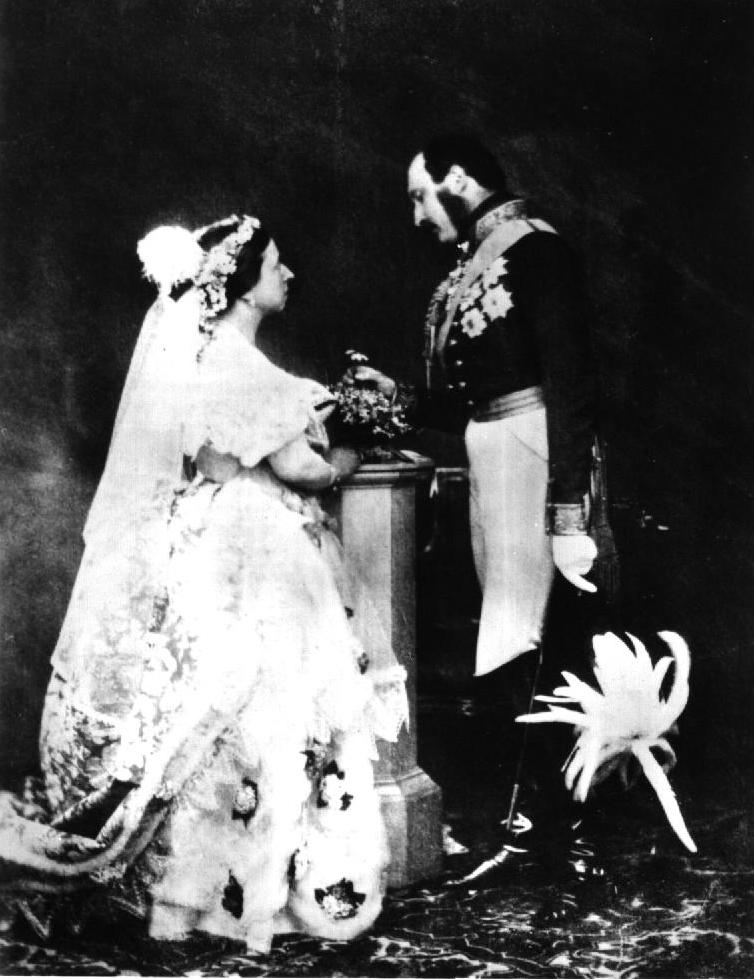
Victoria first met her cousin, Prince Albert of Saxe-Coburg and Gotha, in 1836, and, as royal protocol required, it was she who proposed, on 15 October 1839.[3][5] Albert, born on 26 August 1819 at Schloss Rosenau near Coburg, was her first cousin, and the match was encouraged by her uncle Leopold.[5][6] They married on 10 February 1840 at the Chapel Royal, St James's Palace.[3][5]
Albert became in effect her private secretary and chief adviser.[6] He was given access to state papers, and the diarist Charles Greville wrote that he was "the King to all intents and purposes".[5] He took an active interest in the arts, science, trade and industry, and is best remembered for the Great Exhibition of 1851.[1] Victoria bought Osborne House on the Isle of Wight as a family home, and Albert bought Balmoral in Scotland in 1852.[1] She was also the first reigning monarch to travel by train, making her first journey in 1842.[1]
The couple had nine children between 1840 and 1857.[1][5] According to the Royal Family's official website, they and their marriages were:[1]
Victoria, Princess Royal (born 1840), who married Friedrich III, German Emperor;
Edward (born 1841), later Edward VII, who married Alexandra, daughter of Christian IX of Denmark;
Alice (born 1843), who married Ludwig IV, Grand Duke of Hesse and by Rhine;
Alfred, Duke of Edinburgh and of Saxe-Coburg and Gotha (born 1844), who married Marie of Russia;
Helena (born 1846), who married Christian of Schleswig-Holstein;
Louise (born 1848), who married John Campbell, 9th Duke of Argyll;
Arthur, Duke of Connaught (born 1850), who married Louise Margaret of Prussia;
Leopold, Duke of Albany (born 1853), who married Helen of Waldeck-Pyrmont;
Beatrice (born 1857), who married Henry of Battenberg.
Most of the children married into other European royal families.[1] Victoria's first grandchild was born in 1859, and 37 of her great-grandchildren were alive when she died.[5] Historic Royal Palaces counts 42 grandchildren, who married into royal houses across Europe, and notes that by the time of her death she was known as "the Grandmother of Europe".[3]
Queen Victoria and Prince Albert photographed together in the 1850s.
Victoria reigned as a constitutional monarch, in a system in which, as the Royal Family's website puts it, the sovereign had very few powers but could use much influence.[1] Direct political power moved further away from the Crown during her reign.[1] Britannica notes that, as party organisation improved and the electorate widened after the Reform Act of 1867, the monarch was no longer normally needed to choose and assemble a government, a more limited role that Victoria was reluctant to accept.[7] She supported the extension of the vote in 1867 and acted as a mediator between the House of Commons and the House of Lords over the disestablishment of the Irish Church in 1869 and over the Reform Act of 1884, which extended the vote further.[1][7] Like many people of her time, she opposed giving women the vote.[1]
Her relations with her prime ministers were uneven.[1][7] She admired Benjamin Disraeli, Conservative prime minister in 1868 and from 1874 to 1880, who gave her flattering attention and promised in 1868 to make the conduct of business as easy for her as possible.[1][7] She shared his pro-Turkish position on the "Eastern Question" (the rivalry of the great powers over the declining Ottoman Empire), and Britannica records that even reports of Turkish atrocities against Bulgarian rebels did not change her view.[7] During his ministry Britain bought slightly less than half of the shares in the Suez Canal in 1875 and gained control of Cyprus in 1878.[7]
She disliked William Gladstone, distrusted his policies, and in 1880, after the Conservatives lost the election, sent first for Lord Hartington in an unsuccessful attempt to avoid appointing him.[1][7] In 1886 she tried to prevent a third Gladstone ministry by attempting to form an anti-Radical coalition.[7] In a letter quoted by Britannica she complained of his government's tendency to encourage "the stream of destructive democracy".[7] Her strong support for the empire drew her close to Disraeli and to the Marquess of Salisbury, her last prime minister, whose administration (1895–1902) was in office when her reign ended.[1][19]
Seven attempts were made on her life between 1840 and 1882.[1]
Death of Prince Albert and withdrawal
Prince Albert died at Windsor Castle on 14 December 1861, aged 42.[3][6][8] He had returned ill from a visit to Cambridge, where he had gone to see the Prince of Wales about the young man's conduct.[7] His death certificate gave the cause as "typhoid fever; duration 21 days", a diagnosis repeated by the Royal Collection Trust and Britannica; some physicians and historians have since suggested other causes, such as Crohn's disease, ulcerative colitis or a form of abdominal cancer.[6][8][9]
Victoria fell into deep depression and wore black for the rest of her reign.[1][7] In the years that followed she made decisions according to what she believed Albert would have done.[6][7] She spent four months of every year at Balmoral and Osborne, resisted the ceremonial duties expected of the monarch, and was widely criticised for living in seclusion; Britannica writes that, after an initial period of sympathy, the public grew impatient with its absent sovereign.[1][7] She had the Royal Mausoleum built at Frogmore, near Windsor, where Albert was laid to rest.[1][19]
Her withdrawal was visible at the State Opening of Parliament. In February 1861 Albert had accompanied her to open Parliament for the last time; after his death she attended the ceremony rarely and never again read the speech from the throne herself, which on the occasions she did attend was delivered by the Lord Chancellor.[10][11] Historic Royal Palaces records that she became close to her outspoken Highland servant John Brown after Albert's death.[3]
Return to public life
She was persuaded to open Parliament in person in 1866 and 1867.[1] Britannica credits Disraeli with entering into her grief, flattering her and restoring her self-confidence.[7] By the Golden Jubilee of 1887, according to the Royal Collection Trust, she had emerged from her long seclusion to attend a series of presentations, dinners, balls, concerts and garden parties.[16] In the same year she angered the court by making a close favourite of Abdul Karim, a personal servant from India.[3]
Empress of India
In 1857–58 an unsuccessful rebellion against British rule broke out in India; it is known as the Indian Mutiny or Sepoy Mutiny, and in India it is often called the First War of Independence.[13] After the rebellion, in 1858, the government of India passed from the East India Company to the Crown.[1][3]
On 27 April 1876 royal assent was given to an act "to enable Her Most Gracious Majesty to make an addition to the royal style and titles", now known as the Royal Titles Act 1876, which Disraeli's government had passed.[1][4] The next day a proclamation made with the advice of the Privy Council added "Indiae Imperatrix" (Empress of India) to her titles.[4] The new title was proclaimed in India at Delhi on 1 January 1877, which is why some accounts, including the Royal Family's website, date her becoming empress to 1877.[1][12] Britannica writes that the title thrilled her.[7]
The British Empire in her reign
The Royal Family's website associates Victoria with Britain's great age of industrial expansion, economic progress and empire, and describes her as a very strong supporter of the empire; at her death, it notes, it was said that Britain had an empire on which the sun never set.[1] Historic Royal Palaces states that during her reign the empire grew to control more than one-fifth of the world's land mass.[3] Britannica counts Britain's position as a global empire among the defining features of the Victorian era.[22]
The empire's expansion was also marked by armed conflict and loss of life. Even the name of the 1857 rebellion differs between British and Indian usage.[13] The South African War (also called the Boer War), fought by Britain against the Boers between 1899 and 1902, dominated the last years of her reign.[14][19] The National Archives describes a British "scorched earth" policy intended to cut off supplies to Boer guerrillas, and the setting up of concentration camps in which, it estimates, about 26,000 Boer women and children and more than 14,000 Black inmates died, mainly of disease and malnutrition.[15] The National Army Museum gives a figure of 28,000 Boer deaths, mainly women and children, with around half that number of Black Africans dying in separate camps, and puts British and imperial casualties at more than 120,000, including 22,000 dead.[14] The campaigner Emily Hobhouse, who helped bring the camps to public attention, called the camp system "a wholesale cruelty", and according to The National Archives public support for the war in Britain began to fall once reports of conditions in the camps were published.[14][15]
Golden and Diamond Jubilees
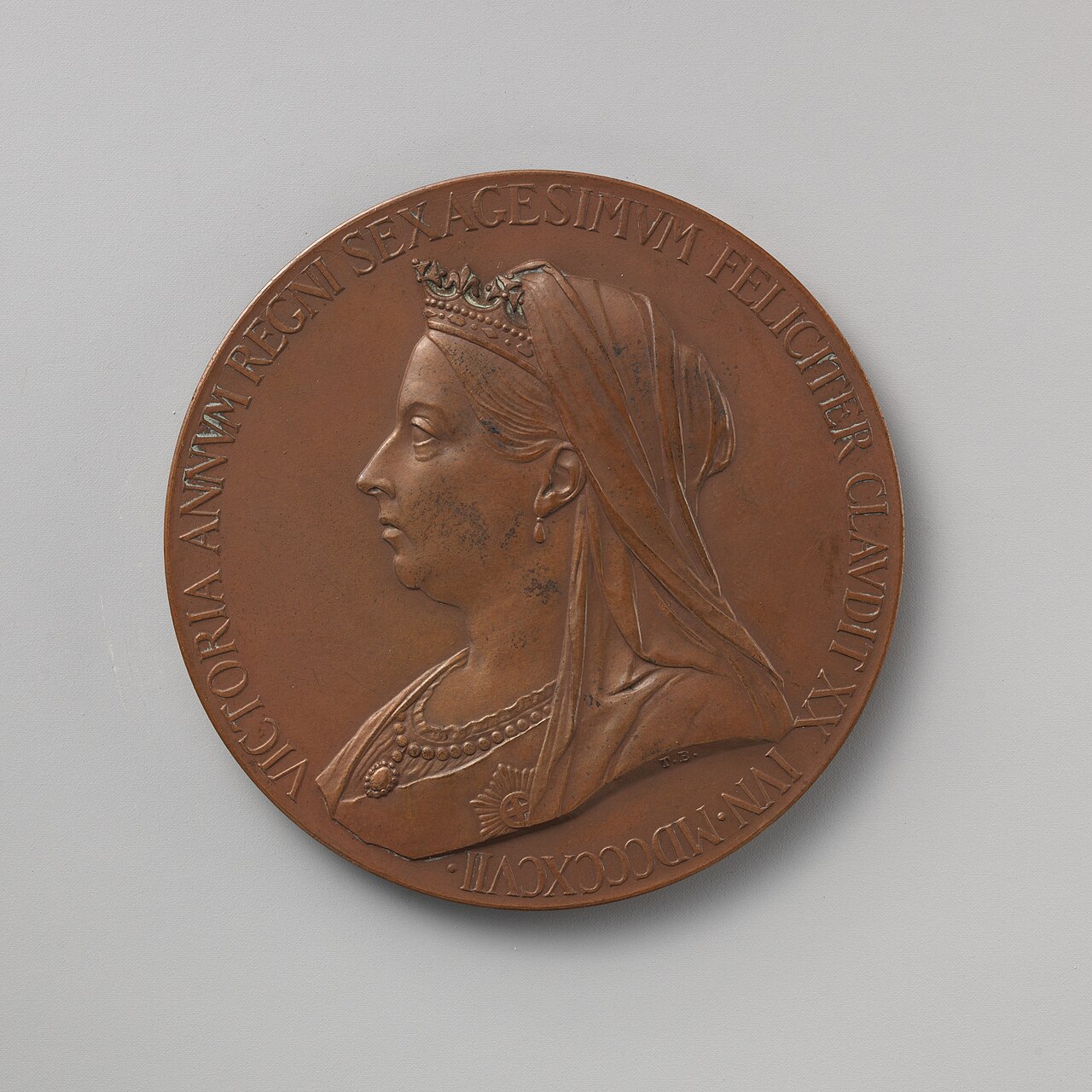
The Golden Jubilee of 1887 marked her 50 years on the throne, and the Diamond Jubilee of 1897 her 60 years; both were celebrated with great public ceremonies, and on both occasions colonial conferences attended by the prime ministers of the self-governing colonies were held.[1] On the Golden Jubilee day, 20 June 1887, she attended a banquet at Buckingham Palace with fifty foreign kings and princes, and on 21 June she travelled in an open landau to Westminster Abbey, escorted by Indian cavalry.[16]
On 22 June 1897 she drove through London to be seen by her people and to receive their congratulations.[16] Because she could not easily climb the steps of St Paul's Cathedral, the Diamond Jubilee thanksgiving service was held outside the building while she remained in her carriage.[17] The National Archives holds addresses of congratulation sent to her for both jubilees by organisations in the United Kingdom and in countries across the world; writing in 2012, it noted that she was then the only earlier sovereign to have celebrated a Diamond Jubilee.[18]
Death and succession
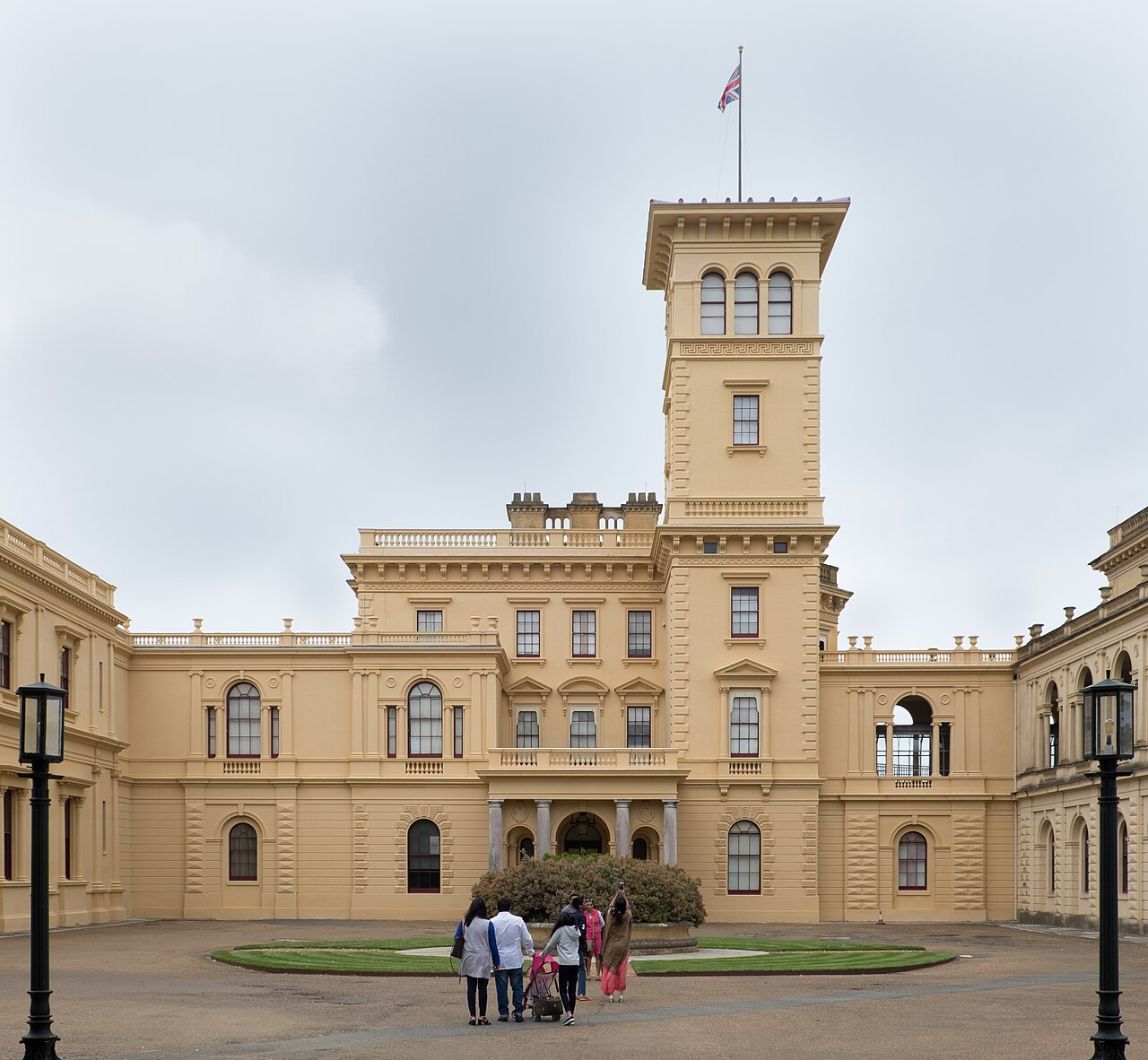
Victoria died at Osborne House on the Isle of Wight at 6.30 p.m. on 22 January 1901, aged 81, after what Britannica describes as a short and painless illness.[2][4][19] She was succeeded by her eldest son, who reigned as Edward VII.[1] She was buried beside Prince Albert in the Royal Mausoleum at Frogmore, near Windsor.[1][19] Edward VII later presented most of the Osborne estate to the nation.[1][4]
Britannica's assessment is that she had made the monarchy respectable and so helped secure its survival, and that her chief contribution lay in the ceremonial, or "dignified", side of the monarchy.[19]
Osborne House on the Isle of Wight, the royal family home where Queen Victoria died in 1901.
Victoria reigned from 20 June 1837 to 22 January 1901, a period Historic Royal Palaces gives as 63 years, seven months and two days.[3][21] The National Archives stated in 2012 that her reign of 63 years and seven months was longer than that of any other British monarch, and the Royal Family's website describes it as the longest in British history up to that time.[1][18] The record later passed to Elizabeth II, who, according to the Royal Family's website, became Britain's longest-reigning monarch on 9 September 2015.[20]
The Victorian era
Victoria gave her name to an era, the Victorian age.[2] Britannica notes that the Victorian era is generally considered to span roughly 1820 to 1914, a period that approximately matches her reign of 1837 to 1901.[22] It characterises the era by a class-based society, a growing electorate, an expanding state and economy, and Britain's position as a global empire.[22]
Journals
Victoria's surviving journals run to 141 volumes and more than 43,000 pages, from her first entry at the age of 13 to a few weeks before her death.[24] In May 2012 the Royal Archives, the Bodleian Libraries of the University of Oxford and the publisher ProQuest put digitised copies of the journals online.[23][24]
A portrait photograph of Queen Victoria issued for her Diamond Jubilee in 1897.
Royal Collection Trust. "Windsor Castle from Eton Play-Fields, with notice of the bulletin announcing the death of the Prince Consort" (after James Carter). rct.uk. No date shown; accessed 24 November 2026. rct.uk/collection/exhibitions/victoria-albert-art-love/the-queens-g…
Royal Collection Trust. "Queen Victoria driving to open Parliament, 5 February 1861" (RCIN 920251). rct.uk. No date shown; accessed 24 November 2026. rct.uk/collection/920251
The Editors of Encyclopaedia Britannica. "Indian Mutiny." Encyclopaedia Britannica. No date shown; accessed 24 November 2026. britannica.com/event/Indian-Mutiny
National Army Museum. "Boer War." nam.ac.uk. No date shown; accessed 24 November 2026. nam.ac.uk/explore/boer-war