George VI (1895–1952) was King of the United Kingdom from December 1936, when his elder brother Edward VIII abdicated, until his death in February 1952; his reign covered the Second World War and the early years of the modern Commonwealth.[1][2]
Birth and early life
He was born on 14 December 1895 on the Sandringham estate in Norfolk, the second son of the future King George V and of Queen Mary.[2][3] His full name was Albert Frederick Arthur George, and until he became king he was known as Prince Albert; his family called him Bertie.[3][5] Because his elder brother Edward stood ahead of him in the line of succession, he was not expected to become king.[1]
From childhood he had a severe stammer (a speech disorder in which the flow of words is broken by repeated or prolonged sounds and blocks).[2] His grandson, the then Prince of Wales, said in a 2017 speech that the stammer cut him off in many ways from his parents, brothers and sisters, and left him with a fear of feeling different from others.[11]
Naval and air service
Prince Albert entered the Royal Naval College at Osborne at the age of 13 and went on to the college at Dartmouth.[4][5] In September 1913 he was commissioned as a midshipman (a junior officer in training) in the battleship HMS Collingwood, and he was still serving in her when the First World War began in 1914.[4][5] Britannica dates his service in the Royal Navy from 1913 to 1917.[2]
He was aboard Collingwood at the Battle of Jutland on 31 May and 1 June 1916, fought off the coast of Denmark and the largest naval battle of the war.[4] Royal Family sources describe him as a sub-lieutenant at the time of the battle.[5][19] In his own account, kept in the Royal Archives, he described being stationed in the ship's forward ("A") turret and following much of the action through a telescope; early in the fighting he had been sitting on top of the turret when a German salvo straddled the ship, and he quickly climbed back inside.[4] He was mentioned in dispatches (named in an official report for good service) for his part in the battle, and the Royal Family notes that he is the only British sovereign to have seen action in battle since William IV.[5][6]
In January 1918 he transferred to the Royal Naval Air Service and was posted to its training establishment at Cranwell in Lincolnshire.[5] There he was appointed Officer in Charge of Boys in February 1918 and later commanded No. 4 Squadron of the Boys' Wing, leaving Cranwell in August 1918.[7] When the Royal Air Force was formed in April 1918 he transferred to it.[6] In February 1919 he was sent to No. 29 Training Squadron at Croydon for flying instruction, and he qualified for his pilot's wings on 31 July 1919, though his royal status meant he was not allowed to fly solo.[6] The Royal Family describes him as the first member of the royal family to hold a pilot's licence.[5] He then studied at Trinity College, Cambridge, in 1919–20.[2]
Duke of York and marriage
On 3 June 1920 he was created Duke of York.[2] He sponsored the annual Duke of York's Camp, held from 1921 to 1939.[2]
His engagement to Lady Elizabeth Bowes-Lyon was announced in January 1923, and they were married on 26 April 1923 in Westminster Abbey.[3][8] They had two daughters: Princess Elizabeth, born on 21 April 1926 at 17 Bruton Street, the London home of her mother's parents, the Earl and Countess of Strathmore; and Princess Margaret, born on 21 August 1930 at Glamis Castle in Scotland.[8]
The stammer and Lionel Logue
The Duke's stammer made public speaking an ordeal.[2][11] He was treated by Lionel Logue, an Australian speech therapist; according to the Prince of Wales's 2017 account, Logue's aim was to persuade the patient that people who stammer are entirely normal people with a normal complaint, and the therapy enabled the King to overcome the condition.[11] Britannica presents his long effort to master the stammer as an example of his determination.[2] Their relationship is the subject of the 2010 film The King's Speech, which ends with the King's live radio address of 3 September 1939, the day Britain entered the Second World War.[2]
Accession and coronation
Edward VIII, who had reigned since January 1936, chose to give up the throne so that he could marry Wallis Simpson, an American who had been divorced twice and would not have been accepted as queen.[9] Edward signed an Instrument of Abdication on 10 December 1936.[9][10] It took legal effect the next day, 11 December, when His Majesty's Declaration of Abdication Act 1936 received royal assent; the Act provided that there should be a "demise of the Crown" (the passing of the throne to the next heir) and excluded Edward and any children he might have from the succession.[9][10] The Duke of York therefore became king on 11 December 1936 and was proclaimed the following day.[2] He took the name George, the last of his given names, rather than reigning as Albert.[3][9] His wife became the first British-born queen consort since Tudor times.[8]
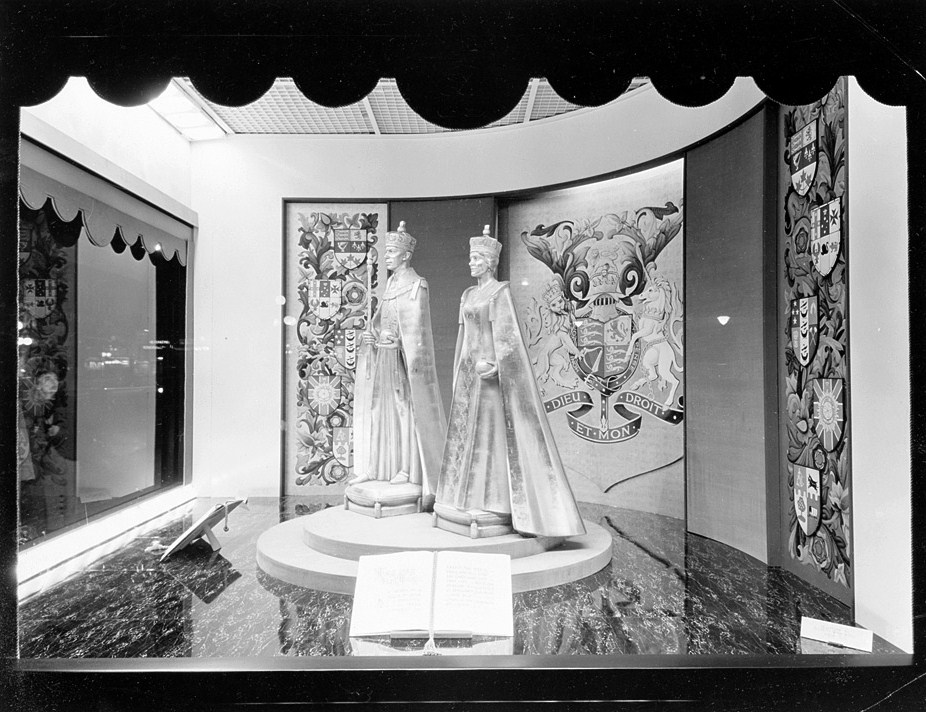
The coronation of George VI and Queen Elizabeth took place in Westminster Abbey on 12 May 1937, the date that had already been fixed for Edward VIII's coronation.[2][3] The service was conducted by the Archbishop of Canterbury, Cosmo Gordon Lang.[3] Westminster Abbey records some small mishaps during the ceremony; the Archbishop, for example, believed that the Dean had handed him St Edward's Crown the wrong way round.[3]
The King made state visits to France in 1938 and to Canada and the United States in 1939; he was the first British monarch to enter the United States.[1]
King George VI and Queen Elizabeth on the day of their coronation, 12 May 1937.
When war came in 1939, the King and Queen stayed in Britain rather than moving the family to the safety of Canada.[2] When it was suggested that the princesses be sent away, the Queen replied that the children would not go without her, that she would not leave the King, and that the King would never leave.[8] The King spent most of the war at Buckingham Palace, which was bombed nine times.[1][12] He and the Queen were in the palace during several of these raids, including the attack of 13 September 1940, at the height of the Blitz (the German air raids on British cities).[8][12] The raids caused considerable damage to the palace chapel and destroyed the North Lodge, where a policeman was killed by flying debris.[12] Writing to his mother the next day, the King said the aircraft had been seen flying along the Mall before it released its bombs and that it had certainly been a direct attack meant to destroy the palace.[12] A Royal Family account of the raid, drawing on the Royal Archives, reproduces his recollection that the whole thing happened in a matter of seconds.[20]
The King and Queen visited badly bombed areas, including the East End of London and other parts of the country.[1][8] On 24 September 1940 the King instituted the George Cross, a new award for outstanding bravery shown away from the heat of battle, chiefly by civilians, and announced that it would rank next to the Victoria Cross; the George Medal was created at the same time.[1][13][14] The first names of George Cross recipients were published in the London Gazette on 30 September 1940.[13] In 1942 the King awarded the George Cross to the island and people of Malta.[1][13]
The King worked closely with Winston Churchill, who became prime minister in May 1940, and supported his wartime leadership without reservation.[1][2] He visited his forces on several fronts: France in 1939, to inspect the British Expeditionary Force; North Africa in 1943, after the victory at El Alamein; the Normandy beaches in June 1944, ten days after D-Day; and Italy and the Low Countries later in 1944.[1][2] On VE Day, 8 May 1945, Buckingham Palace was a focal point of the victory celebrations.[1]
Post-war years and the Commonwealth
Wartime shortages continued well into the post-war years, and the period also saw the start of the Cold War.[1] In 1947 the King made a major tour of South Africa with the Queen and both princesses, the first time a monarch had toured with his family.[1]
When India and Pakistan became independent in 1947, George VI ceased to be Emperor of India.[1][2] The title was formally removed from the royal style by a proclamation dated 22 June 1948, which ordered that the words "Emperor of India" (in Latin, "Indiae Imperator") be dropped from the King's titles.[15] Soon after independence, India said it wished to adopt a republican constitution while remaining in the Commonwealth.[16] The London Declaration of 1949 made this possible by recognising the King as the symbol of the free association of the independent member nations and, as such, Head of the Commonwealth.[16] Britannica dates his formal recognition as head of the Commonwealth to 27 April 1949.[2] Britannica judges that his reign was perhaps most important for the faster evolution of the British Empire into the Commonwealth and for Britain's post-war transformation into a welfare state (a system in which the state provides health care, social insurance and other benefits).[2]
Illness, death and succession
The King's health declined from 1948, under the strain of the war and the post-war years.[1][2] In 1952 illness forced him to give up a planned Commonwealth tour, and Princess Elizabeth and her husband, Prince Philip, left London Airport on 31 January 1952 to undertake it in his place.[17] He had an operation on his lung, from which he did not recover; Britannica describes the operation as one for lung cancer.[1][2] He died in his sleep at Sandringham House in Norfolk on 6 February 1952, aged 56.[1][2][8]
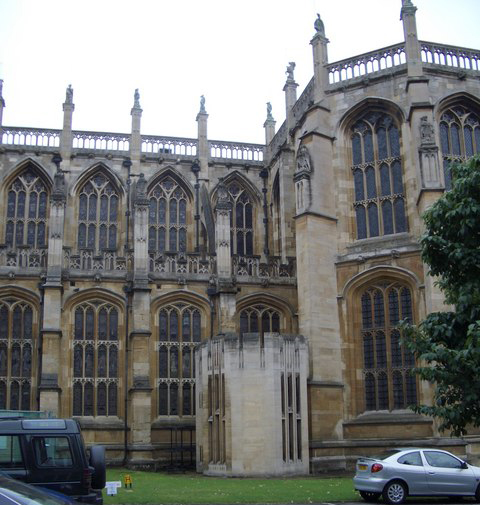
His elder daughter learned of his death, and of her own accession as Elizabeth II, while on an official visit to Kenya.[17] The King's coffin lay in state in Westminster Hall, where 305,806 people filed past.[3] His funeral took place at St George's Chapel, Windsor Castle, on 15 February 1952, and he was laid in a vault there.[1][3] On the government's wreath, Churchill wrote "For Valour", the words inscribed on the Victoria Cross.[1] In 1969 his remains were placed in the King George VI Memorial Chapel at St George's, where Queen Elizabeth The Queen Mother, Princess Margaret, Prince Philip and Queen Elizabeth II were later also buried.[18]
The King George VI Memorial Chapel at St George's Chapel, Windsor Castle, where the King has lain since 1969.
The Royal Family. "George VI (r.1936-1952)". royal.uk. No date shown; accessed 24 November 2026. royal.uk/george-vi
The Editors of Encyclopaedia Britannica. "George VI". Encyclopaedia Britannica. No date shown; accessed 24 November 2026. britannica.com/biography/George-VI
The Royal Family. "Edward VIII (Jan-Dec 1936)". royal.uk. No date shown; accessed 24 November 2026. royal.uk/edward-viii
UK Parliament. "His Majesty's Declaration of Abdication Act 1936" (1936 c. 3), as enacted, 11 December 1936. legislation.gov.uk. Accessed 24 November 2026. legislation.gov.uk/ukpga/Edw8and1Geo6/1/3/enacted
The Royal Family. "The 80th anniversary of bombing of Buckingham Palace during the Blitz". Everyday Exceptional, royal.uk. No date shown (marks the 80th anniversary, 13 September 2020); accessed 24 November 2026. everydayexceptional.royal.uk/80th-anniversary-bombing-buckingham-pa…