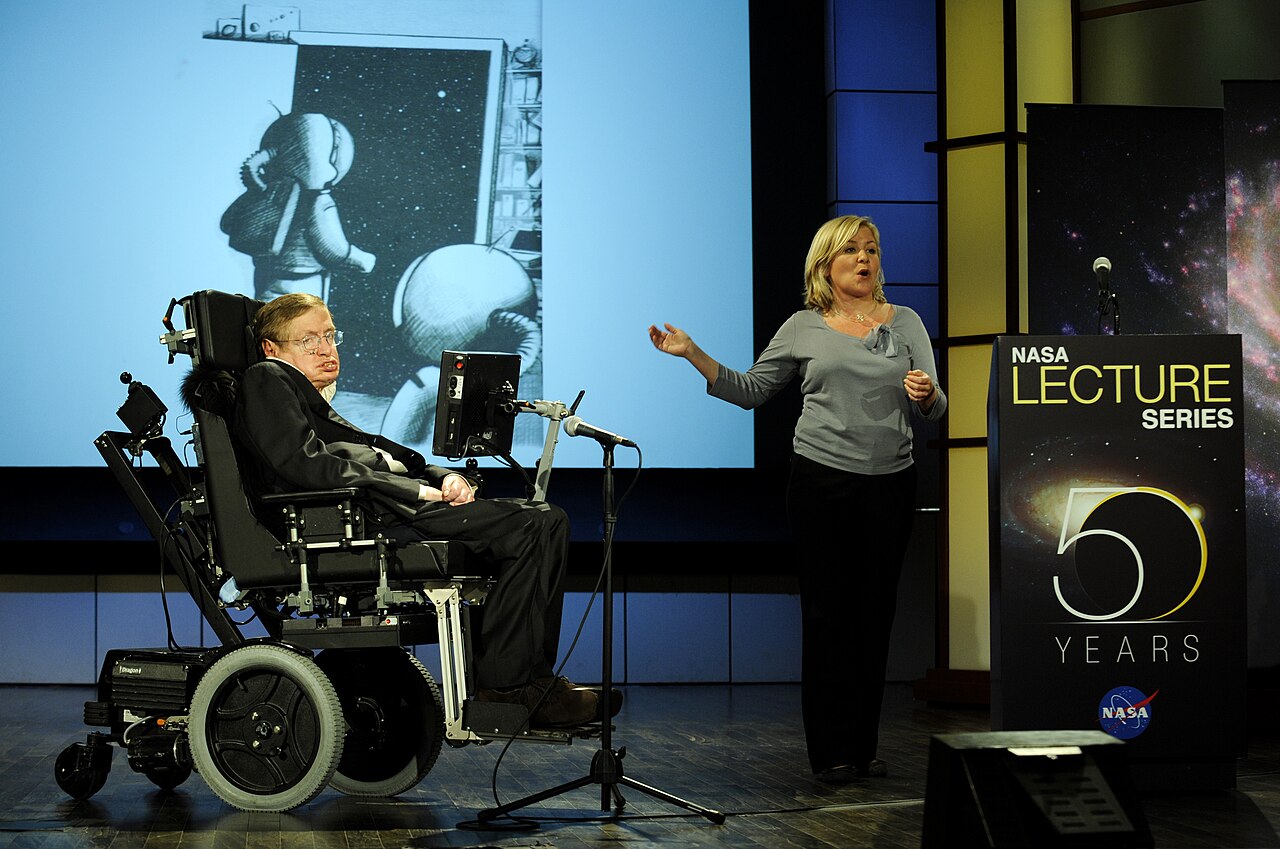
English theoretical physicist and cosmologist (1942–2018), known for his work on black holes and the origin of the universe and for A Brief History of Time
Stephen Hawking (1942–2018) was an English theoretical physicist at the University of Cambridge who showed that black holes should give off radiation and who held the Lucasian Professorship of Mathematics from 1979 to 2009.[1][4][5]
Early life and education
Stephen William Hawking was born in Oxford on 8 January 1942.[1][2][4] When he was eight his family moved to St Albans, and he later attended St Albans School.[3] He passed the entrance examination for University College, Oxford, at the age of 17, although his headmaster had thought him too young to sit it.[2] He wanted to study mathematics, which University College did not offer, so he took physics instead and was awarded a first-class honours degree in natural science.[3] The Royal Society's memoir of his life records that his examination results put him on the border between a first and a second, and that he was given the first after an interview with the examiners.[2] Britannica dates his Oxford bachelor's degree to 1962.[4]
In the autumn of 1962 he went to Trinity Hall, Cambridge, for research in cosmology (the study of the universe as a whole).[2][3] He had hoped to work with the astronomer Fred Hoyle, who could not take him on, and he was supervised instead by Dennis Sciama.[2] His doctoral thesis, Properties of Expanding Universes, was approved on 1 February 1966, and he received his PhD from Trinity Hall that year.[2][4] The Science Museum Group describes the thesis as giving crucial support to the big-bang theory, the theory that the universe expanded from an extremely hot, dense early state.[13] He also received an "auxiliary" Adams Prize for an essay on singularities and the structure of space-time.[2]
He became a Research Fellow of Gonville and Caius College, Cambridge, in 1965, and later a Professorial Fellow; he remained a Fellow of the college for more than 52 years.[3][6][7] He was also an Honorary Fellow of Trinity Hall.[5]
Motor neurone disease
Shortly after his 21st birthday, in early 1963, Hawking was diagnosed with an incurable illness that was later identified as motor neurone disease, specifically amyotrophic lateral sclerosis (ALS).[2] Britannica describes ALS as an incurable degenerative neuromuscular disease, meaning one in which the nerves that control the muscles steadily waste away.[4] His doctors expected that he probably had only two years to live.[2][6] Gonville and Caius College notes that his arrival there as a Fellow came two years after that prognosis.[6]
The illness progressed over the following years. By the late 1970s he had almost no movement left, and his speech could be understood by only a very few family members and colleagues.[2] While in Switzerland in 1985 he caught pneumonia, and a tracheotomy (a surgical opening into the windpipe to help breathing) was needed to save his life.[2] Gonville and Caius College has recalled paying for his flight back to the United Kingdom from Switzerland when he urgently needed medical help.[6] The tracheotomy took away his ability to speak, and from then on he communicated through a computerised speech synthesiser.[2] According to the memoir, the progression of the disease seemed almost to stop after 1985.[2] He remained active in research for more than three decades after the operation, until his death in 2018.[1][2]
Positions at Cambridge
Hawking left the Institute of Astronomy at Cambridge in 1973.[3] His 1975 paper on particle creation by black holes gives his address as the Department of Applied Mathematics and Theoretical Physics (DAMTP) at Cambridge, together with the California Institute of Technology in Pasadena.[14] He became professor of gravitational physics at Cambridge in 1977.[4]
In 1979 he was appointed Lucasian Professor of Mathematics, the chair once held by Isaac Newton; the Royal Society memoir counts him as the 17th holder.[1][2][4] He held the chair until 2009.[1][3][6] After that he held a special research professorship endowed by the Avery-Tsui Foundation.[2]
In 2007 he founded the Centre for Theoretical Cosmology within DAMTP, and he was its Director of Research until 2014; from then on his title was the Dennis Stanton Avery and Sally Tsui Wong-Avery Director of Research.[1] The Kavli Institute for Cosmology at Cambridge records that he supported its creation and later helped to expand its research on gravitational waves, a field in which it calls him a pioneer.[1] In 2008 he also took up a visiting research chair at the Perimeter Institute for Theoretical Physics in Waterloo, Ontario.[4]
His physics, explained plainly
Hawking worked mainly on gravity, black holes and the origin of the universe.[2][4] Much of this work rests on Albert Einstein's general theory of relativity, which describes gravity as a curving of space-time, the combination of space and time: massive objects curve space-time much as a heavy ball makes a dip in a stretched sheet of fabric.[20] A black hole is a region where gravity is so strong that nothing can get out once it has crossed the boundary called the event horizon, the black hole's "point of no return."[19] At its centre, general relativity predicts a singularity, where the laws of physics as currently understood stop working.[19]
Singularity theorems
In the 1960s Hawking, the mathematician Roger Penrose and others proved a series of "singularity theorems."[2] In 1970 the two published a joint theorem in the Proceedings of the Royal Society.[10] It showed that, given Einstein's equations, a reasonable condition on the energy of matter and a few other general assumptions, singularities must form in several situations: if the universe is spatially closed, if a collapsing object forms a "trapped surface" (a sign of runaway gravitational collapse), or if enough matter lies in the past of an observer.[10] In plain terms, Einstein's theory implies that space and time had a beginning in the Big Bang and would come to an end inside black holes.[3] The memoir puts it this way: the theorems showed that the classical (non-quantum) Einstein equation implies the universe began in a hot big bang, and that the equation itself breaks down at that beginning.[2] Hawking argued that this made it necessary to combine general relativity with quantum theory, the physics of atoms and subatomic particles.[3]
The area theorem
In 1971 Hawking derived what is now called his area theorem: the area of a black hole's event horizon can never decrease.[12] One consequence is that when two black holes merge, the surface area of the new black hole's horizon must be at least as large as the combined areas of the two original horizons.[12] In the same year he published a paper on colliding black holes showing that there is an upper limit to the energy that can be carried away as gravitational radiation when one collapsed object captures another.[11]
The theorem closely resembles the second law of thermodynamics, which says that the entropy, or degree of disorder, of an isolated system never decreases.[2][12] In 1972 the physicist Jacob Bekenstein suggested that a black hole's entropy is proportional to the area of its horizon.[2] In 2021 a team led by researchers at the Massachusetts Institute of Technology reanalysed the first gravitational-wave signal detected by the LIGO observatory, GW150914, which came from two merging black holes in 2015, and found with 95 per cent confidence that the total horizon area did not decrease, the first observational test of the theorem.[12]
Hawking radiation
Hawking's best-known result came in 1974, in a short letter to Nature titled "Black hole explosions?".[13] Before then, black holes were thought to be completely black: in the classical theory they can only take in matter and radiation.[14] By applying quantum theory to matter near a black hole, Hawking found that black holes should instead emit particles steadily, as if they were hot bodies, at a temperature set by the strength of gravity at the horizon.[14] This emission is now called Hawking radiation.[1] He set out the full calculation in "Particle creation by black holes", published in Communications in Mathematical Physics in 1975.[14]
The radiation carries energy away, so the black hole slowly loses mass and should eventually evaporate and disappear.[3][14] NASA's educational explanation describes the radiation as coming from just outside the event horizon, with particles of negative energy falling into the black hole and reducing its mass, so that over a long enough time the black hole "evaporates."[18] In Hawking's formula the temperature is inversely proportional to the black hole's mass, so smaller black holes are hotter.[2] Hawking calculated that any very small black holes formed in the early universe with masses below about 10^15 grams (roughly a billion tonnes) would have evaporated by now.[14] The Science Museum Group summarises the 1974 paper as having overturned the conventional idea that nothing can ever escape from a black hole.[13]
The work also tied black holes to thermodynamics.[12] It gave black holes a definite temperature and entropy, and Hawking showed that although the radiation lets the horizon area shrink, a "generalised second law" still holds: the entropy of the matter outside the black hole plus one quarter of the horizon area never decreases.[2][14] MIT News describes this as Hawking reconciling the area theorem with the idea that black holes have entropy and give off radiation over very long periods once quantum effects are taken into account.[12]
The information paradox
Hawking radiation led to a puzzle that occupied Hawking for the rest of his life.[2] In a 1976 paper in Physical Review D, "Breakdown of predictability in gravitational collapse", Hawking argued that when a black hole forms and then evaporates, information about what fell in is lost, so the final state can only be described statistically (as what physicists call a "mixed state," described by a density matrix) rather than by a single definite quantum state.[15] He argued that this was a fundamental limit on predicting the future, beyond the ordinary uncertainty of quantum theory.[15] The conflict between quantum mechanics and this picture of black hole evaporation is known as the black hole information paradox.[2]
According to the Royal Society memoir, Hawking wrestled with the paradox on and off for about forty years and eventually became convinced that the quantum-mechanical picture is correct, so that information is not destroyed; he was persuaded by a later theoretical framework known as the AdS/CFT correspondence.[2]
The no-boundary proposal
Hawking also applied quantum theory to the beginning of the universe.[2] At a conference at the Vatican in 1981 he suggested that the universe began with a geometry in which time behaved like a fourth direction of space, which then made a quantum transition to the ordinary space-time in which time is distinct from space.[2][16] He developed the idea with the American physicist James Hartle, and they published it in 1983 in Physical Review D as "Wave function of the Universe".[16][17] The paper gave a mathematical rule for the most basic quantum state of a closed universe.[17]
The name "no-boundary" reflects the central idea: the geometries included in the calculation have no boundary other than the single three-dimensional state of the universe being described, so there is no separate starting edge at which special conditions have to be imposed.[16] The Centre for Theoretical Cosmology summarises Hawking's conjecture as a universe that has no edge or boundary in "imaginary time" (a mathematical treatment in which time is handled like a direction of space), which would mean that the way the universe began was determined entirely by the laws of science.[3][16]
A Brief History of Time and public life
Hawking became widely known far beyond physics.[6] His popular book A Brief History of Time, published in 1988, became a best seller; according to the Royal Society memoir it was translated into some 35 languages and sold more than 10 million copies in the following 20 years.[2][4] He wrote it in a college house that Gonville and Caius had adapted for him.[6] His other popular books include Black Holes and Baby Universes and Other Essays, The Universe in a Nutshell and The Grand Design (2010).[3] With colleagues he also wrote or edited technical books, including The Large Scale Structure of Space-Time with George Ellis.[3] On his death the Master of Gonville and Caius College, Sir Alan Fersht, called him the most famous scientist since Einstein.[6]
Hawking was elected a Fellow of the Royal Society in 1974, at the unusually early age of 32.[2][4] He was made a Commander of the Order of the British Empire (CBE) in 1982 and a Companion of Honour (CH) in 1989.[3][4] The Royal Society awarded him its Hughes Medal and its Copley Medal, the latter in 2006.[1][4] He also received the Wolf Prize, the US Presidential Medal of Freedom (2009) and the Fundamental Physics Prize.[1][3][4][5] He was a member of the US National Academy of Sciences, and the Centre for Theoretical Cosmology's biography credits him with twelve honorary degrees.[3] Westminster Abbey lists the letters after his name as CH, CBE, FRS and FRSA.[8]
Death and burial
Hawking died at his home in Cambridge on 14 March 2018, aged 76.[1][5][6] His children, Lucy, Robert and Tim, issued a statement describing him as a great scientist and an extraordinary man.[6] A private funeral was held on 31 March 2018 at Great St Mary's, the University Church in Cambridge.[7]
On 15 June 2018 a Service of Thanksgiving for his life was held in Westminster Abbey, conducted by the Dean of Westminster, John Hall, during which his ashes were interred in the nave between the graves of Sir Isaac Newton and Charles Darwin.[8] The address was given by the Astronomer Royal, Lord Rees of Ludlow, and readings included one by his daughter Lucy Hawking and one by the astronaut Tim Peake.[8] His formula for the temperature of a black hole is engraved on the stone over his grave.[2]
At the moment his ashes were interred, the European Space Agency's ground station at Cebreros in Spain transmitted a piece of music by the composer Vangelis, featuring Hawking's voice, towards 1A 0620–00, the nearest known black hole to Earth.[9] ESA's Director of Science said the signal would take about 3,500 years to arrive.[9]
Bernard Carr, George F. R. Ellis, Gary Gibbons, James Hartle, Thomas Hertog, Roger Penrose, Malcolm Perry and Kip S. Thorne. "Stephen William Hawking: A Biographical Memoir". Preprint of the memoir for Biographical Memoirs of Fellows of the Royal Society. arXiv:2002.03185, February 2020; accessed 25 November 2026. arxiv.org/pdf/2002.03185
Centre for Theoretical Cosmology, DAMTP. "Stephen Hawking". University of Cambridge. No date shown; accessed 25 November 2026. ctc.cam.ac.uk/outreach/stephen_hawking.php
The Editors of Encyclopaedia Britannica. "Stephen Hawking". Encyclopaedia Britannica. No date shown; accessed 25 November 2026. britannica.com/biography/Stephen-Hawking
S. W. Hawking and R. Penrose. "The Singularities of Gravitational Collapse and Cosmology". Proceedings of the Royal Society of London, Series A, vol. 314, p. 529, January 1970 (record in NASA Astrophysics Data System). Accessed 25 November 2026. ui.adsabs.harvard.edu/abs/1970RSPSA.314..529H/abstract
S. W. Hawking. "Gravitational Radiation from Colliding Black Holes". Physical Review Letters, vol. 26, p. 1344, May 1971 (record in NASA Astrophysics Data System). Accessed 25 November 2026. ui.adsabs.harvard.edu/abs/1971PhRvL..26.1344H/abstract
Science Museum Group. "Scientific Publication: 'Black Hole Explosions?'" (offprint of S. Hawking, Nature, vol. 248, no. 5443, pp. 30–31, 1 March 1974). Science Museum Group Collection. No date shown; accessed 25 November 2026. collection.sciencemuseumgroup.org.uk/objects/co8796004/scientific-p…
S. W. Hawking. "Particle creation by black holes". Communications in Mathematical Physics, vol. 43, no. 3, pp. 199–220, 1975. Springer; accessed 25 November 2026. link.springer.com/article/10.1007/BF02345020
S. W. Hawking. "Breakdown of predictability in gravitational collapse". Physical Review D, vol. 14, no. 10, pp. 2460–2473, 15 November 1976 (record on Scilit). Accessed 25 November 2026. scilit.com/publications/9d5cd45bb73750a51b259d3177ead4ff
James Hartle. "The Genesis of the No-Boundary Wave Function of the Universe". arXiv:2202.07020, February 2022; accessed 25 November 2026. arxiv.org/pdf/2202.07020
J. B. Hartle and S. W. Hawking. "Wave function of the Universe". Physical Review D, vol. 28, no. 12, 1983 (record at the US Department of Energy Office of Scientific and Technical Information). Accessed 25 November 2026. osti.gov/biblio/5310722