William Shakespeare was an English playwright, poet and actor who grew up in Stratford-upon-Avon, was baptised there in April 1564 and died there in April 1616.[1][5]
The documentary record and its limits
Records of Shakespeare's life survive mainly as church, property, tax, court and royal documents.[1][7][8] The National Archives in the UK states that it holds more than 120 documents bearing on his life as a playwright, actor and property owner, about 40 of which are on UNESCO's Memory of the World Register.[8] Folger Shakespeare Library editors Barbara Mowat and Paul Werstine note that there is no generally accepted documentation of his life between the end of his schooling and his appearance in the London theatre, and that it is not known when or why he left Stratford.[5] They also write that the King's New School in Stratford was considered excellent, but that his attendance there cannot be proved.[5]
Birth, marriage and children
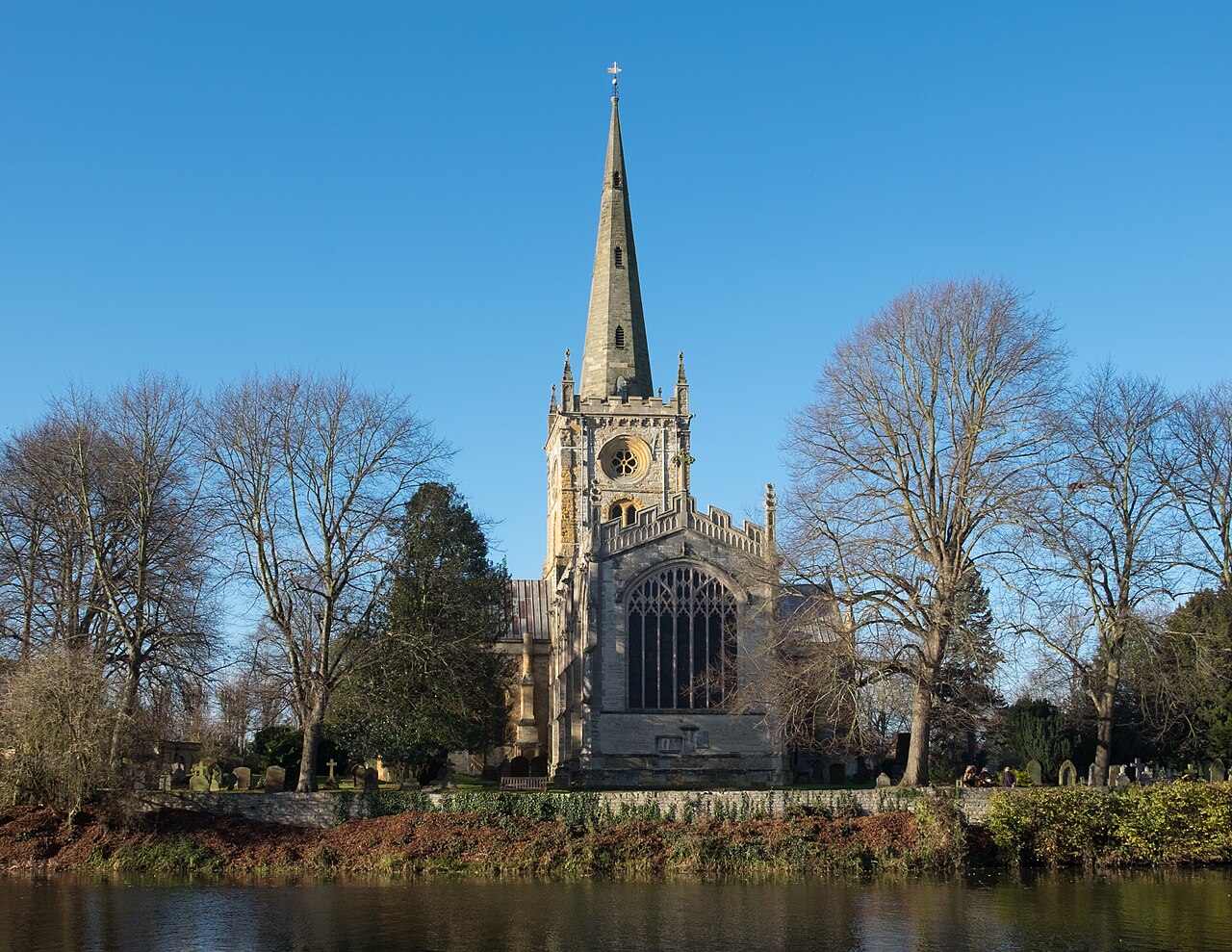
The earliest record of Shakespeare is the entry for his baptism on 26 April 1564 in the parish register of Holy Trinity Church, Stratford-upon-Avon.[1] The entry, in Latin, names him as the son of John Shakespeare; the surviving register is a copy made from an earlier book that is now lost.[1][2] His exact date of birth is not recorded.[1] The traditional birthday of 23 April was first proposed by the antiquary William Oldys and taken up by the editor George Steevens in 1773; because his funeral monument gives his age at death as 53, he must have been born no later than 23 April, and some scholars suggest 21 or 22 April.[1]
A marriage bond dated 28 November 1582, held by the Diocese of Worcester, names "William Shakespeare and Anne Hathaway of Stratford-upon-Avon"; two Stratford farmers, Fulk Sandells and John Richardson, stood as sureties (guarantors).[3] An entry dated a day earlier in the bishop's register instead records a licence for his marriage to "Anne Whateley of Temple Grafton"; the bond is an original document, while the register entry is a later copy.[3]
A daughter, Susanna, was baptised on 26 May 1583, and twins, Hamnet and Judith, on 2 February 1585.[4] Hamnet was buried in Stratford on 11 August 1596, aged 11; the cause of his death is not known.[4] According to the Shakespeare Birthplace Trust, Susanna married John Hall in 1607 and Judith married Thomas Quiney in 1616, and none of Shakespeare's four grandchildren left heirs, so he has no direct descendants.[4]
London career
By 1592 Shakespeare had gained some prominence in London as an actor and playwright.[5] Around then the writer Robert Greene published an attack on an actor who thought himself "the only Shake-scene in a country", which Mowat and Werstine say is generally read as aimed at Shakespeare.[5] Exchequer accounts dated 15 March 1595 record a payment of £20 to William Kempe, William Shakespeare and Richard Burbage, as servants of the Lord Chamberlain, for two comedies or interludes performed at Christmas 1594.[6] Alan H. Nelson, writing for the Folger's Shakespeare Documented project, reads this as showing that Shakespeare had become a leading member of the Lord Chamberlain's company by that time.[6] Mowat and Werstine add that he acted, wrote and held a share in this company, later called the King's Men, for the rest of his career.[5]
In 1599 his company took down its old playhouse and used the timber to build the Globe.[9] A 1599 record in The National Archives shows Shakespeare and others occupying land in Southwark that the Archives identifies as the Globe site, leased on 21 February 1599.[7] The Globe burned down in 1613 during a performance of Henry VIII and was rebuilt within a year.[9] Mowat and Werstine suggest that plays from about 1608 to 1612 were presumably written for the company's indoor theatre at Blackfriars.[5]
In May 1603, soon after James I came to the throne, the company was appointed as the King's Men, with a condition that they could perform only once the plague had eased.[8] In 1604 Shakespeare and other members were issued red cloth for the king's ceremonial entry into London, and the royal Revels accounts for 1604–05 list "Shaxberd" among the writers of plays performed at court.[7][8] The National Archives states that the company performed at court at least 107 times before his death.[7]
In 1612 he gave evidence as a witness in a Court of Requests case, Bellot v Mountjoy, and his signature on that statement is the earliest known example.[8]
Property in Stratford and London
In 1597 Shakespeare bought New Place, a house with gardens and barns in Stratford-upon-Avon, which the National Archives describes as his family home from then until his death.[7] In 1613 he bought the Blackfriars gatehouse in London.[9] Many biographers place his return to live in Stratford between 1610 and 1613, while others think he did not leave London for good until close to his death.[5]
Death and will
Shakespeare's will is dated 25 March 1616, was written in stages and is signed on each of its three pages.[7] It contains three of the six known examples of his signature and is held by The National Archives, having been proved (validated after death) in the Prerogative Court of Canterbury.[7][8] His wife is mentioned only once, in the bequest of his "second best bed with the furniture"; the Archives notes that this is often read as a slight, but that the best bed was customarily an heirloom for the heir and that newer research suggests Anne may have been better provided for by widows' rights.[8] According to the Archives, most of the estate went to his elder daughter, Susanna Hall.[7]
He died in Stratford on 23 April 1616, the date given by the epitaph under his bust in Holy Trinity Church.[5] The parish register records his burial on 25 April 1616, and he is buried in the church's chancel, the area around the altar.[2][5]
Holy Trinity Church in Stratford-upon-Avon, seen from outside.
Counts of Shakespeare's plays vary with how collaborations and disputed texts are treated.[11][12][13] The Folger Shakespeare Library gives 38 as the generally accepted number, noting recent claims for King Edward III, that some scholars would add part of Sir Thomas More, and that a play called Cardenio has not survived.[11] The Royal Shakespeare Company likewise puts the total at around 38 plays, including collaborations.[12] The scholar Gary Taylor, writing in Shakespeare Survey in 2014, states that attribution research finds Shakespeare's writing in at least forty plays and counts 13 of the 43 surviving plays he worked on as collaborations, and finds 28 plays that survive in texts written entirely by him.[13] Named collaborators include John Fletcher, with whom he wrote The Two Noble Kinsmen around 1613, and Thomas Middleton, whose scenes in Timon of Athens Taylor discusses.[11][13]
His first printed poem, Venus and Adonis, appeared in 1593, followed by The Rape of Lucrece in 1594; both were dedicated to Henry Wriothesley, Earl of Southampton, who may have been his patron.[5][9] His sonnets were first printed together in 1609 in a quarto (a small-format book) published by Thomas Thorpe, though many were probably written in the 1590s.[5][14] Two of them had appeared ten years earlier in The Passionate Pilgrim, a 1599 collection attributed to Shakespeare on its title page although much of its verse is not his.[15]
The First Folio
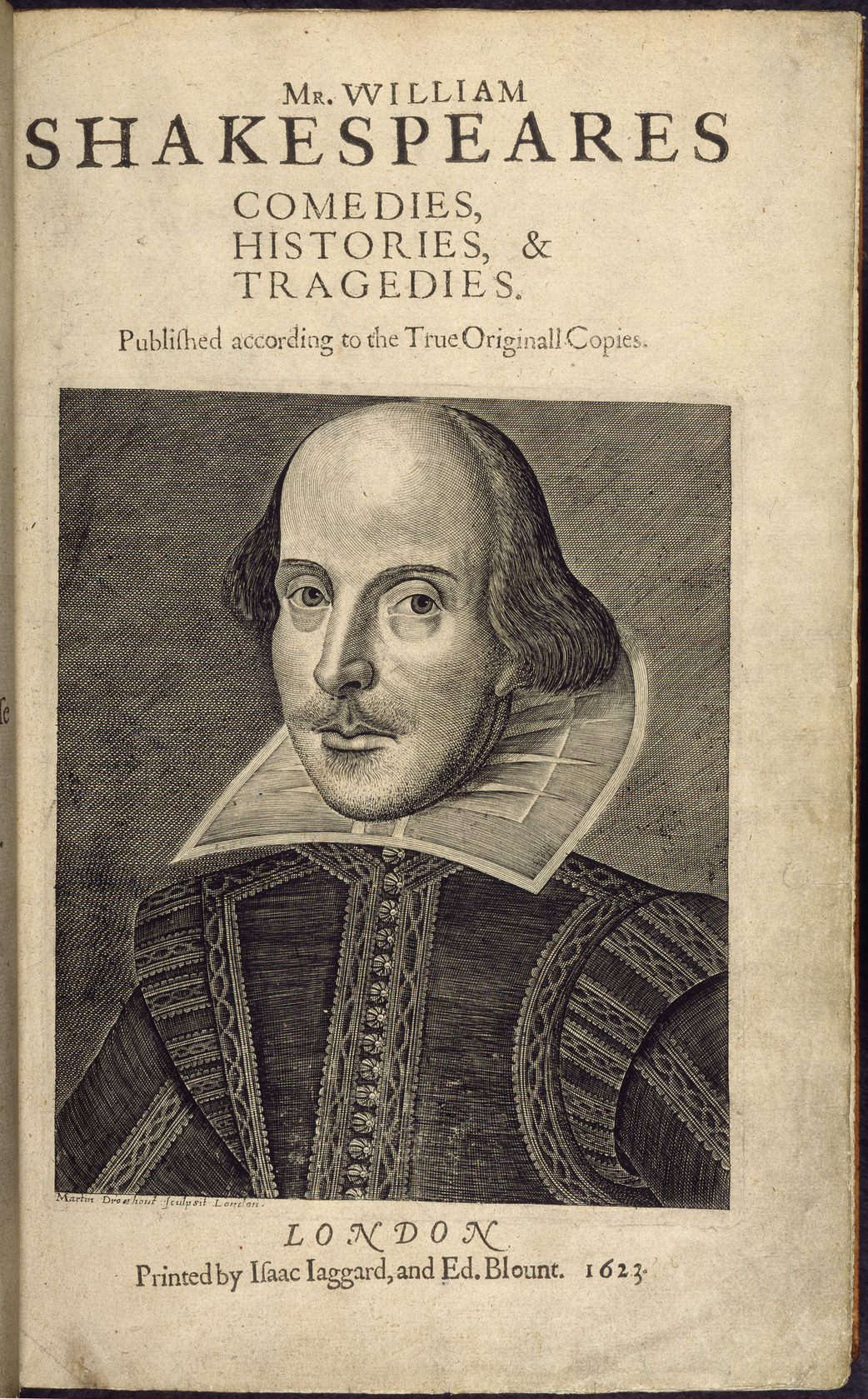
In 1623, seven years after his death, two of his friends, John Heminges and Henry Condell, published a collection of 36 of his plays, now known as the First Folio (a folio being a large-format book).[10] The Shakespeare Birthplace Trust states that 18 of these plays, including Macbeth, The Tempest and Twelfth Night, had not previously appeared in print, so that about half of his plays might otherwise have been lost.[10] The Trust estimates that 750 to 1,000 copies were printed and about 230 survive; a bound copy cost £1 in 1623.[10]
The title page of the 1623 First Folio, with Martin Droeshout's engraved portrait of Shakespeare.
The National Archives calls Shakespeare "Britain's greatest playwright", and Mowat and Werstine describe his plays and poems as works that "dominate the cultures of much of the world four centuries after his death".[7][5]
Since the mid-19th century some writers have argued that Shakespeare of Stratford could not have written the works bearing his name, proposing alternatives such as Francis Bacon, Edward de Vere and Christopher Marlowe.[5] Mowat and Werstine respond that the surviving documents tie him firmly to those plays and poems.[5]
Sources
Robert Bearman and Folger staff, "Parish register entry recording William Shakespeare's baptism", Shakespeare Documented, Folger Shakespeare Library, last updated 22 May 2020. shakespearedocumented.folger.edu/node/108
Robert Bearman, "The Shakespeare marriage bond", Shakespeare Documented, Folger Shakespeare Library, last updated 25 January 2020. shakespearedocumented.folger.edu/node/679
Alan H. Nelson, "Exchequer, Pipe Office, Declared Accounts: Listing Shakespeare as a leading player of the Lord Chamberlain's company", Shakespeare Documented, Folger Shakespeare Library, last updated 26 January 2018. shakespearedocumented.folger.edu/node/304
"Timeline of Shakespeare's Life", Shakespeare Documented, Folger Shakespeare Library. No date shown; accessed 25 November 2026. shakespearedocumented.folger.edu/node/652