The Ottoman Empire was a state founded in Anatolia around 1300 by the dynasty of Osman I that at its height ruled most of southeastern Europe, the Middle East and North Africa, and that came to an end in 1922.[1]
Origins and early expansion
Osman I, a Turkmen chief whose reign a 1995 Library of Congress study of Turkey dates to about 1284–1324, is regarded as the founder of the Osmanli, or Ottoman, dynasty.[1][2][3] Britannica dates the founding of the state to about 1300.[1] The Ottoman state was one of many small principalities that appeared in Anatolia in the early fourteenth century, after the Seljuq sultanate there broke apart amid Mongol domination.[3]
Sources differ on when the city of Bursa was taken: Britannica credits Osman's son Orhan with capturing it in 1324, noting that some sources give 1326, while the Library of Congress study places its fall in the last year of Osman's reign.[1][2] Ottoman forces set up a permanent base in Europe at Gallipoli in 1354, and Murad I took Adrianople, renamed Edirne, in 1361 and made it the capital.[1][2] At the Battle of Kosovo in 1389 the Ottomans defeated the Serbs, but Murad was killed.[1][2] In 1402 Timur defeated and captured Sultan Bayezid I near Ankara, and Bayezid's sons fought over the succession until 1413.[1][2]
Constantinople and Mehmed II
Mehmed II, who reigned in 1444–46 and again from 1451 to 1481, besieged Constantinople, the Byzantine capital, and his troops broke into the city on 29 May 1453.[2][3] He made the city, which became known as Istanbul, his capital, repopulated it and encouraged trade and industry.[1] The church of Hagia Sophia was converted into an imperial mosque, and Mehmed commissioned two palaces, the second of which became the Topkapı Palace.[3] Britannica also credits him with codifying Ottoman law (kanun) and with extending Ottoman rule across Anatolia and the Balkans.[1]
Selim I and Süleyman I
Selim I (reigned 1512–20) defeated the Safavid rulers of Iran in eastern Anatolia in 1514.[3] He then conquered the lands of the Mamluk sultanate, including Syria, Palestine and Egypt, and gained recognition as guardian of the holy cities of Mecca and Medina.[2][3] The Metropolitan Museum of Art's Heilbrunn Timeline (the Met) states that the conquest of the Mamluk realm in 1517 made the Ottomans rulers of the most powerful state in the Islamic world.[3]
Süleyman I (reigned 1520–66) is known in Europe as Süleyman the Magnificent and was called kanuni, "the lawgiver", by his Muslim subjects because of a new codification of law.[2][4] He took Belgrade in 1521 and won the Battle of Mohács in 1526, but a siege of Vienna in 1529 failed.[2] Hungary remained under Ottoman control for more than 150 years, Iraq was taken from the Safavids, and the navy captured the main ports of North Africa.[4] The Met describes his reign as the peak of Ottoman military and political power and as a "Golden Age" of trade and culture.[3][4] At its greatest extent the empire held most of southeastern Europe, the Middle East, North Africa as far west as Algeria and much of the Arabian Peninsula.[1]
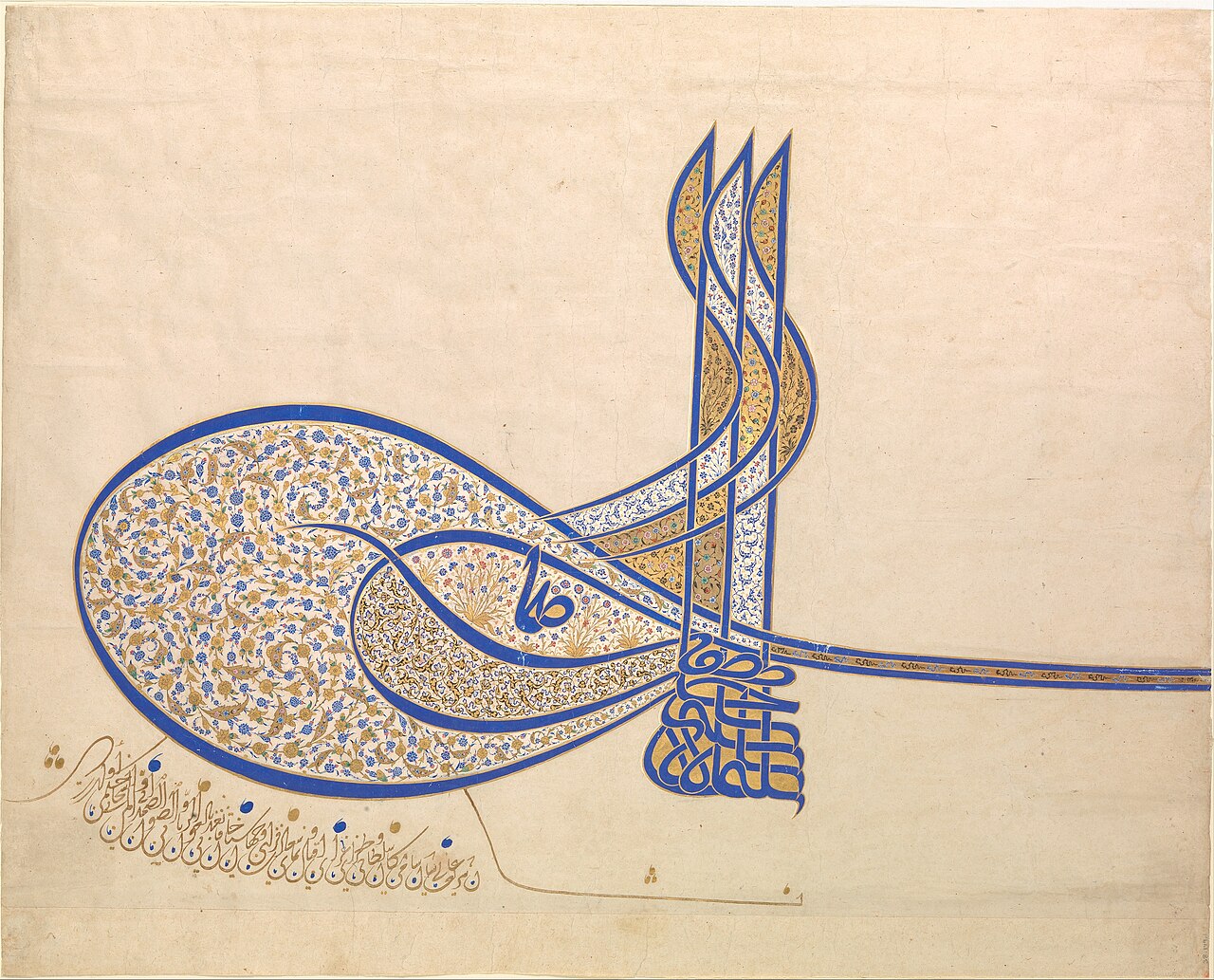
The tughra, or imperial monogram, of Sultan Süleyman I, painted in ink and gold on paper around 1555–60.
Via Wikimedia Commons: Tughra Suleiman by Thadswanek , taken from here (uploaded by Pagan ), public domain.
Government and society
In theory the sultan answered only to God and God's law.[2] He was supreme military commander, held formal title to all land, issued every law as a firman (a decree) and was the chief enforcer of the sharia, the Islamic religious law.[2]
Under the devshirme system, developed under Murad I, Christian youths from the Balkan provinces were drafted, converted to Islam and trained for lifelong service to the sultan.[1] Devshirme recruits supplied the administration and the Janissaries, a salaried infantry corps of slave soldiers that became the most important part of the Ottoman army and a major base of the sultans' power.[1] Over time the sultans withdrew from day-to-day government, which passed to viziers (ministers) headed by a grand vizier.[1]
Non-Muslim communities such as the Greeks, Armenians and Jews were recognized as millets, self-governing religious communities that ran their own schools, religious institutions and courts under the sultan's protection.[1][2] Britannica notes that each millet kept its own religious law, traditions and language, and that its religious leaders also held civil authority over its members.[1]
Art and architecture
Ottoman court art drew on Turkic, Persian-Islamic and Byzantine traditions, and Mehmed II's court attracted artists and scholars from the Ottoman lands, Iran and Europe.[3] Under Süleyman, calligraphy, manuscript painting, textiles and ceramics flourished.[4] Regional centers specialized: Iznik in ceramics, Bursa in silks, Cairo in carpets and Baghdad in the arts of the book.[3]
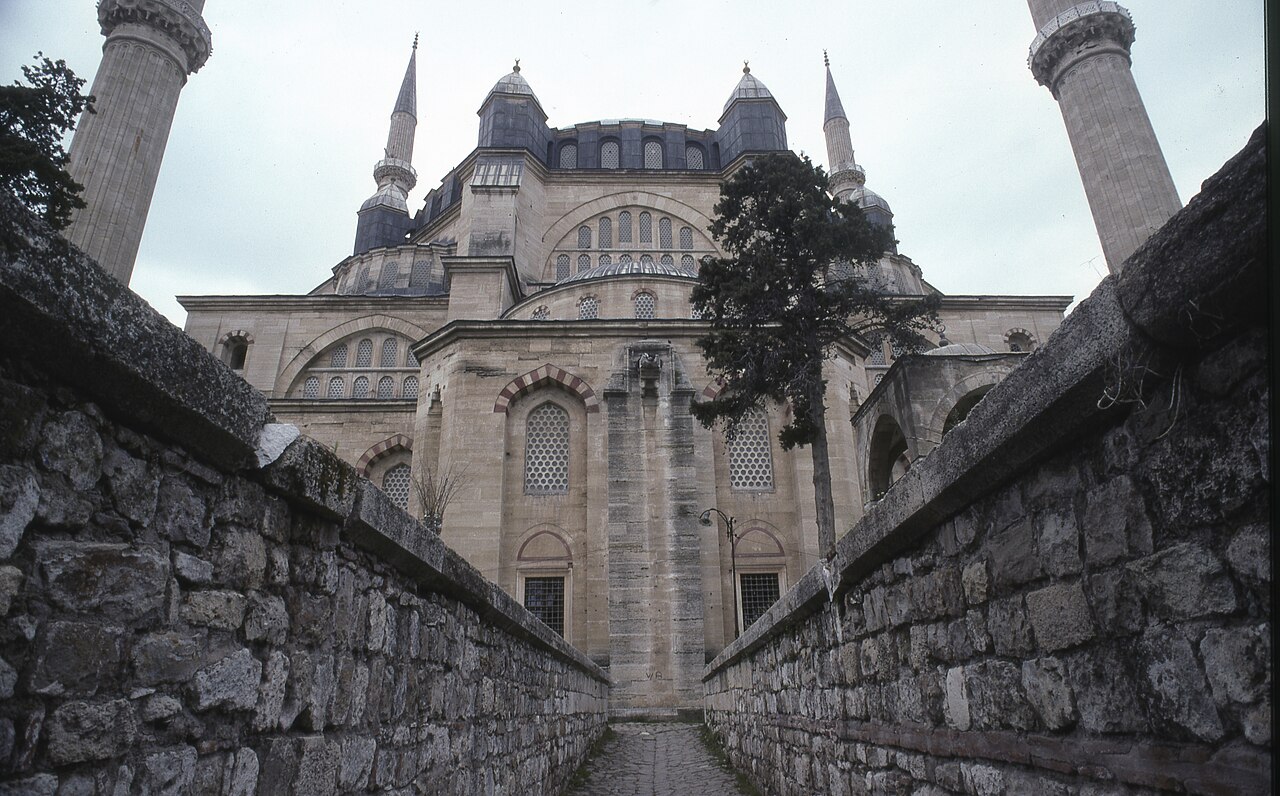
The architect Sinan (about 1500–1588), chief of the Corps of Royal Architects, designed hundreds of buildings across the empire.[4] His best-known works are the Süleymaniye mosque complex in Istanbul (1550–57) and the Selimiye complex in Edirne (1568–74).[4]
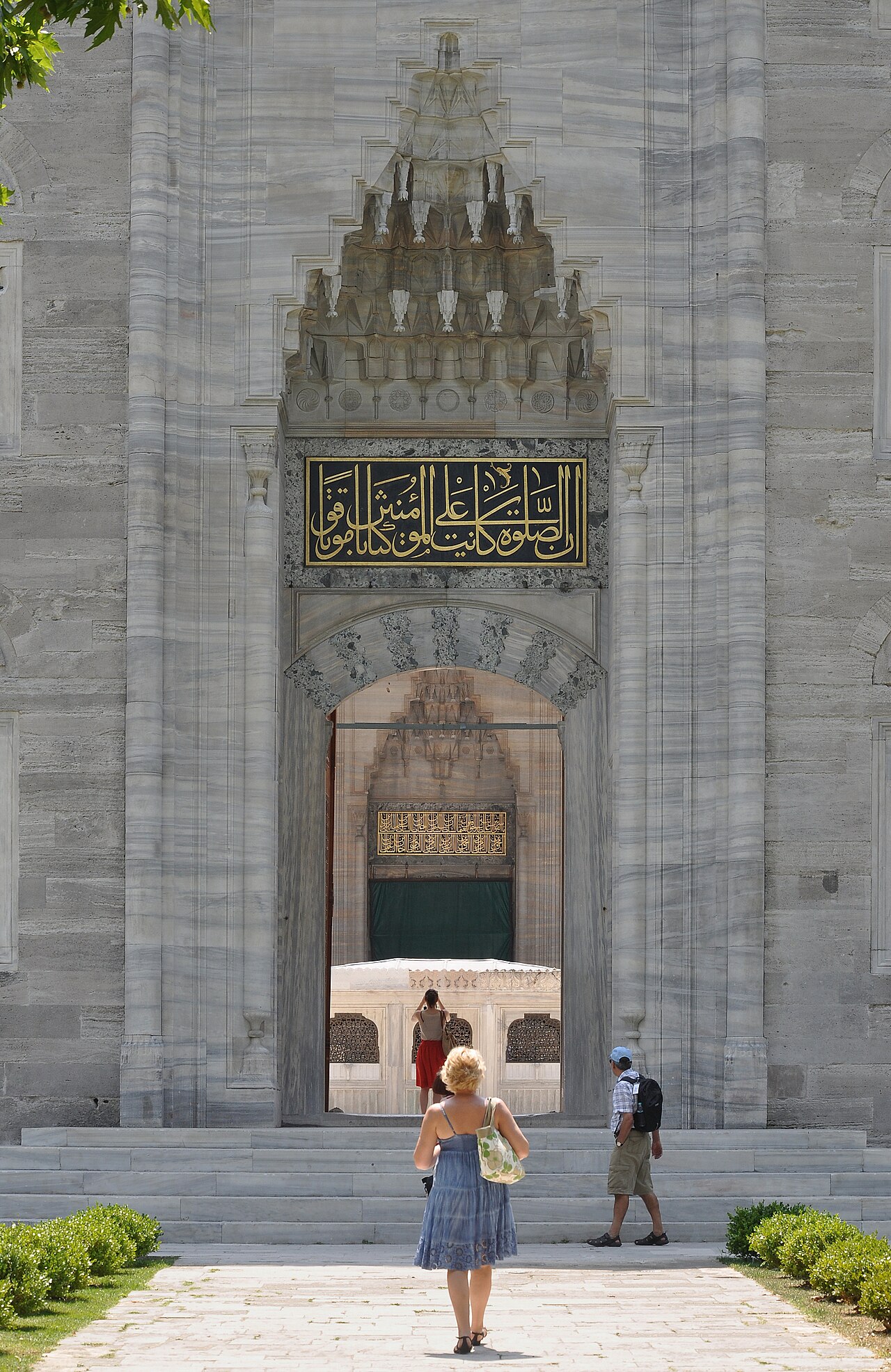
The Süleymaniye Mosque in Istanbul, built between 1550 and 1557 to designs by the architect Sinan.
A long-standing view held that Ottoman power faded after about 1600 and that the empire then declined until its end.[5] The historian Suraiya Faroqhi traces this view to Ottoman advice literature (nasihatname), whose authors blamed debased coinage, military change and the influence of palace women.[5] The 1995 Library of Congress study still follows this framework, dating "the rapid onset of a decline in Ottoman power" to the last thirty years of the sixteenth century and pointing to the naval defeat at Lepanto in 1571 and violent succession struggles in the palace.[2]
In a 2010 article, Faroqhi wrote that this "decline theory" had come under increasingly serious questioning and that a quiet but important change of paradigm had taken place among historians of the empire.[5] She cites Rifa'at Abou-El-Haj, who showed that the advice texts were political arguments rather than neutral records; Leslie Peirce and Jane Hathaway, whose work questions the idea that queen mothers and chief eunuchs damaged government; and economic historians including Şevket Pamuk and Haim Gerber.[5] Faroqhi proposes describing the change after the age of conquest as a shift to a "sedentary monarchy" that ruled through political households.[5]
Territory was nonetheless lost: after the Congress of Berlin in 1878, for example, Serbia and Romania became independent and Cyprus became a British protectorate.[2]
The Tanzimat and the 1876 constitution
The Tanzimat (Turkish for "reorganization") was a series of reforms issued from 1839 to 1876 under the sultans Abdülmecid I and Abdülaziz.[6] The Gülhane edict of 1839 promised new institutions to protect the life, property and honor of all subjects regardless of religion or ethnicity.[6] The reform movement stalled in the mid-1870s, during the last years of Abdülaziz's reign.[6]
In December 1876 the new sultan, Abdülhamid II (reigned 1876–1909), promulgated a constitution drafted under the direction of the reformist minister Midhat Pasha, which created a representative parliament, guaranteed religious liberty and widened freedom of expression.[2] Abdülhamid called the empire's first parliament but dissolved it within a year.[2]
The Young Turks and the First World War
Opponents of Abdülhamid's rule formed secret societies, several of which merged in 1907 into the Committee of Union and Progress (CUP), also known as the Young Turks, which sought to restore the 1876 constitution.[2] In July 1908 army units in Macedonia revolted and demanded constitutional government; the sultan agreed to elections, and in 1909 he was forced to abdicate in favor of his brother, Mehmed V.[2] In the Balkan Wars of 1912–13 the empire lost almost all of its European territory, although it recovered part of eastern Thrace, including Edirne.[2][7] In January 1913 a small group of CUP officers carried out a coup that forced the grand vizier from office.[7]
On 2 August 1914 Enver concluded a secret alliance with Germany.[2] After an Ottoman bombardment of Russian ports on the Black Sea on 29 October 1914, Russia declared war on the empire on 5 November, followed by Britain and France the next day.[2][7] Allied landings at Gallipoli failed against Ottoman resistance in which Mustafa Kemal, later known as Atatürk, played a leading part.[2] In October 1918 the Young Turk leaders Enver, Talat and Cemal fled to exile in Germany, and on 30 October the empire signed the Armistice of Mudros.[2][7]
Deportation and massacre of the Armenians
During the war the Armenian population of eastern Anatolia and Cilicia was deported and massacred.[7] A statement by United States President Joe Biden on 24 April 2021 dates the start of the campaign to 24 April 1915, when Ottoman authorities arrested Armenian intellectuals and community leaders in Constantinople.[8] The Library of Congress study reports that Enver claimed an Armenian revolt was imminent and that the deportation of as many as 2 million Armenians from the war zone turned into a massacre.[2] Estimates of the dead vary: Britannica gives between 600,000 and 1,500,000 killed, and the Library of Congress study says the most conservative estimates put the toll at 600,000 while other sources give more than one million.[2][7]
Britannica states that the events are now widely described as a genocide of the Armenian people.[7] Biden's 2021 statement used the term, referring to "the Ottoman-era Armenian genocide" and stating that 1.5 million Armenians were deported, massacred or marched to their deaths.[8] The government of Turkey rejects the term: in a press release issued the same day, its Ministry of Foreign Affairs denounced Biden's statement, argued that none of the conditions for using the term "genocide" under international law were met, and pointed to its 2005 proposal for a joint history commission.[9]
Dissolution
After the armistice, nationalists led by Mustafa Kemal convened a Grand National Assembly in Ankara in April 1920, in defiance of the Ottoman government, and elected him its president.[2] The Treaty of Sèvres, signed on 10 August 1920, left the sultan Istanbul and part of Thrace but took away the Arab provinces; only Greece ratified it, and Mustafa Kemal led the struggle against its terms.[7] In November 1922 the Assembly separated the offices of sultan and caliph and abolished the sultanate.[2] Sultan Mehmed VI went into exile on Malta, and his cousin Abdülmecid was named caliph.[2]
The Treaty of Lausanne, signed on 24 July 1923, replaced the Treaty of Sèvres.[7] On 29 October 1923 the Grand National Assembly proclaimed the Republic of Turkey, with Mustafa Kemal as president and Ankara as its capital.[2] On 3 March 1924 the Assembly abolished the Ottoman caliphate.[10]
Sources
Editors of Encyclopaedia Britannica. "Ottoman Empire." Encyclopaedia Britannica. No date shown; accessed 25 November 2026. britannica.com/place/Ottoman-Empire
Helen Chapin Metz, ed. Turkey: A Country Study, chapter 1, "Historical Setting" (sections "The Ottoman Empire" through "Atatürk and the Turkish Nation"). Washington: GPO for the Library of Congress, 1995. Online text hosted by countrystudies.us, sections 6–13; accessed 25 November 2026. countrystudies.us/turkey
Suzan Yalman, based on original work by Linda Komaroff. "The Art of the Ottomans before 1600." Heilbrunn Timeline of Art History, The Metropolitan Museum of Art, October 2002. metmuseum.org/essays/the-art-of-the-ottomans-before-1600
Suraiya Faroqhi. "Empires before and after the Post-colonial Turn: The Ottomans." Osmanlı Araştırmaları / The Journal of Ottoman Studies, no. 36, 2010. dergipark.org.tr/en/download/article-file/112263
Editors of Encyclopaedia Britannica. "Tanzimat." Encyclopaedia Britannica. No date shown; accessed 25 November 2026. britannica.com/event/Tanzimat
Republic of Türkiye, Ministry of Foreign Affairs. "No: 160, 24 April 2021, Press Release on 24 April." 24 April 2021, as published on the website of the Embassy of Türkiye in Hanoi. hanoi-emb.mfa.gov.tr/Mission/ShowAnnouncement/383793
The Institute of Ismaili Studies. "The abolition of the Ottoman caliphate in 1924: debates, controversies, and implications." 27 July 2025. iis.ac.uk/?p=14923