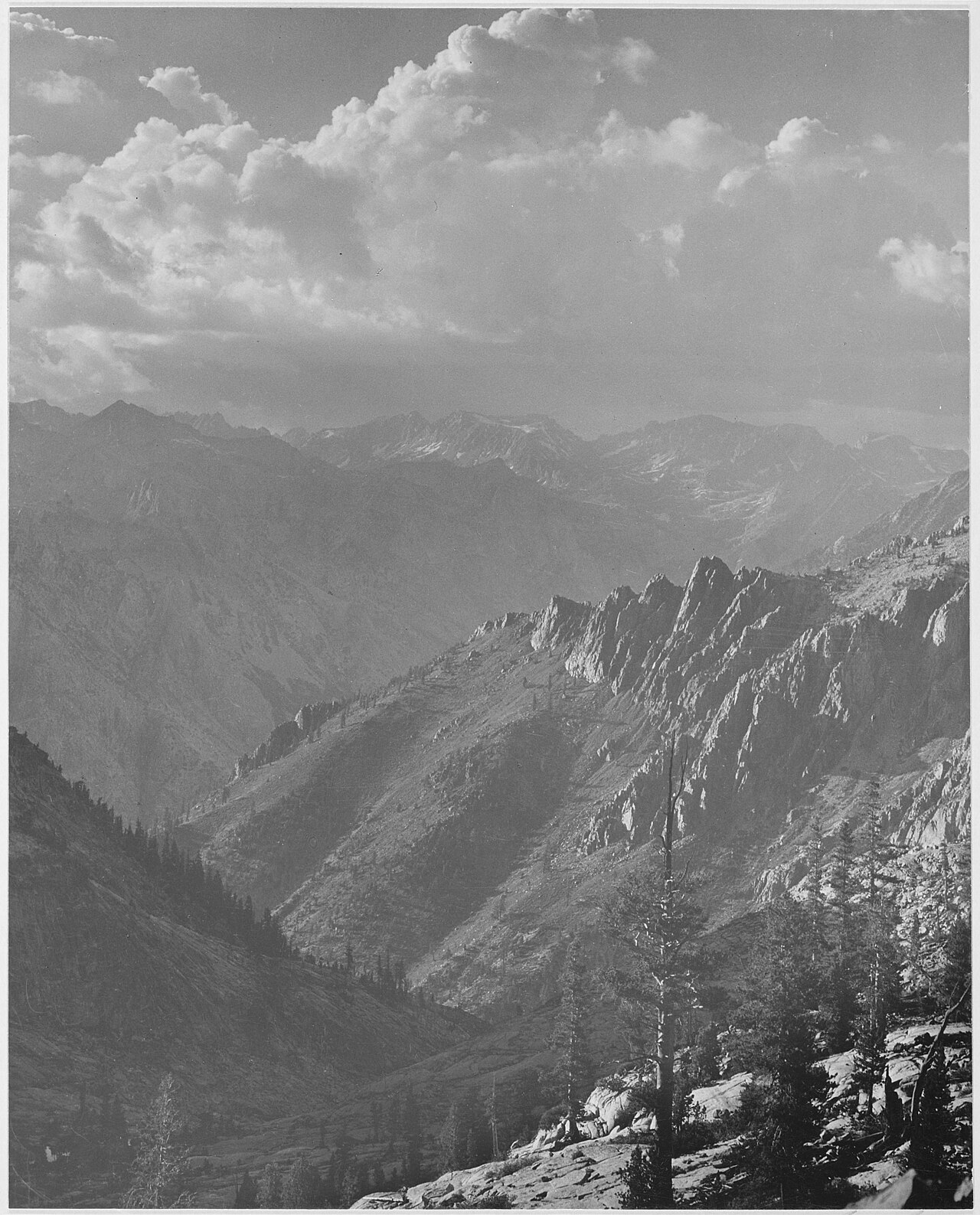
Ansel Adams (1902–1984) was an American photographer, best known for black-and-white pictures of Yosemite and other wild places in the American West, who also campaigned for decades to protect those places.[1][2]
Early life
Adams was born in San Francisco on 20 February 1902.[3] He was an only child and the grandson of a wealthy timber baron, and the family lost most of its fortune after the 1906 San Francisco earthquake and the banking panic of 1907.[1] According to the Sierra Club, an aftershock of the 1906 earthquake threw him to the ground and broke his nose, and his childhood play in the sand dunes beyond the Golden Gate was the start of his attachment to nature.[2] After he struggled at school, his father arranged for him to be taught at home by tutors.[1]
As a young man Adams trained as a pianist, and in his teens and early twenties he hoped to become a concert pianist.[3] Time magazine's 1984 obituary credited his strict piano teacher with teaching him that technical excellence matters in artistic work.[10]
At about 14 he read James Mason Hutchings's book In the Heart of the Sierras, which led his family to visit Yosemite in 1916; that year his parents gave him a Kodak Brownie, a simple box camera.[1] The Sierra Club notes that this first visit came two years after the death of the naturalist John Muir and three months before the National Park Service was founded.[2]
Sierra Club and first photographs
In 1919, at the age of 17, Adams became custodian of the Sierra Club's LeConte Memorial Lodge in Yosemite, his first role with the club.[2] The Center for Creative Photography gives the length of that job as four years.[5] He joined the club's annual High Trip outing in 1927, became its official trip photographer in 1928, and in 1930 became assistant manager of these month-long outings, which could include up to 200 people.[2] His first published photographs and writings appeared in the Sierra Club Bulletin, beginning in its 1922 issue according to the National Park Service.[2][1]
In 1927 he made Monolith, the Face of Half Dome, a view of Yosemite's best-known cliff made with a red filter over the lens, which brought him wide notice.[1] PBS describes that 1927 hike as the point at which he first developed his distinctive style.[3] He married Virginia Best, whom he had met in Yosemite, in 1928; seven years later she inherited her father's studio in the park.[3][1]
Alongside his personal work Adams took commercial assignments, among them work for the National Park Service, Kodak, Zeiss, IBM, AT&T, and Life and Fortune magazines.[1] In the 1930s the Yosemite park concessionaire hired him to photograph winter tourism, and in 1943 he documented the Ahwahnee hotel before the US Navy turned it into a hospital.[1]
Group f/64 and "straight" photography
Time reported that Adams's early soft-focus pictures gave way to a sharper style after he met the photographer Paul Strand in 1930.[10] On 15 November 1932, at the M. H. de Young Memorial Museum in San Francisco, Adams and ten other photographers, including Edward Weston and Imogen Cunningham, exhibited together as Group f/64.[4] The name referred to the smallest lens opening (aperture) on the large-format view cameras of the time, a setting that keeps most of a scene in sharp focus.[4] According to the Metropolitan Museum of Art, the group broke with Pictorialism, the style then dominant among West Coast photographers, and favoured sharp focus, contact prints (prints made at the same size as the negative) and glossy papers.[4] The Center for Creative Photography describes the group as a protest against what it calls "the sentimental and imitative style" of Pictorialism.[5] The Metropolitan Museum cites Adams's Winter Yosemite Valley (1933–34) as an example of the group's landscape work.[4]
Adams met the photographer and gallery owner Alfred Stieglitz in New York on 28 March 1933, and Stieglitz later gave him a solo exhibition at his New York gallery in November 1936.[3][10]
The Zone System
The Zone System is a set of techniques that gives photographers close control over the range of tones, from black to white, recorded on black-and-white film.[5] It was formulated by Adams and Fred Archer in 1939–40.[5]
The method divides the possible tones of a print into steps called zones, numbered in Roman numerals, running from pure black, through eight or nine shades of grey, to the plain white of the photographic paper.[5] Dark areas are called low values (Zones I to III), greys are middle values (Zones IV to VI) and light areas are high values (Zones VII to IX).[5] Zone V is the mid-tone grey that matches a standard grey card used for measuring light.[5] Time described the scale as ten zones running from deepest black to pure white.[10]
In practice the photographer first imagines how the finished print should look, deciding which parts of the scene should be dark, grey or light; this mental step is called previsualization.[5] The photographer then chooses the exposure, meaning the amount of light allowed to fall on the film, and the development, the chemical process in the dark that makes the image on the film visible and permanent as a negative.[5] Developing the film for less than the normal time lowers contrast, and developing it for longer raises contrast, so that, used together, exposure and development let the photographer control the range of tones in the negative consistently.[5] Adams summed up the relationship between the stages by saying, "The negative is the score," and "The print is the performance."[10]
Museums and books
In 1940 Adams worked closely with Beaumont Newhall to set up the Department of Photography at the Museum of Modern Art (MoMA) in New York.[6] The two organised the department's first exhibition, Sixty Photographs: A Survey of Camera Esthetics, which ran from 31 December 1940 to 12 January 1941.[6]
Adams published many books of photographs and technical instruction; Time put the number of his books on photography at about 40 in 1984.[10] One of them, the limited-edition Sierra Nevada: The John Muir Trail, played a part in his conservation work.[2]
National parks and the Mural Project
In the mid-1930s Secretary of the Interior Harold Ickes proposed painted murals for the department's headquarters in Washington, DC, and later widened the plan to include large photographs, recommending Adams.[7] In 1941 Adams was commissioned to make enlarged photographs of scenes from the national parks for the building.[3][7] In his autobiography Adams gave his pay as $22.22 a day for up to 180 days a year, plus $5 a day for expenses.[7]
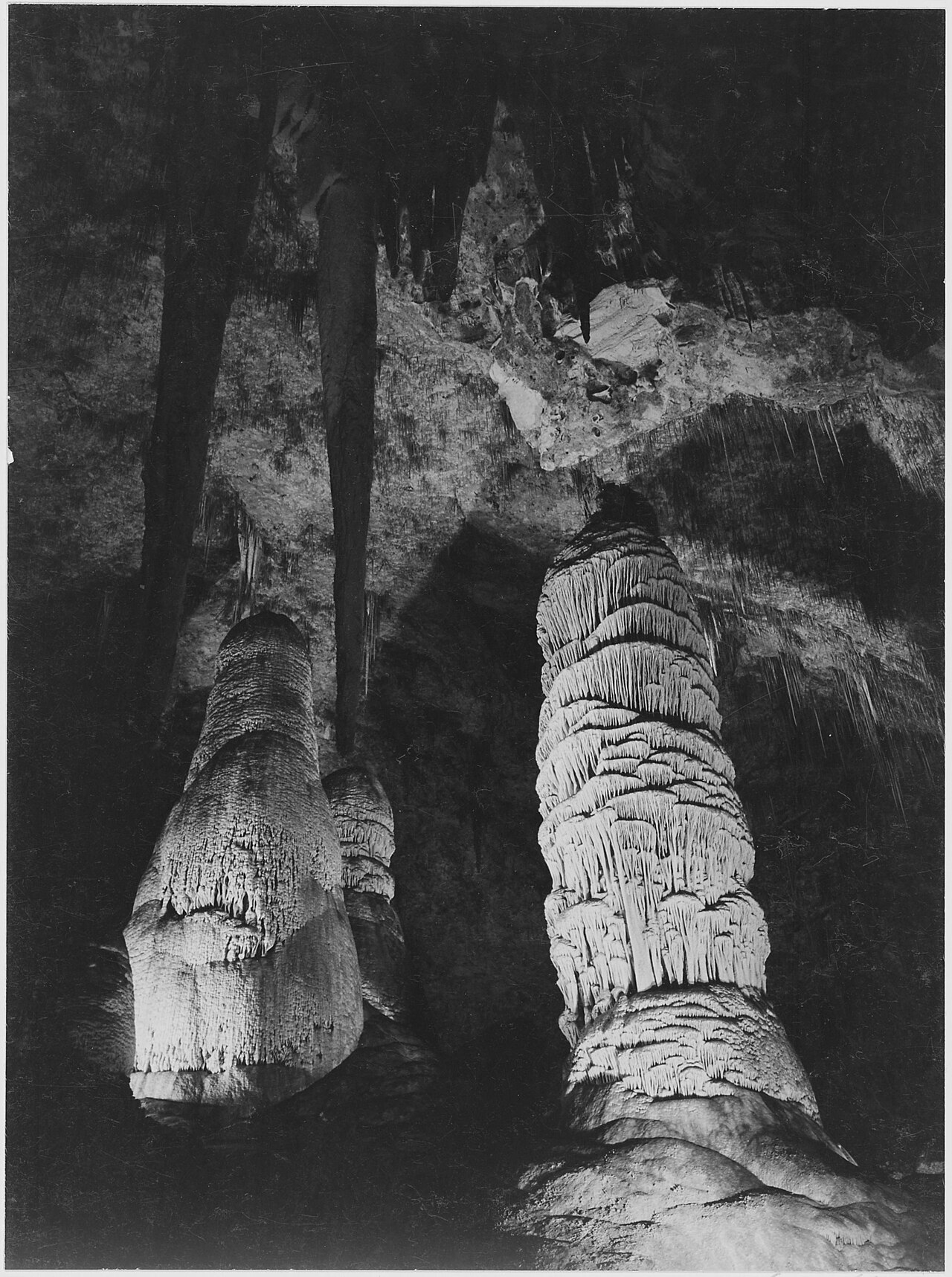
He began travelling to the parks in October 1941 and submitted his prints to the Department of the Interior about a year later.[7] The Second World War halted the project, and it was never resumed; PBS dates the cancellation to 1942.[7][3] The series held by the National Archives covers national parks and monuments in Arizona, California, Colorado, Montana, New Mexico, Utah and Wyoming, including Grand Canyon, Yosemite, Yellowstone, Mesa Verde and Carlsbad Caverns.[7] Adams kept the original negatives, which are at the Center for Creative Photography, while the National Archives' Still Picture Branch holds the original prints.[7] In a letter of 18 August 1942 to E. K. Burlew of the Interior Department, Adams stated that the photographs were US government property, and the National Archives states that the series has no copyright restrictions.[7] In 2010 the Department of the Interior installed 26 of the images as murals in an exhibit titled Ansel Adams: The Mural Project 1941–1942.[7]
Time called Moonrise, Hernandez, New Mexico, made in 1941, probably his most famous single image.[10]
The Hall of Giants in the Big Room of Carlsbad Caverns, New Mexico, photographed by Ansel Adams for the Mural Project in 1941–42.
In the autumn of 1943 Adams photographed the Manzanar War Relocation Center in Inyo County, California, one of the camps where Japanese Americans were held during the Second World War.[8] The National Park Service notes that he made this work at his own expense.[1] Most of the more than 200 photographs are portraits, but they also show daily life, farming, sports and leisure.[8] A selection appeared in 1944 in the book Born Free and Equal, published by U.S. Camera.[8] The photographs were also shown at MoMA, and PBS records that some critics accused Adams of disloyalty for the project.[3] When he offered the collection to the Library of Congress in 1965, Adams wrote that the purpose of his work had been "to show how these people, suffering under a great injustice," had built a community.[8]
Conservation work
Adams was elected to the Sierra Club's board of directors in 1934 and served on it for 37 years.[2][10] In 1936 the club sent him to a national parks conference in Washington, DC, to lobby for making Kings Canyon a national park, and he met members of Congress and Secretary Ickes.[3] According to the Sierra Club, his book Sierra Nevada: The John Muir Trail helped persuade Ickes and President Franklin D. Roosevelt to support the park.[2] Kings Canyon National Park was established in 1940.[2][1] In 1968 he received the Department of the Interior's Conservation Service Award.[2]
The Sierra Club's own account notes that Adams was criticised for leaving people out of his landscapes and for showing an idealised wilderness, while crediting him with helping to build public environmental awareness in the United States.[2] Time's 1984 obituary likewise described his photographs as presenting nature as timeless and ideal.[10]
Later life and honours
PBS identifies the 1963 retrospective The Eloquent Light at the de Young Museum, covering his work from 1927 to 1963, as marking a shift in his career towards teaching, public life and environmental activism.[3] By the mid-1960s, according to Time, he had largely stopped taking photographs for public release and concentrated on printing earlier negatives and revising his books.[10]
In 1980 President Jimmy Carter awarded Adams the Presidential Medal of Freedom, the highest civilian honour in the United States.[1][3] The Sierra Club quotes the citation as recognising "his efforts to preserve this country's wild and scenic areas."[2]
Death and legacy
Adams died on 22 April 1984, aged 82.[3] Time reported that he died of heart disease near his home in Carmel, California, while the National Park Service gives the place of death as Monterey, California.[10][1]
Six months after his death, Congress designated more than 200,000 acres near Yosemite as the Ansel Adams Wilderness; the area had previously been the Minarets Wilderness.[3][1] In 1985 an 11,760-foot (about 3,580-metre) peak on the boundary of Yosemite National Park was named Mount Ansel Adams.[1][3]
Adams and the University of Arizona's then-president, John P. Schaefer, founded the Center for Creative Photography in Tucson in 1975, and his archive was one of the five photographers' archives with which its collection began.[9] The Ansel Adams Archive there holds his prints, negatives and correspondence, including, according to the center, more than 3,000 exhibition prints.[5]
Lisa Hostetler, Department of Photographs, The Metropolitan Museum of Art. "Group f/64." Heilbrunn Timeline of Art History, 1 October 2004. metmuseum.org/essays/group-f64
Center for Creative Photography, University of Arizona. "Intimate Nature: Ansel Adams and the Close View" (educator's guide; curator's overview by Trudy Wilner Stack). No date shown; accessed 25 November 2026. ccp.arizona.edu/learn/educators-guides-archive/intimate-nature-anse…
The Museum of Modern Art. "Sixty Photographs: A Survey of Camera Esthetics" (exhibition page). No date shown; accessed 25 November 2026. moma.org/calendar/exhibitions/2089