Franklin Delano Roosevelt (1882–1945) was the 32nd president of the United States, the only one to serve more than two terms, and led the country through the Great Depression and the Second World War.[1][2]
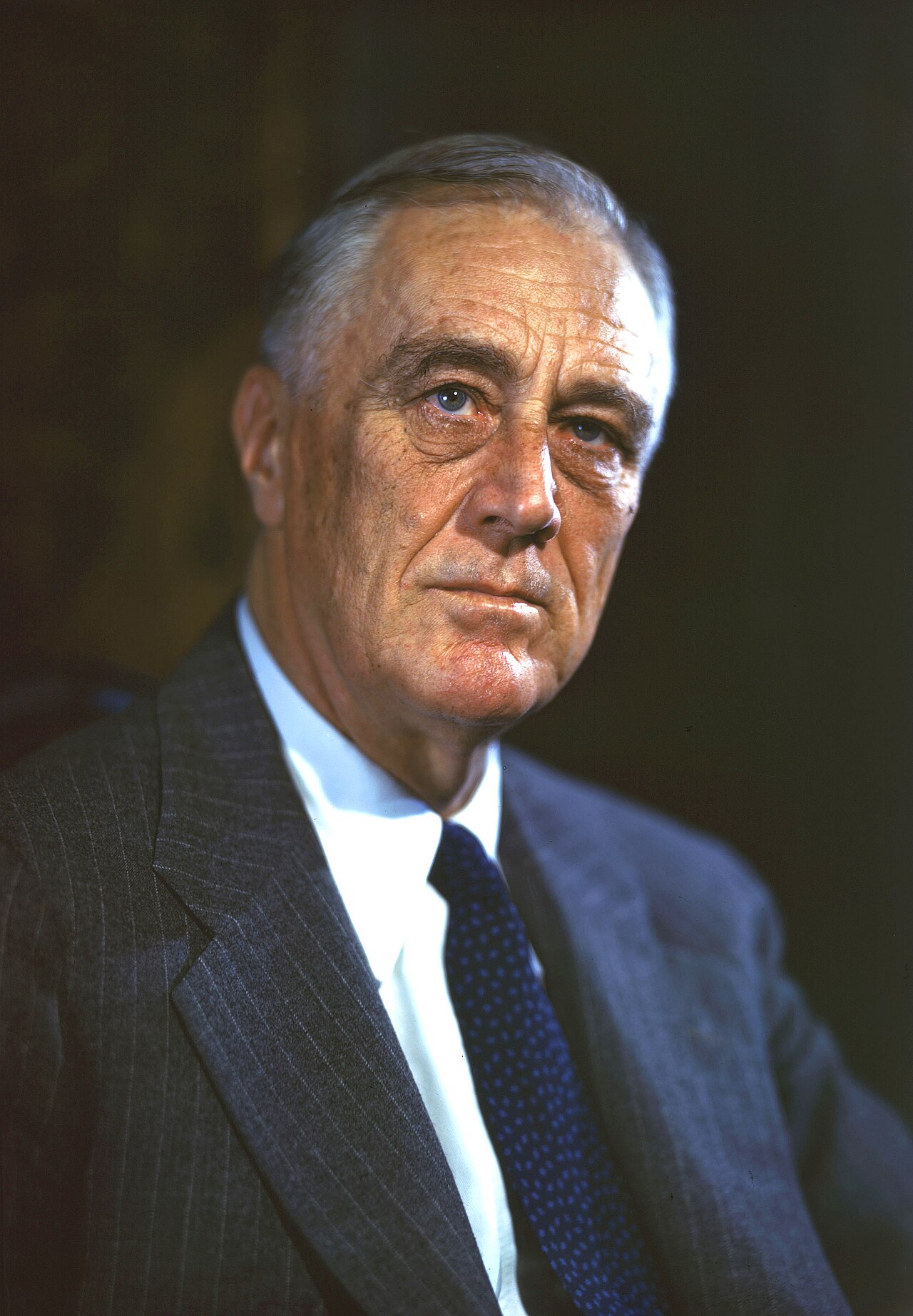
Formal portrait photograph of Franklin D. Roosevelt as president.
Roosevelt was born on January 30, 1882, at Hyde Park, New York, to James and Sara Delano Roosevelt.[2] His parents and private tutors taught him at home until he went to the Groton School in Massachusetts in 1896.[2] He then earned a bachelor's degree in history from Harvard in three years, from 1900 to 1903.[2] He studied law at Columbia University but left without a degree after passing the bar examination in 1907.[2][3] On March 17, 1905, he married Anna Eleanor Roosevelt, a distant cousin who was a niece of President Theodore Roosevelt.[2]
Early political career
In 1910 Roosevelt won a seat in the New York State Senate as a Democrat, and he was re-elected in 1912.[2] President Woodrow Wilson appointed him Assistant Secretary of the Navy in 1913, a post he held until 1920.[2] In 1920 the Democrats nominated him for vice president on a ticket headed by James M. Cox, which lost to the Republican Warren Harding.[2][3]
Polio
In August 1921, while on holiday at Campobello Island in New Brunswick, Canada, Roosevelt contracted poliomyelitis, also called infantile paralysis.[2][4] He never regained the use of his legs.[2] The historian William E. Leuchtenburg writes that he was left partly paralyzed from the abdomen down and spent much of his life in a wheelchair.[3] In 1927 Roosevelt founded the Georgia Warm Springs Foundation, a therapy center for people with infantile paralysis at Warm Springs, Georgia.[4] He also inspired and directed the March of Dimes, which eventually funded an effective polio vaccine.[2]
Governor of New York
In 1928 Roosevelt succeeded Alfred E. Smith as governor of New York, winning the election by about half a percentage point, and he was re-elected in 1930.[2][3] As governor he supported lower taxes for farmers, urged the state to develop public power utilities, and persuaded the legislature to pass a public works program for the unemployed and relief for the needy.[3]
The 1932 election
The Democratic Party nominated Roosevelt for president at its 1932 convention in Chicago, and he broke with tradition by flying there to accept the nomination in person.[2] On accepting it, he promised a "New Deal" to help the country out of the Depression.[5] He defeated Herbert Hoover on November 8, 1932, by about seven million votes.[2][4]
The New Deal
"New Deal" is the name given to the Roosevelt administration's domestic program against the Great Depression: a series of laws and new federal agencies meant to steady the banks, give relief and jobs to the unemployed, and revive business.[5] Historians divide it into a "First New Deal" (1933–1935) and a "Second New Deal" (1935–1938), but Leuchtenburg notes that these are scholars' labels that Roosevelt himself never used.[5]
When Roosevelt took office on March 4, 1933, more than twelve million Americans, over a quarter of the workforce, were out of work, and a new wave of bank failures had begun in February.[2][5] In his inaugural address he told the country that "the only thing we have to fear is fear itself."[6] On March 6 he declared a national "bank holiday," temporarily closing the banks to stop runs by depositors, and on March 12 he gave the first of his radio "fireside chats."[2][5]
During his first "100 days," Congress passed a burst of recovery laws at his urging.[2][5] These laws created agencies such as the Agricultural Adjustment Administration, and other measures insured bank deposits, regulated the stock market and aided the unemployed.[2] According to Leuchtenburg, the Civilian Conservation Corps put 300,000 young men to work in 1,200 camps, and the Tennessee Valley Authority built dams and power plants in the poor Tennessee Valley.[5]
In 1935 Congress created the Works Progress Administration (also called the Works Projects Administration), which gave jobs to the unemployed, and passed the Social Security Act.[2][5] That act set up old-age assistance and insurance, unemployment insurance, and aid for dependent children and the blind.[5]
The Supreme Court struck down major New Deal measures, invalidating the National Industrial Recovery Act in May 1935 and the Agricultural Adjustment Act in 1936.[5] In 1937 Roosevelt proposed adding justices to the Court; critics called it "packing" the Court and Congress rejected the plan, but the Court then began upholding New Deal laws.[2][5]
Judgments of the New Deal differ. Leuchtenburg writes that its measures "could not end the Great Depression" and that World War II, not the New Deal, ended it.[5][7] He also writes that white men generally received better benefits from it than women, Black Americans or Latinos.[7]
Four presidential elections
Roosevelt won the presidency four times, defeating Herbert Hoover in 1932, Alfred M. Landon in 1936, Wendell Willkie in 1940 and Thomas E. Dewey in 1944.[2] He was the only American president to serve more than two terms.[2] George Washington's decision to step down after two terms had set an unwritten custom that lasted about 150 years.[8] In 1947, after Roosevelt's death, Congress proposed the Twenty-second Amendment to the Constitution, which limits presidents to two terms; it was ratified on February 27, 1951.[8]
Second World War
After Germany invaded Poland in September 1939, Roosevelt tried to make American aid available to Britain, France and China, sought changes to the Neutrality Acts that stood in the way, and built up the armed forces despite isolationist opposition.[2] On January 6, 1941, in his State of the Union message, he set out the "Four Freedoms."[4] The Lend-Lease Act, passed on March 11, 1941, let the president sell, lease, lend or otherwise transfer war supplies to any government whose defense he judged vital to the defense of the United States.[9] It allowed the country to help Britain while remaining officially neutral, in line with Roosevelt's aim of making the United States a "great arsenal of democracy."[9]
In August 1941 Roosevelt met the British prime minister, Winston Churchill, off Newfoundland, and they issued the Atlantic Charter, a statement of eight shared principles.[10] Japan attacked Pearl Harbor on December 7, 1941; the next day Roosevelt asked Congress to declare war on Japan, and Germany and Italy declared war on the United States four days after the attack.[2][4] On January 1, 1942, the Allied nations signed the Declaration by United Nations, pledging not to make a separate peace and to form a peacekeeping organization after the war.[2]
On February 19, 1942, Roosevelt signed Executive Order 9066, which allowed military commanders to exclude people from designated military areas.[11] It led to the forced removal of about 122,000 Japanese Americans from the West Coast to inland camps, nearly 70,000 of them United States citizens.[11] In 1988 Congress passed a law that apologized for the incarceration and paid $20,000 to each person who had been held.[11]
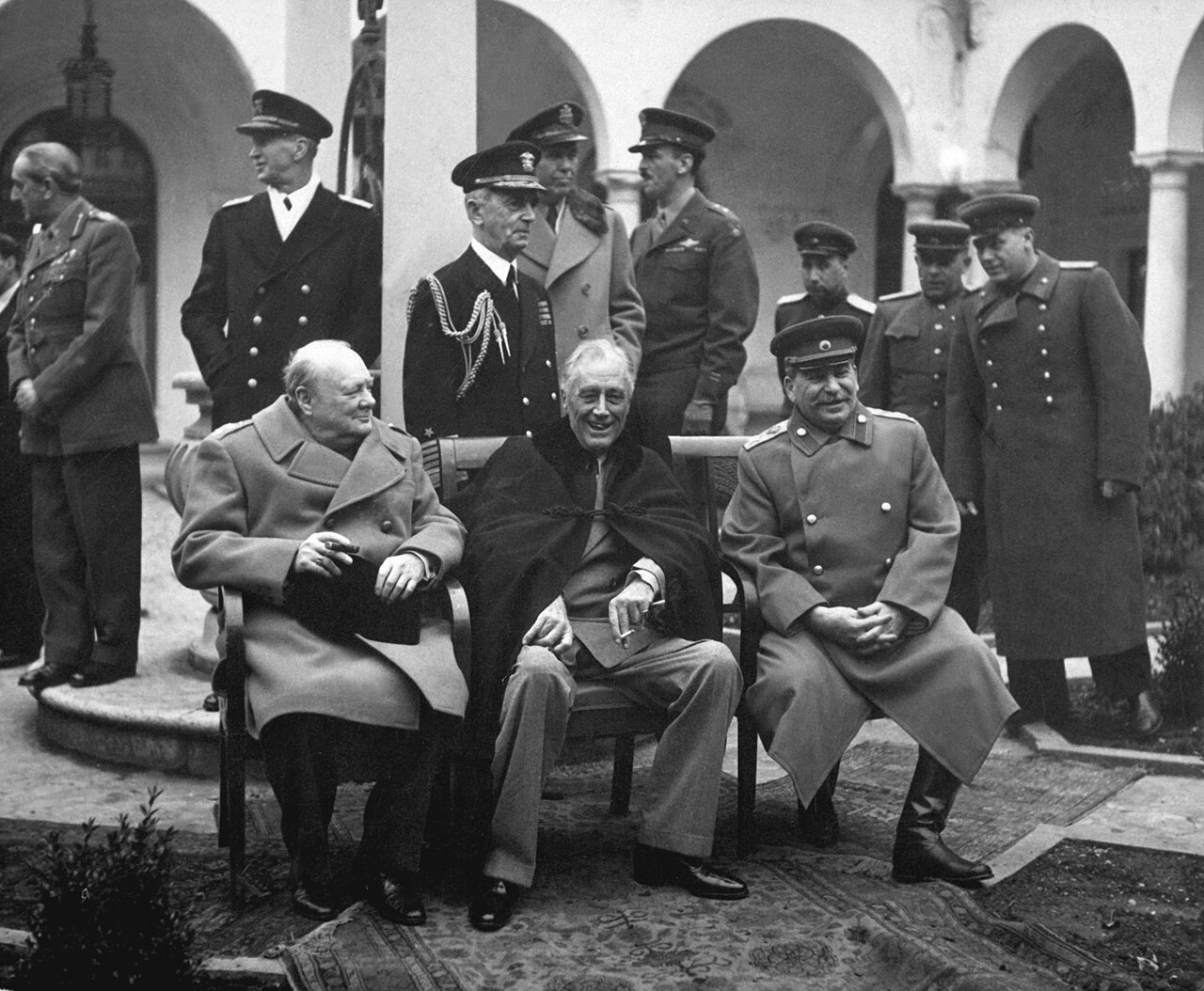
Roosevelt gave priority to the war in western Europe, where the Allies landed in Normandy, France, on June 6, 1944.[2] At Tehran, Iran, from November 28 to December 1, 1943, Roosevelt, Churchill and the Soviet leader Joseph Stalin met together for the first time; they agreed to go ahead with the cross-Channel invasion of Europe, and Stalin agreed to enter the war against Japan.[10] At Yalta, in the Soviet Crimea, in February 1945, the three leaders agreed to divide Germany into four occupation zones, Stalin promised to send troops against Japan within a few months of Germany's defeat, and Roosevelt pressed for a new world security organization, the United Nations.[4][10] Critics have argued that Roosevelt gave the Soviet Union too many concessions at Yalta, according to the FDR Library.[10] Leuchtenburg judges that Roosevelt "proved a talented wartime leader."[7]
Death
A medical examination in early 1944 found serious heart and circulatory problems, including high blood pressure, though most Americans did not know how ill he was.[2][12] On April 12, 1945, while sitting for a portrait at Warm Springs, Georgia, Roosevelt suffered a massive stroke, a cerebral hemorrhage, and died about two and a half hours later at the age of 63.[2][12] His death came a few weeks before Germany surrendered.[7] Vice President Harry S. Truman took the oath of office the same day.[12] Large crowds lined the route of the funeral train, and Roosevelt was buried in the Rose Garden of his home at Hyde Park on April 15, 1945.[4][12]
Churchill, Roosevelt and Stalin seated side by side at the Yalta Conference in February 1945.
The National Park Service calls Roosevelt "one of the most important political figures of the twentieth century."[1] Leuchtenburg writes that he "lifted both the standing and power of the American presidency to unprecedented heights."[7] His record has also been criticized, including over the concessions made at Yalta and the incarceration of Japanese Americans, for which Congress apologized in 1988.[10][11]
Franklin D. Roosevelt Presidential Library and Museum (National Archives). "FDR Biography." No date shown; accessed 25 November 2026. fdrlibrary.org/fdr-biography
William E. Leuchtenburg. "Franklin D. Roosevelt: Life Before the Presidency." Miller Center, University of Virginia. No date shown; accessed 25 November 2026. millercenter.org/node/312
William E. Leuchtenburg. "Franklin D. Roosevelt: Domestic Affairs." Miller Center, University of Virginia. No date shown; accessed 25 November 2026. millercenter.org/node/314
William E. Leuchtenburg. "Franklin D. Roosevelt: Life in Brief." Miller Center, University of Virginia. No date shown; accessed 25 November 2026. millercenter.org/node/311
National Archives. "Executive Order 9066: Resulting in Japanese-American Incarceration (1942)." Milestone Documents. No date shown; accessed 25 November 2026. archives.gov/milestone-documents/executive-order-9066