The Infancy Gospel of Thomas is an early Christian text, kept outside the Bible, that tells stories of Jesus between about the ages of five and twelve and was most likely written in Greek in the second century.[1][2][3]
Overview
The text is apocryphal, a word used for early writings about biblical figures that did not become part of the accepted list (the canon) of the New Testament.[2] In its earliest known form it names no author and is titled simply "The Childhood Deeds of Jesus."[1] Some scholars call it the Paidika, Greek for "childhood deeds," to keep it apart from the better-known Gospel of Thomas, a collection of sayings.[2] It is a set of short episodes rather than a full life of Jesus: it begins with his play as a five-year-old and ends with a retelling of the Gospel of Luke's story of the twelve-year-old Jesus in the Temple at Jerusalem.[1]
The text has long been read in different ways. Enrico Norelli of the University of Geneva, in a 2010 review, noted that some readers had dismissed it as a loose string of episodes with little theological content, while others saw in it hidden allusions to a Gnostic myth of the soul imprisoned in the world (Gnostic is a name for several early Christian movements that stressed secret knowledge).[5] The scholar Reidar Aasgaard, in a 2009 study, argued that its picture of Jesus does not require a heretical background, placed its origin among ordinary village people in the eastern Mediterranean, and suggested it was first meant to tell children about Jesus; Norelli found much of this a real gain but called the idea of a child audience a hypothesis and raised objections to it.[5]
Contents
The stories show the child Jesus as caring and mischievous, and at times cruel and vengeful, as a boy still coming to terms with his divine power.[2] In the best-known episode, Jesus shapes sparrows out of clay on the Sabbath, the Jewish day of rest; when Joseph scolds him for working, he brings the birds to life.[4][2]
Other early episodes are harsher. A scribe's son who spoils the pools of water Jesus has made is cursed and dies, as does a boy who bumps into him, and Jesus blinds the parents who complain to Joseph about him.[2][1]
A long section describes Jesus' schooling. A teacher named Zacchaeus tries to instruct him, is outwitted by the boy's questions about the alphabet, and ends by lamenting that the child is not of this world.[1][2]
After this, Jesus heals those he had cursed and works a series of further wonders.[1] He carries water in his cloak after a jug breaks, multiplies a single measure of wheat, lengthens a beam that is too short for a bed, raises a boy named Zeno after a fall, and heals his brother James after a snakebite.[2] Some Greek forms add the healing of a woodcutter's foot, the reviving of an infant and the raising of a builder who had fallen.[2] The text closes with the scene in the Temple adapted from Luke.[1]
Date, authorship and language
No author is known.[5] Some manuscripts introduce the work as written by "Thomas the Israelite," but not all do, and Norelli notes that the name appears in only part of the Greek tradition and is clearly a later addition.[2][5] Scholars once tried to link this Thomas with the apostle Thomas or with the author of the sayings Gospel of Thomas; Britannica's entry describes the name as most likely just an attribution to a well-known figure.[2]
On the date, most researchers place the composition in the second or third century.[2] The main outside evidence is Irenaeus of Lyon (who died around 200), who mentions the story of Jesus' alphabet lesson; Britannica's entry notes that this has led scholars to favour the middle of the second century.[2][6] The papyrologists Lajos Berkes and Gabriel Nocchi Macedo, writing in 2024, likewise date its composition most likely to the second century.[3][4]
There has also been disagreement over the original language. An older proposal held that it was first written in Syriac (a dialect of Aramaic used by many Christians in the Middle East).[3] According to Berkes and Nocchi Macedo, that view has been largely abandoned since the 1970s, and they argue that the oldest surviving copy supports a Greek original.[3][4]
Manuscripts and versions
The work survives in many languages and in several recensions, meaning distinct edited forms of the same text.[1] Tony Burke of York University, who published a critical edition of the Greek text in 2010, lists four Greek forms, labelled S, A, B and D.[1]
The best-known Greek form, called Greek A, has nineteen chapters.[1] The early translations into Syriac, Latin, Ethiopic, Irish and Georgian lack four of those chapters (chapters 1, 10, 17 and 18).[1] Berkes and Nocchi Macedo regard Greek S, which resembles the early Latin and Syriac versions, as the form closest to the original.[3] Greek D places several stories about the Holy Family's stay in Egypt in front of the childhood stories, and Greek B is a shortened form of Greek D.[1] Another family of versions survives in Church Slavonic and Ukrainian copies from the fourteenth to eighteenth centuries.[1]
Until 2024 the oldest Greek copy was an eleventh-century manuscript now in Jerusalem, Codex Sabaiticus 259, which is also the only full copy of Greek S.[4][3][1] In 2024 Berkes, of Humboldt University in Berlin, and Nocchi Macedo, of the University of Liège, identified a small papyrus fragment, about 11 by 5 centimetres, in the State and University Library in Hamburg, catalogued as P.Hamb.Graec. 1011.[4][3] They date it by its handwriting to the fourth or early fifth century, which makes it the earliest known copy in any language.[3] It preserves part of the clay-sparrow episode and the beginning of the next one, in a text close to Greek S.[3] Because the writing is clumsy and not that of a professional scribe, they suggest it was a writing exercise from a school or monastery.[3][4]
Translations into Latin and Syriac had been made by the fifth century.[3] A Latin version survives as the lower, scraped-off writing of a palimpsest (a manuscript reused by writing over an earlier text) in Vienna, dated probably to the fifth century.[1] The oldest Syriac copy, in the British Library, dates from the sixth century.[1] Other versions exist in Arabic, Ethiopic and Georgian, and a seventeenth-century Irish manuscript is said to descend from a Latin translation made around the year 700.[2]
The stories were also absorbed into longer works.[1] Parts of the text were taken into some manuscripts of the Gospel of Pseudo-Matthew (a later Latin account of the childhood of Mary and Jesus), into the Arabic Infancy Gospel and into Syriac lives of Mary, and they appear as one of the miracles in an Ethiopic collection called the Miracles of Jesus.[1]
Reception by early writers and churches
The first known reference to one of the stories comes from Irenaeus.[2] In his work Against Heresies (book 1, chapter 20), he says that a group he calls the Marcosians used many "apocryphal and spurious" writings, and he gives as an example a story in which the boy Jesus, told by his teacher to say "Beta" after "Alpha," asks to have Alpha explained first.[6] Irenaeus does not name the book the story came from; the identification with the Infancy Gospel is made by modern editors.[6] Norelli observes that Irenaeus describes this group's use of the story without presenting it as a children's tale.[5]
Later church writers rejected the childhood miracles.[2] Epiphanius of Salamis and John Chrysostom held that such stories could not be true because Jesus' miracles began only after his baptism.[2] Chrysostom, in a sermon on the Gospel of John, argued that if Jesus had worked wonders as a child, John the Baptist and the people of Israel would already have known him, so the reported childhood miracles must be invented.[7]
A list of rejected books known as the Gelasian Decree, which Britannica describes as a fifth-century decree of Pope Gelasius, condemns among many others a "Gospel under the name of Thomas, which the Manicheans use."[2][8] Britannica's entry takes this as a condemnation of the Infancy Gospel, though the line itself does not say which work called Thomas is meant; the same list separately rejects a "Book about the childhood of the Savior."[2][8]
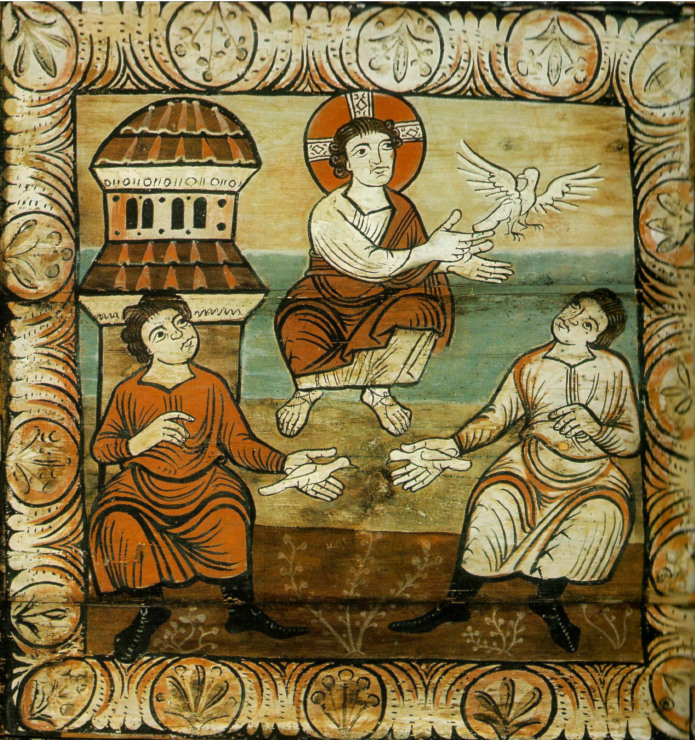
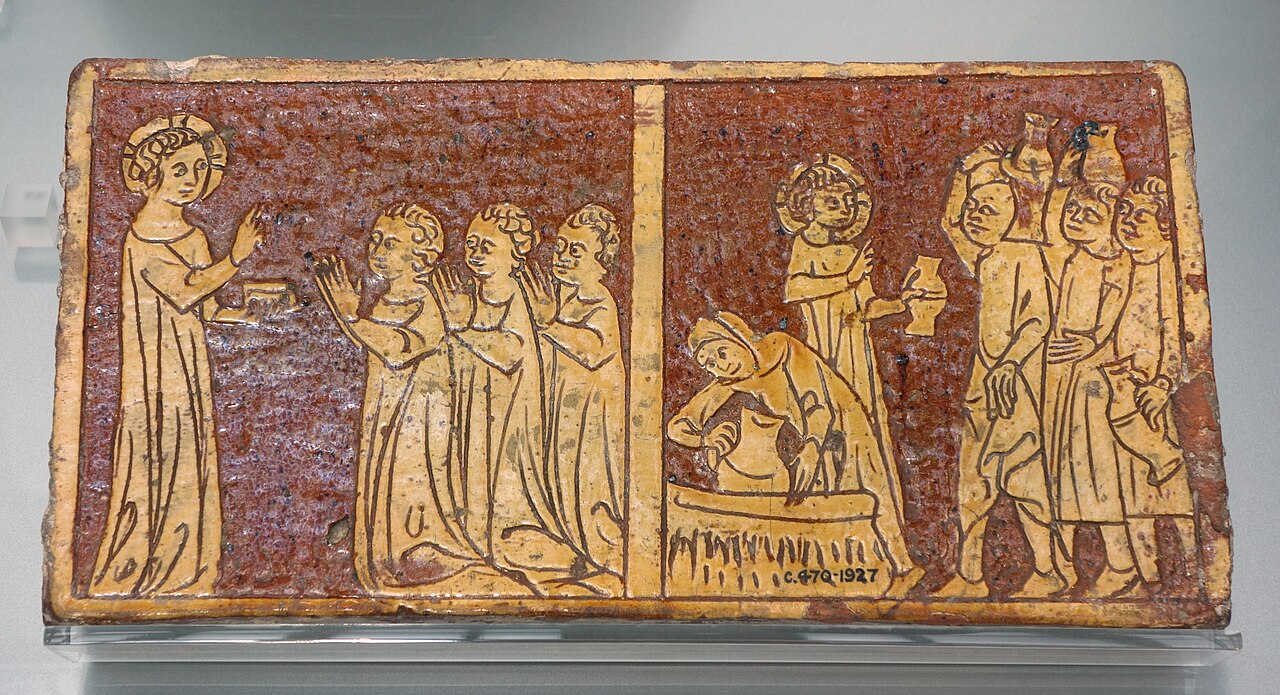
Despite this official rejection, the stories stayed popular in the Middle Ages.[2] The clay-sparrow story in particular appears often in Christian art.[2] A twelfth-century painted panel in the ceiling of St. Martin's Church at Zillis, Switzerland, shows the bringing to life of the birds.[1][2] A set of earthenware tiles said to come from the parish church of Tring, Hertfordshire, made in England around 1330, shows incidents from the apocryphal childhood stories of Christ, drawn from Pseudo-Matthew, the Infancy Gospel of Thomas and other tales.[9][1]
A twelfth-century painted ceiling panel in St. Martin's Church, Zillis, Switzerland, showing the boy Jesus bringing clay birds to life.
An earthenware wall tile of about 1330, probably from a church at Tring, Hertfordshire, now in the Victoria and Albert Museum, showing scenes from the apocrypha
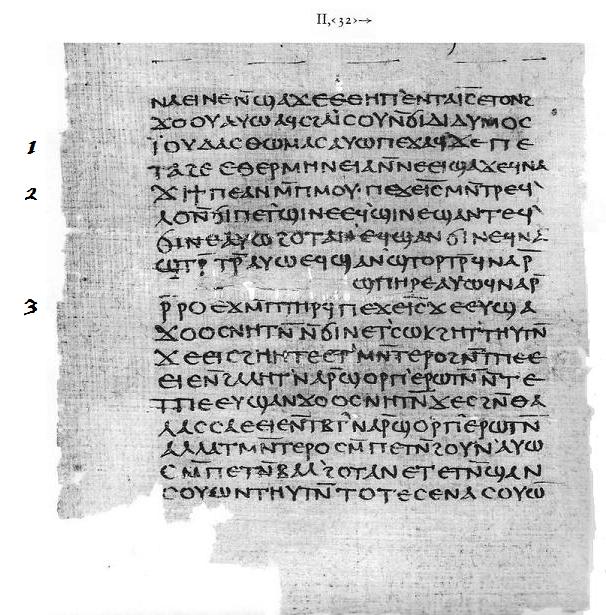
The Infancy Gospel of Thomas is a separate work from the Gospel of Thomas, although the two have sometimes been linked through the name Thomas.[2] The Gospel of Thomas is a collection of 114 sayings, most of them credited to Jesus, with no connected narrative and no focus on his death or resurrection.[10] It is known from three Greek papyrus fragments found at Oxyrhynchus in Egypt in 1897 and 1903, and from a complete fourth-century Coptic copy found near Nag Hammadi, Egypt, in December 1945, where it is the second text in the volume called Codex II.[10] The Infancy Gospel, by contrast, is a narrative of Jesus' childhood, and its earliest form carries no author's name at all.[1] The scholarly name Paidika is used partly to avoid this confusion.[2]
Page 32 of Nag Hammadi Codex II, a fourth-century Coptic manuscript, where the Gospel of Thomas begins; it is a different work from the Infancy Gospel.
Tony Burke, "Infancy Gospel of Thomas," e-Clavis: Christian Apocrypha, North American Society for the Study of Christian Apocryphal Literature (NASSCAL). Created October 2015; current as of May 2023. nasscal.com/e-clavis-christian-apocrypha/infancy-gospel-of-thomas/
Lajos Berkes and Gabriel Nocchi Macedo, "The Earliest Manuscript of the So-called Infancy Gospel of Thomas: Editio Princeps of P.Hamb.Graec. 1011," authors' copy in ORBi, University of Liège (published in Zeitschrift für Papyrologie und Epigraphik 229, 2024, pp. 68–74). orbi.uliege.be/bitstream/2268/331147/1/berkes_macedo_14.3.pdf
Humboldt-Universität zu Berlin, "Papyrologists decipher manuscript fragment and date it to the 4th to 5th century," press release via idw – Informationsdienst Wissenschaft, 4 June 2024. idw-online.de/en/news834714
Enrico Norelli, review of Reidar Aasgaard, The Childhood of Jesus: Decoding the Apocryphal Infancy Gospel of Thomas (Cascade Books, 2009), Bryn Mawr Classical Review 2010.08.09, August 2010. bmcr.brynmawr.edu/2010/2010-08-09.html
Glenn Davis, modified by Robert A. Kraft, "Extra-Canon Lists" ("Parabiblical" titles from lists, including the Decretum Gelasianum), University of Pennsylvania. Created 1997–2002; accessed 25 November 2026. ccat.sas.upenn.edu/rak/courses/735/Parabiblical/lists.htm