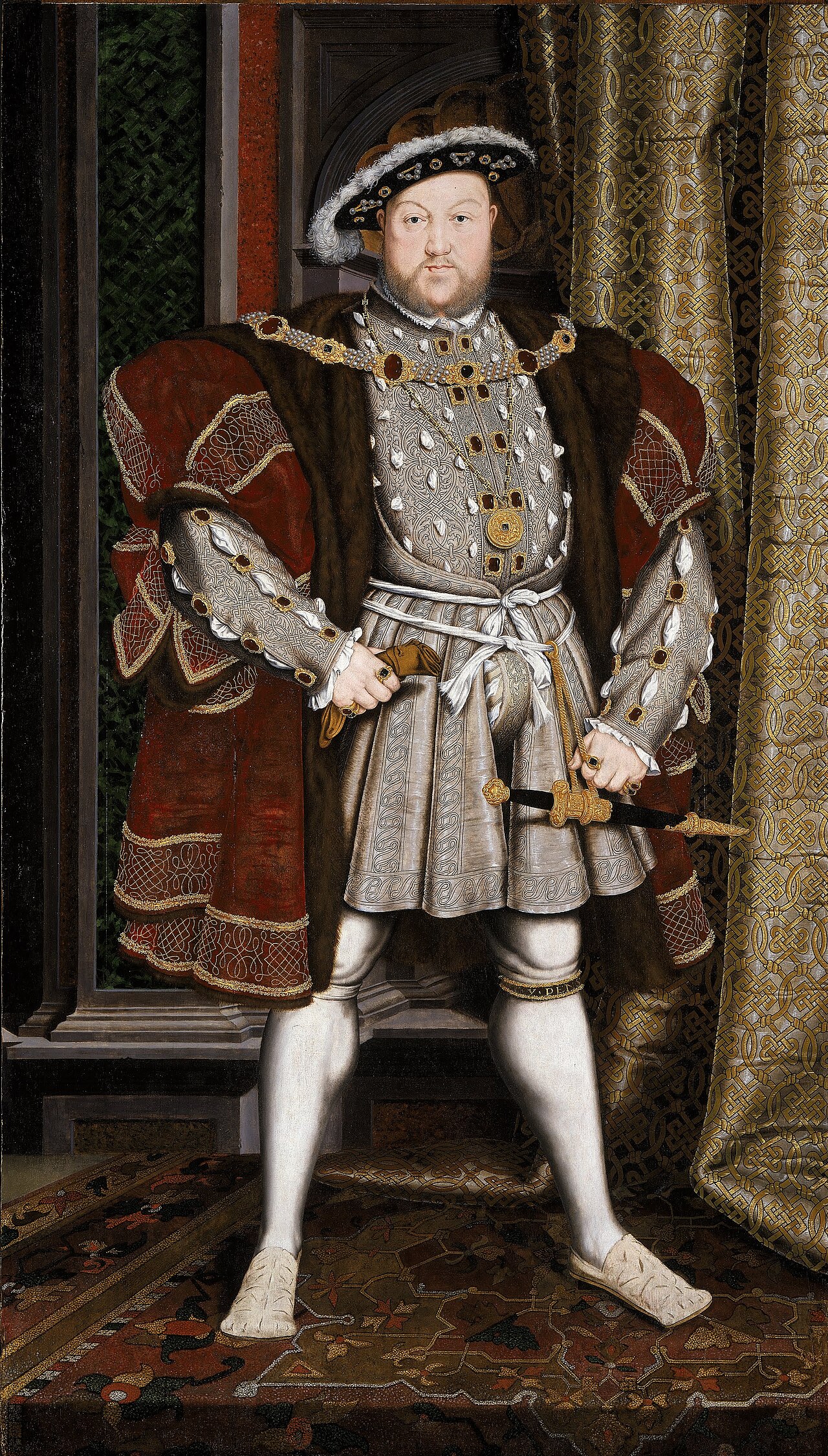
Henry VIII (1491–1547) was King of England from 1509 to 1547, and his reign saw the English Church separated from papal authority, with Parliament recognizing the king as its supreme head.[1][2]
Portrait of Henry VIII, by the Workshop of Hans Holbein the Younger, about 1540–1547, showing the king standing full length in court dress.
Henry was born at Greenwich on 28 June 1491, the second son of Henry VII, the first Tudor king, and of Elizabeth of York, a daughter of Edward IV.[1] He became heir to the throne when his elder brother, Arthur, died in 1502, and he succeeded his father in 1509.[1]
Arthur had married Catherine of Aragon in November 1501 and died about four months later.[3] Soon after his accession Henry married Catherine, his brother's widow.[1] Before the marriage, permission had been sought from the Pope and granted; such a permission is called a dispensation, meaning a waiver of a church rule.[3]
Wolsey and the early wars
In 1512, against the advice of his councillors, Henry joined his father-in-law, Ferdinand II of Aragon, in war against France.[1] Thomas Wolsey organized the king's first campaign in France, and in 1513 the Earl of Surrey defeated an invading Scottish army at Flodden.[1]
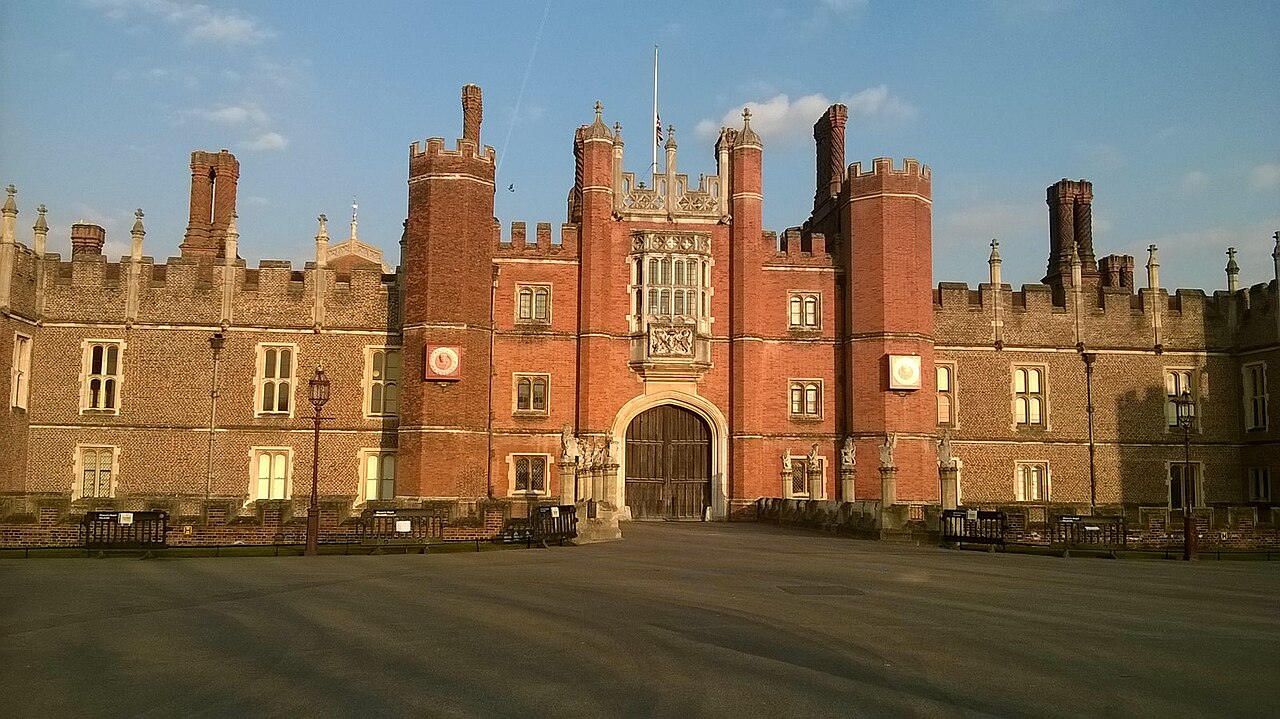
By 1515 Wolsey was Archbishop of York, Lord Chancellor and a cardinal, and Elton treats the years 1515 to 1527 as the period of his ascendancy.[1] Wolsey also served as papal legate, the Pope's personal representative, and from 1515 he rebuilt the manor of Hampton Court on a grand scale as a palace.[4]
In 1521 Henry wrote the Assertio septem sacramentorum, a book defending the seven sacraments against Martin Luther, and the Pope rewarded him with the title Defender of the Faith.[1]
The annulment question
An annulment is a ruling that a marriage was never valid in the first place. Henry and Catherine had six pregnancies, but only one child, Princess Mary, survived, and Historic Royal Palaces describes the marriage as failing amid miscarriages, stillbirths, and political and dynastic pressures.[4] In 1527 Henry told Catherine that he believed their marriage had been unlawful; he wanted a male heir, and he instructed Wolsey to seek an annulment so that he could marry Anne Boleyn.[3]
Henry's case rested on two verses of the Book of Leviticus that forbid a man to take his brother's wife, and he argued that the Pope had no power to waive that rule.[3] Catherine held that her marriage to Arthur had never been consummated, because of Arthur's poor health.[3] Thomas More, a firm believer in papal primacy, disagreed with Henry's view that the Pope could not grant such a waiver.[3] The papacy did not grant the annulment, and in 1529 Henry summoned a Parliament to settle what was called the king's "great matter."[5]
Wolsey failed to obtain the annulment and fell quickly from favour; he was arrested for treason and died at Leicester Abbey in 1530.[4] Henry took over Hampton Court, and in 1530 he and his councillors sent from it the first letter to Rome threatening a break with the papacy.[4]
The break with Rome
The Parliament that met from 1529 to 1536, later called the Reformation Parliament, passed laws on almost every area of national life, including religion, which had been a matter for the Church alone.[5] It transferred religious authority from the Pope to the English Crown, gave the Crown control of the old Church's wealth and buildings, settled official doctrine, and altered the succession by declaring some of the king's children illegitimate.[5]
According to Elton, Thomas Cromwell won control of the king's council in April 1532 and kept it for about eight years, with a policy of making the English Church independent of Rome under the king.[1] Henry married Anne Boleyn in January 1533.[1] On 23 May 1533, at Dunstable, Archbishop Thomas Cranmer pronounced the sentence ending Henry's marriage to Catherine; The National Archives holds a notification of that sentence.[6] Princess Elizabeth was born in September of that year, and the Pope excommunicated Henry, that is, expelled him from the communion of the Church.[1]
The Act of Supremacy of 1534 (26 Henry VIII, c. 1) defined the king's right to be "supreme head on earth of the Church of England," cutting the English Church's ties with Rome.[2] Denying the king's supremacy became treason.[7] Thomas More, who had been Speaker of the House of Commons in 1523, was tried in Westminster Hall in 1535 and executed.[5] About fifty other men were also put to death under the treason laws.[1] Henry rejected the Pope's authority but kept most of the doctrine he had inherited, although his views on details changed over time.[1]
Dissolution of the monasteries
In 1534–35 the Crown carried out the Valor Ecclesiasticus, a survey of the property and income of the Church across England, so that church revenues could be taxed accurately.[7] In 1535 Cromwell ordered inspections, called visitations, of the religious houses.[7] The National Archives notes that the charges brought against the monks of Bath, which mostly concerned immorality and relics, may have served as a pretext for closing houses.[7]
The monasteries were dissolved between 1536 and 1540, and their wealth passed to the Crown.[1] At Chertsey Abbey, which surrendered in 1537, the buildings were demolished and the materials reused at the royal palaces of Oatlands and Hampton Court.[7]
The west front and main gatehouse of Hampton Court Palace, the palace Henry VIII took over from Thomas Wolsey.
Catherine of Aragon (married 1509). The marriage was annulled by Cranmer's sentence in May 1533.[1][6] She died in 1536, shortly before Anne Boleyn's execution.[1] Their daughter became Mary I.[1]
Anne Boleyn (married January 1533). She was the mother of Elizabeth I.[1] In 1536 she was executed at the Tower of London on charges of adultery and incest; Elton describes the charge as alleged treasonable adultery.[4][1]
Jane Seymour (married May 1536). She gave birth to Prince Edward at Hampton Court in 1537 and died soon afterwards of complications from the birth.[4]
Anne of Cleves (married January 1540). The marriage was annulled after about six months, the divorce being signed at Hampton Court, and she stayed in England on good terms with the king.[4]
Catherine Howard (married 1540). On 2 November 1541 Cranmer told Henry that she had been accused of adultery; she was taken to the Tower on 7 February 1542 and beheaded on 13 February 1542.[4] Two men linked with her, Thomas Culpepper and Francis Dereham, were executed in December 1541.[4]
Kateryn Parr (married July 1543, in the Chapel Royal at Hampton Court). She outlived Henry, later married Thomas Seymour, and died in 1548.[4]
Government, Wales and Ireland
Elton credits Cromwell's work of the 1530s with bringing the king under the law and under the legislative supremacy of Parliament.[1] The parliament.uk account describes the same period as establishing the sovereignty of the "Crown-in-Parliament," meaning the monarch, Lords and Commons acting together, and quotes Henry telling Parliament that "we at no time stand so highly in our estate royal as in the time of parliament."[5]
The Laws in Wales Act 1535 declared Wales incorporated with England and extended English laws, including the laws of inheritance, to Wales.[8] A further Act of 1542 set out the laws to be used in Wales and divided it into twelve counties, eight of them old and four created under the 1535 Act.[9] In 1542 the Crown of Ireland Act, a statute of the old Irish Parliament, provided that the King of England, his heirs and his successors should be Kings of Ireland.[10]
Cromwell himself was executed in July 1540; Elton's account says that the failure of the Cleves marriage, which Cromwell had promoted, allowed his enemies to turn the king against him.[1]
Later wars and death
In 1542 war resumed between the emperor and the King of France; Henry sided with the emperor and the Scots with the French.[1] At Solway Moss in 1542 the Scots were routed, and the Scottish king died soon afterwards; a planned marriage alliance between the infant heirs of England and Scotland then failed.[1] The emperor made peace with France in 1544, but Henry kept fighting for two more years.[1] The wars were very costly: former monastic lands were sold, and the coinage was debased, which caused inflation.[1]
In late 1546 Henry destroyed the powerful Howard family, whom he suspected of plotting against his heir.[1] He died in London on 28 January 1547 and was succeeded by his young son, Edward VI.[1] All three of his children who survived him later reigned, as Edward VI, Mary I and Elizabeth I.[1]
Legacy and assessments
According to parliament.uk, the Reformation Parliament became "omnicompetent," meaning that no area of government lay outside its authority, and Henry's successors also used Parliament to change the nature, doctrine and authority of the Church.[5]
Historians judge Henry differently. Geoffrey Elton, writing for Britannica, credits him with giving the nation a visible symbol of its nationhood and with some work toward better government, a useful navy, a start on religious reform and social improvement, but concludes that he "was not a great man in any sense."[1] Elton describes him as cold, self-centred and suspicious, and as a king who raised able ministers and then turned on them, and who caused the deaths of leading English humanist scholars despite his own interest in humanist learning.[1] Elton also writes that Henry had not sought the supreme headship of the Church, and his account presents the separation from Rome as part of Cromwell's programme.[1] Historic Royal Palaces notes that historians argue Mary I was no more cruel than her half-siblings, since Henry VIII and Elizabeth I also sent people to the Tower for their religious beliefs.[4]
Douglas O. Linder. "Was Henry VIII's marriage to Catherine of Aragon contrary to the teachings of Leviticus?" Famous Trials. No date shown; accessed 25 November 2026. famous-trials.com/thomasmore/985-leviticus
Historic Royal Palaces. "History at Hampton Court Palace" (teachers' history notes, PDF). No date shown; accessed 25 November 2026. hrp.org.uk/media/1205/hcphistory_v1.pdf
The National Archives (UK). "Notification of the sentence of divorce between Henry VIII and Katherine of Aragon, at Dunstable", E 30/1025, dated 23 May 1533. No date shown; accessed 25 November 2026. images.nationalarchives.gov.uk/asset/15898