Bruce Lee (1940–1973) was a martial artist, actor and film-maker, born in San Francisco and raised in Hong Kong, who created the fighting approach Jeet Kune Do and became an international film star shortly before his death at 32.[1][2]
Early life in Hong Kong
Lee was born in San Francisco on 27 November 1940.[1][2] His Chinese name is given as Lee Jun-fan in a 2022 medical paper and as Lee Jun-fon by the Hong Kong government.[3][4] He was born in the United States because his father, a Cantonese opera performer, was on tour there, and the family returned to Hong Kong while he was still an infant.[2][3]
His father's work brought him into films early. The Bruce Lee Foundation dates his first screen appearance to 1941 and counts more than 20 films made as a child actor in Hong Kong.[1] The Hong Kong government's account of his life singles out "The Kid" (1950) and "Infancy" (1951), performances that earned him praise as a "genius child actor".[2]
At 13 he began studying the Wing Chun style of kung fu under the teacher Ip Man (also written Yip Man); the Foundation dates the start of this training to 1954.[1][2] He also danced, and the Foundation records that he won a cha-cha championship in Hong Kong in 1958.[1] In 1959, after finishing his last Hong Kong film of that period, "The Orphan", released in 1960, he left for the United States.[2]
Seattle and teaching in the United States
Lee arrived in San Francisco in 1959 and then settled in Seattle, Washington.[1] He was 19 when he came to Seattle, where he took classes at Seattle Central College.[5] He attended the University of Washington from 1961 to 1964 and majored in philosophy, according to public radio station KUOW and the Foundation; a 2022 paper says he studied drama as well as philosophy.[5][1][3]
While a student he taught martial arts, and a KUOW report describes him as willing to teach anyone who wanted to learn.[5] The Foundation dates the first of his schools, the Jun Fan Gung Fu Institute in Seattle, to 1963; a Hong Kong government account places the founding of his own institute in 1962.[1][2] He opened a second school in Oakland, California, in 1964 and a third in Los Angeles Chinatown in 1967.[1] Also in 1964, according to the Foundation, he demonstrated his "one-inch punch" at a martial arts exhibition in Long Beach, California, and was noticed by Hollywood.[1]
The Green Hornet
In 1965, 20th Century Fox invited Lee to play Kato, the masked hero's sidekick, in the television series "The Green Hornet".[2] The series was brought to ABC by William Dozier, executive producer of "Batman", and ran on ABC for a single season, 1966–1967, with 26 episodes.[6] The Television Academy's account of the series reports that its lead actor, Van Williams, asked for more screen time for Lee, and that the producers chose not to give more prominence to a non-white actor.[6] Lee later appeared in another short-lived ABC series, "Longstreet" (1971–1972).[6][1]
Jeet Kune Do
Lee developed his own approach to fighting, which he called Jeet Kune Do. The name is usually translated as "the Way of the Intercepting Fist".[3] According to the Foundation, the name first appeared in writing in 1967.[1] Jeet Kune Do drew together methods from several sources, including kung fu, fencing, boxing and philosophy.[3] The Hong Kong Heritage Museum describes it as a combination of various schools of martial arts.[4]
Lee also set down his ideas in letters and other writing.[4] His first published book was "Chinese Gung Fu: The Philosophical Art of Self-Defense", and "Tao of Jeet Kune Do" was first published in 1975, after his death.[4][1] He popularised philosophical sayings, the best known beginning "Be water, my friend".[3]
Hong Kong films
Lee returned to Hong Kong in 1971 and became a writer, director, lead actor and fight choreographer there.[2][3] In 1971 he starred in "The Big Boss", which was filmed in Thailand and, according to the Foundation, broke Hong Kong box-office records.[1][4] "Fist of Fury" followed in 1972.[1] Later that year he wrote, directed and starred in "The Way of the Dragon".[1] In 1972 he also began filming "Game of Death", whose yellow jumpsuit costume is among the items shown in the Hong Kong Heritage Museum's exhibition.[1][4]
Enter the Dragon
Lee interrupted work on "Game of Death" to make "Enter the Dragon", a co-production between Hollywood and Hong Kong.[1][7] Directed by Robert Clouse and shot on location in Hong Kong, it cast Lee as a Shaolin monk recruited by British intelligence to enter a martial arts tournament and track down a crime boss.[7] The Foundation describes Lee's role as the first time an Asian American actor took the lead in a Hollywood film.[1]
Warner Bros. released the film in the United States on 17 August 1973, about a month after Lee's death.[7] It grossed 21 million US dollars at the time and topped the US box office for its first two weeks of wide release, according to The Hollywood Reporter.[7] In 2004 it was added to the National Film Registry, the Library of Congress list of films chosen for preservation.[7]
Death
On 10 May 1973, two months before his death, Lee collapsed during a dubbing session in Hong Kong and was treated in hospital for cerebral oedema, a swelling of the brain.[3] He died in Hong Kong on 20 July 1973, aged 32, while still working on "Game of Death".[1][2]
A coroner's inquest in Hong Kong examined the death.[3][8] The post-mortem examination found severe cerebral oedema and no external injuries, and the death was officially attributed to cerebral oedema caused by hypersensitivity (an abnormal reaction) to Equagesic, a prescription painkiller combining aspirin and the tranquilliser meprobamate.[3] The coroner recorded a verdict of "death by misadventure", a form of accidental-death verdict.[8] The Bruce Lee Foundation likewise attributes his death to an allergic reaction to pain medication.[1]
The authors of a 2022 medical paper regard the cause as still unknown, noting among other points that Lee had taken Equagesic before, and other explanations have been put forward.[3] In 2018 the biographer Matthew Polly suggested heatstroke.[3] In a paper published in the Clinical Kidney Journal in 2022, a group of kidney specialists in Madrid proposed instead that the brain swelling was caused by hyponatraemia, an abnormally low level of sodium in the blood that can follow drinking more water than the kidneys can clear; the authors present this as a hypothesis based on publicly available information, and it contradicts the inquest's finding.[3]
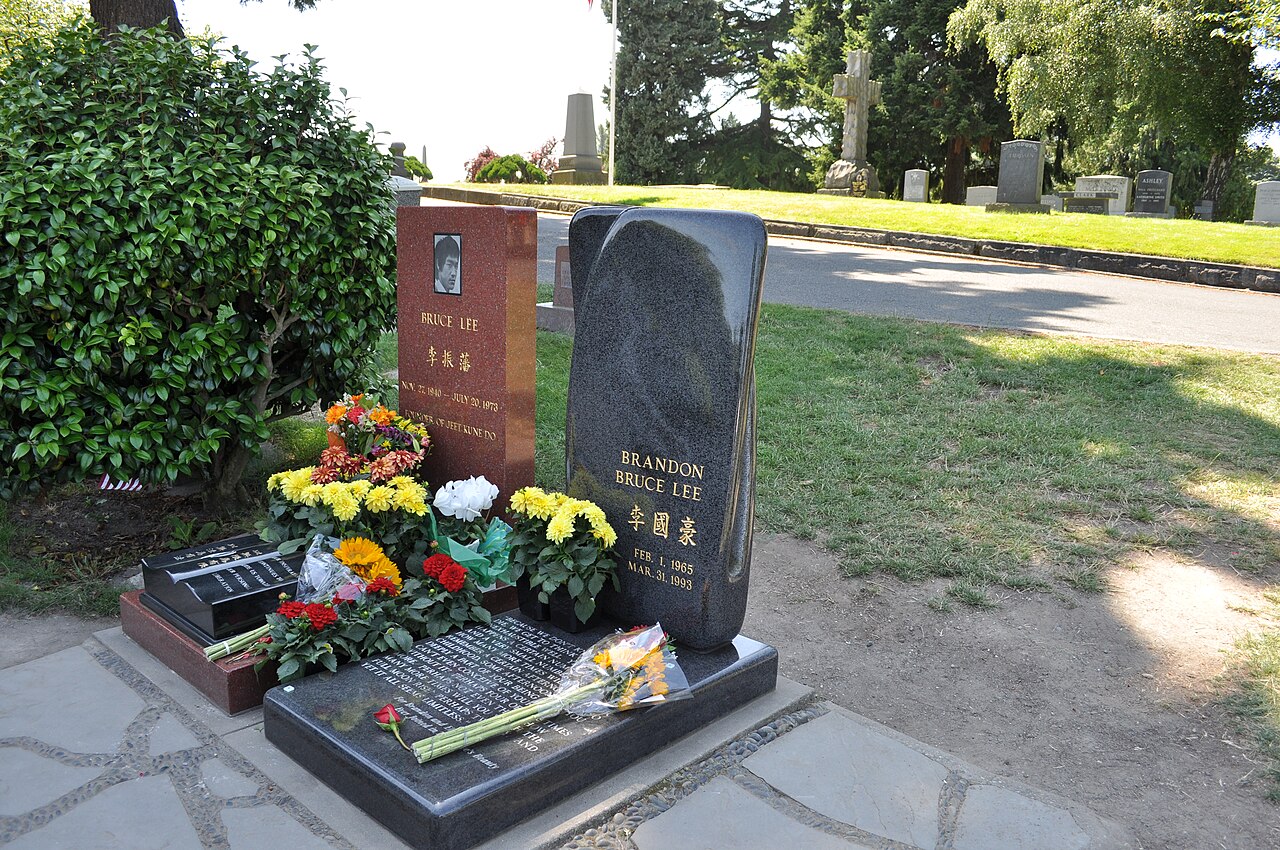
Lee had funerals in both Hong Kong and Seattle and was buried in Lake View Cemetery in Seattle.[9][1] His son, Brandon Lee, died in 1993 and is buried beside him.[9]
The headstones of Bruce Lee and his son Brandon Lee at Lake View Cemetery in Seattle, with flowers left by visitors.
Lee is credited with bringing wide attention to martial arts in the Western world, and "Enter the Dragon" with bringing Chinese kung fu cinema to international audiences.[3][2] Honours after his death include a star on the Hollywood Walk of Fame in 1993 and a place in Time magazine's 1999 list of the 100 most important people of the 20th century.[1] In 2012 the United States House of Representatives paid tribute to him as "a master teacher, a catalyst for social change and civil rights".[1]
The Bruce Lee Foundation was formed in 2002 to promote his legacy, and it runs educational programmes including Camp Bruce Lee.[1]
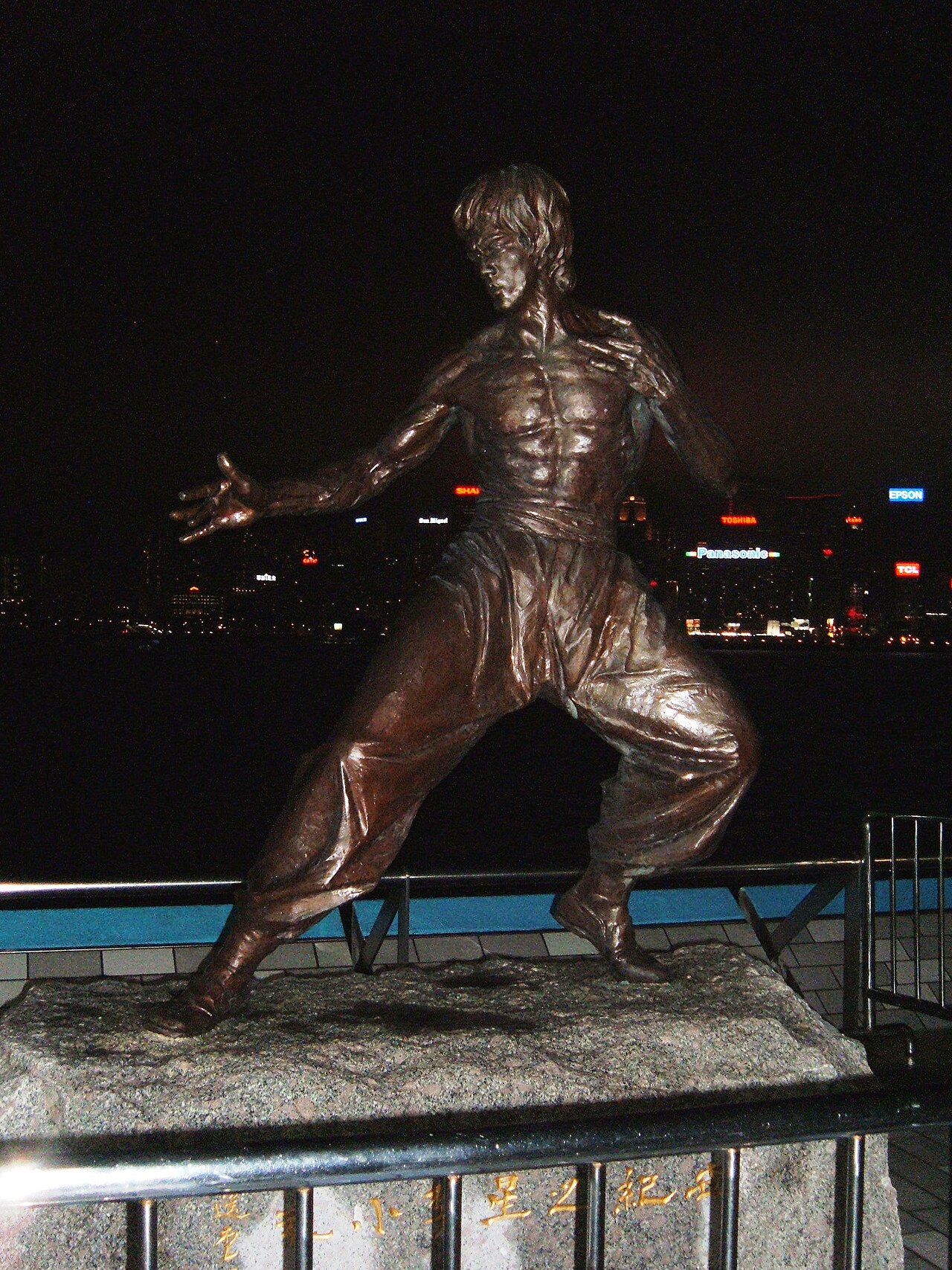
In Hong Kong, a 2.5-metre, 600-kilogram bronze statue of Lee by the sculptor Cao Chongen was unveiled on the Avenue of Stars, a harbourfront promenade modelled on the Hollywood Walk of Fame, on 27 November 2005, the 65th anniversary of his birth.[10] It was paid for after years of fund-raising and lobbying by the Bruce Lee Club, and its base carries the words "Star of the Century: Bruce Lee".[10]
The bronze statue of Bruce Lee on the Avenue of Stars in Hong Kong, photographed at night with Victoria Harbour behind it.
In July 2013, on the 40th anniversary of his death, the Hong Kong government's Leisure and Cultural Services Department opened the exhibition "Bruce Lee: Kung Fu • Art • Life" at the Hong Kong Heritage Museum in Sha Tin.[2] Planned to run for five years, it filled an 850-square-metre gallery with more than 600 items, reconstructed film sets and a 3.5-metre statue.[2] The museum and the Bruce Lee Foundation followed it with a second exhibition, "A Man Beyond the Ordinary: Bruce Lee", which opened on 28 November 2021 with about 400 items and was announced to run for five years, into 2026.[4]
In Seattle, the Wing Luke Museum has staged exhibitions on Lee's years in the city.[1][5]
Sources
Bruce Lee Foundation. "About Bruce Lee" (biography and timeline). Bruce Lee Foundation. No date shown; accessed 25 November 2026. bruceleefoundation.org/about-bruce-lee/
Hong Kong Government (Leisure and Cultural Services Department). "Bruce Lee exhibition unveiled today at Hong Kong Heritage Museum (with photos)". Press release, Government of the Hong Kong Special Administrative Region, 19 July 2013. info.gov.hk/gia/general/201307/19/P201307190587.htm
Villalvazo P, Fernandez-Prado R, Sánchez Niño MD, Carriazo S, Fernández-Fernández B, Ortiz A, Perez-Gomez MV. "Who killed Bruce Lee? The hyponatraemia hypothesis". Clinical Kidney Journal 15(12):2169–2176, December 2022 (online 10 March 2022). doi:10.1093/ckj/sfac071. doi.org/10.1093/ckj/sfac071
Hong Kong Government (Leisure and Cultural Services Department). "Hong Kong Heritage Museum to feature legendary story of martial arts superstar Bruce Lee (with photos)". Press release, Government of the Hong Kong Special Administrative Region, 26 November 2021. info.gov.hk/gia/general/202111/26/P2021112500732.htm