Jehovah's Witnesses reject the doctrine of the Trinity, teaching instead that Jehovah alone is Almighty God, that Jesus Christ is God's created and subordinate Son, and that the holy spirit is God's active force rather than a person.[1]
The Trinity and the Witness position
The Trinity is the teaching, held by the Catholic Church and most other churches, that there is one God in three persons: the Father, the Son and the Holy Spirit.[8] The Catechism of the Catholic Church states it in these words: "We do not confess three Gods, but one God in three persons, the 'consubstantial Trinity'", meaning that the three persons share one divine being and each is fully God.[8] A group that rejects this teaching is called non-trinitarian; an article in the New Georgia Encyclopedia describes the Witnesses' beliefs about the Trinity as one of the distinctive features of the movement.[7]
The Witnesses' fullest statement of their position is the brochure Should You Believe in the Trinity?, released in 1989.[2] As of November 2026 it is published on the Witnesses' website, jw.org, in chapters that cover how the Trinity is explained, how the doctrine developed, what the Bible says about God and Jesus, the holy spirit, and the Bible passages trinitarians cite in support of the doctrine.[1] The general history and organization of the movement are covered in Jehovah's Witnesses.
What Jehovah's Witnesses teach
God
Jehovah's Witnesses teach that Jehovah alone is supreme, the "Most High" and "God Almighty", and the brochure cites Genesis 17:1, Psalm 83:18 and Isaiah 45:5 for this.[1] The name itself is the subject of Jehovah.
Jesus Christ
Jehovah's Witnesses teach that Jesus is a created spirit being, made by God "as the beginning of God's invisible creations", who lived in heaven before he came to earth.[1] The brochure cites Colossians 1:15, which it quotes as calling him "the first-born of all creation", and Revelation 3:14, "the beginning of God's creation", as well as Proverbs 8 and John 3:13.[1] Because he had a beginning, the brochure says, Jesus "could never be coequal with God in power or eternity"; it describes God as the senior and Jesus as the junior "in time, position, power, and knowledge".[1]
The Witnesses teach that this subordination holds at every stage of Jesus' existence.[1] According to the brochure, Jesus was subordinate to God before he came to earth; on earth he prayed to his Father, said "The Father is greater than I" (John 14:28) and said he did not know the day or hour of the end (Mark 13:32); after his resurrection he remained in "a subordinate, secondary position"; and in the future he will continue to be "a separate, subordinate servant of God", citing 1 Corinthians 15:24 and 15:28.[1] The brochure also states that Jesus "had a God above him, a God whom he worshiped".[1] Jesus' death, which the Witnesses describe as a ransom, is covered in Ransom sacrifice.
Jehovah's Witnesses also teach that Michael the archangel is another name for Jesus, in particular in his existence before he became human; a 1 April 2010 Watchtower article sets out this teaching, citing Daniel 10:13 and 12:1, Jude 9, Revelation 12:7 and 1 Thessalonians 4:16.[3] That teaching is the subject of the entry Michael the archangel (Jehovah's Witnesses).
The holy spirit
Jehovah's Witnesses teach that the holy spirit is "God's active force that he uses to accomplish his will", not a person, and that it is "not equal to God" but subordinate to him; the brochure explains Bible passages that speak of the spirit as a person as personification, a common figure of speech in Scripture.[1] The teaching is covered in the entry Holy spirit (Jehovah's Witnesses).
The brochure discusses the opening verse of the Gospel of John, John 1:1, first among the passages it calls Trinity "proof texts".[1] The brochure quotes the 1950 New World Translation of the Christian Greek Scriptures, which renders the last clause "and the Word was a god".[1] It explains the rendering by pointing out that the Greek text has the definite article ("the") before the first occurrence of theos ("God") but not before the second, and says the second occurrence therefore describes a quality of the Word rather than identifying him as Almighty God.[1] The brochure sets this beside the King James Version, which reads "and the Word was God", and beside other renderings such as "the Word was divine" from a 1935 translation.[1]
The same section of the brochure also discusses other passages that trinitarians cite, including John 10:30, John 20:28, Philippians 2:6, Isaiah 9:6 and 1 John 5:7, the last of which it describes as a later addition to the text.[1]
History
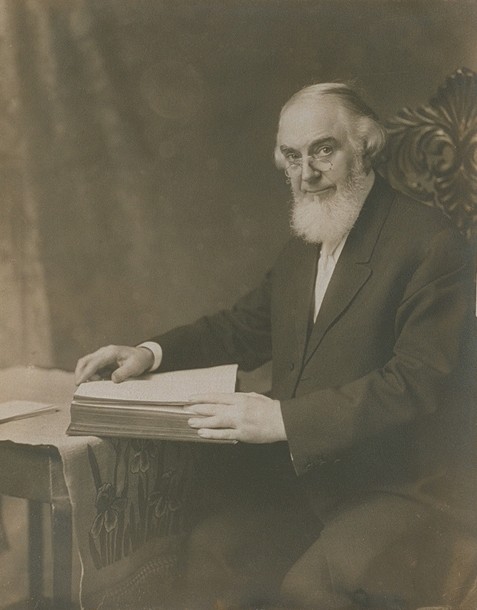
Charles Taze Russell, who organized the Bible Student movement from which Jehovah's Witnesses developed.
Jehovah's Witnesses developed from the Bible Student movement that Charles Taze Russell organized in Pennsylvania in the 1880s; the name "Jehovah's Witnesses" was adopted in 1931.[7] Russell rejected the idea that the Father and the Son are one person.[4] In The At-one-ment Between God and Man, the fifth volume of his Studies in the Scriptures, published in 1899, he wrote that neither Jesus nor the apostles had ever said that the Father and the Son "were one in person" or "equal in glory and in power", a claim he described as made "without divine authority" in "the creeds and catechisms of men".[4] In the same volume he wrote that the exaltation of Jesus did not mean "that the Father and the Son are one in person, for both persons are recognized", with the Father "as always, being given the first place".[4]
An October 1989 issue of Our Kingdom Ministry, a Witness publication, introduced the brochure as one of "three new releases" received at the "Godly Devotion" District Convention, and described its arguments as intended both to show that "the Trinity is a false doctrine to be rejected" and to help Witnesses explain their own understanding of God, his Son and the holy spirit to others.[2]
The brochure also gives the Witnesses' account of how the doctrine developed.[1] It states that the Council of Nicaea in 325, at which, it says, the Roman emperor Constantine presided, asserted that Christ was "of the same substance as God" but "did not establish the Trinity", and that the Council of Constantinople in 381 placed the holy spirit "on the same level as God and Christ".[1] Drawing on quotations from several encyclopaedias and church historians, the brochure concludes that the Trinity teaching is "a deviation from the truth".[1]
Comparison with Arianism
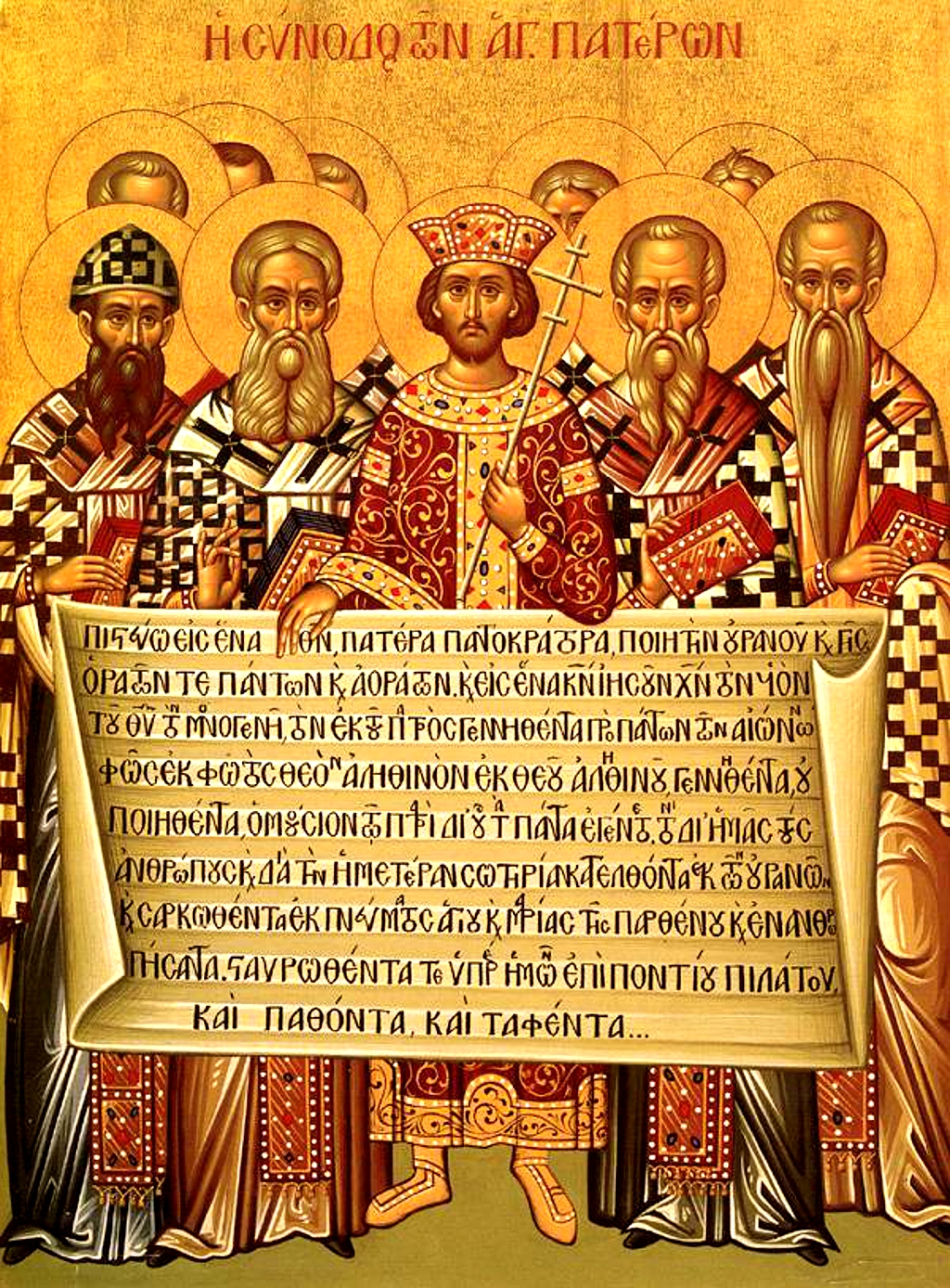
An Eastern Orthodox icon of the First Council of Nicaea (325), with the text of the Nicene Creed in Greek.
Via Wikimedia Commons: Nicaea icon by Unknown author Unknown author, public domain.
Arianism is the position, proposed by Arius, a priest in Alexandria in the early 4th century, that Jesus, as the Son of God, was created by God.[6] Encyclopaedia Britannica describes it as a Christological position (Christology being the doctrine of Christ) and notes that the Council of Nicaea condemned it as a heresy in 325, although it remained widespread in the Roman Empire after that.[6]
The New Georgia Encyclopedia states that the Witnesses' beliefs about the Trinity are similar to the ancient doctrine of Arius, and that the Witnesses regard the holy spirit as the power of God at work rather than as the third person of the Trinity.[7] A 1 September 1984 Watchtower article acknowledged that the Witnesses had been said to practise "a form of Arianism", quoting The New Encyclopædia Britannica: "The Christology of Jehovah's Witnesses, also, is a form of Arianism."[5] The article replied that "the fact that they are not Trinitarians does not make them Arians", and said the Witnesses disagree with Arius "in many respects", giving as one example Arius' claim that the Word became God's Son "by adoption" because of his moral integrity.[5]
How other churches respond
The Catholic Church's position is the one quoted above from its Catechism: one God in three persons, each of them fully God.[8]
The World Council of Churches (WCC), an international fellowship of churches, defines itself by a short statement called its basis.[9] The basis adopted at the WCC's first assembly in 1948 described it as "a fellowship of churches which accept our Lord Jesus Christ as God and Saviour".[9] After requests for "a more explicit expression of the Trinitarian faith", the third assembly in New Delhi in 1961 revised it to read that the WCC is "a fellowship of churches which confess the Lord Jesus Christ as God and Saviour according to the scriptures, and therefore seek to fulfill together their common calling to the glory of the one God, Father, Son and Holy Spirit".[9] The WCC describes the basis as a point of reference for its member churches and says that, since it is not itself a church, it "passes no judgment upon the sincerity or firmness" with which they accept it.[9]
Catholic practice on baptism draws on the same doctrine.[10] Under the Catholic norm, a valid baptism needs water, by immersion or pouring, and "the Trinitarian formula as found in the liturgical books", with reference to canons 849 and 850 of the Code of Canon Law.[10] As of November 2026, a list on the website of the Catholic Archdiocese of Baltimore, which draws on a 1995 pastoral handbook, places Jehovah's Witnesses under the heading "Some Ecclesial Communities without Valid Baptism".[10]
Sources
Watch Tower Bible and Tract Society of Pennsylvania. Should You Believe in the Trinity? (brochure, released 1989; online edition read in its chapters "What Does the Bible Say About God and Jesus?", "Is God Always Superior to Jesus?", "The Holy Spirit—God's Active Force", "What About Trinity 'Proof Texts'?", "How Did the Trinity Doctrine Develop?" and "Foreword"). jw.org. No date shown online; accessed 25 November 2026. jw.org/en/library/brochures/Should-You-Believe-in-the-Trinity/
"New Releases Help Us Train With Godly Devotion." Our Kingdom Ministry, October 1989, pp. 7–8. Watchtower Online Library. wol.jw.org/en/wol/d/r1/lp-e/201989368