In the teaching of Jehovah's Witnesses, the ransom sacrifice is Jesus' death as a perfect man, offered to God as a "corresponding ransom" for the perfect human life Adam lost, so that Adam's descendants can be freed from sin and death.[1][2]
The teaching
Jehovah's Witnesses teach that the ransom is "Jehovah's way of freeing humans from sin and death."[1] Their introductory study book gives the word two senses: a price paid to release someone or to buy something back, and a price that covers the cost of something.[1]
Witness publications teach that Adam possessed human perfection and lost it, both for himself and for all his offspring, when he sinned.[2] They teach that no human could pay for the perfect life Adam lost, and that the price had to be another perfect human life of the same value.[1] They call this "a corresponding ransom", a phrase they take from 1 Timothy 2:6, where the Greek word they render this way is antilytron (a noun for a ransom price).[1][2]
An April 1953 issue of The Watchtower stated that Jesus as a perfect man "corresponded exactly to Adam before that one sinned."[3] The same article taught that, as a spirit creature before his human birth, Jesus had to become human, because a spirit creature could no more provide the release than an imperfect human could.[3]
Jehovah's Witnesses teach that Jesus never sinned, that he gave his perfect life, and that he presented the value of his perfect human life to Jehovah as the ransom.[1] Their Bible encyclopaedia, Insight on the Scriptures, describes that value as presented "to the God of absolute justice in heaven."[2]
What the ransom is taught to achieve
A February 2017 study article in The Watchtower sets out what the ransom is taught to make possible. On the basis of Christ's sacrifice, it says, God forgives the sins of those who exercise faith and gives them the opportunity to reach perfection and live forever.[4] The same article teaches that the ransom makes possible the resurrection of the dead, and the gathering of 144,000 people to serve as kings and priests with Christ in heaven (see 144,000).[4] It ties the ransom to God's original purpose that the earth be filled with the perfect children of Adam and Eve, the subject of the entry Paradise earth.[4]
Witnesses also teach that the ransom answered a question about God's standards: by staying loyal, Jesus showed that a perfect human could keep perfect obedience to them, and so contributed to the sanctification, or honouring, of God's name.[4] Their study book says the ransom will benefit millions of people who have already died.[1]
Who benefits
Insight on the Scriptures teaches that Jesus' sacrificed life is not accepted by God as a ransom for the sinner Adam himself, but serves for the redemption of all mankind descended from Adam.[2] Witness publications describe the benefits as reaching those who exercise faith.[4]
A June 2011 study edition of The Watchtower explained that the ransom works out differently for two groups. It taught that a limited number, anointed with holy spirit, are declared righteous as God's spiritual sons and "joint heirs with Christ", while others are declared righteous as friends of God, in the way Abraham was.[5] Who belongs to each group is covered in the entries Anointed, Other sheep and Great crowd.
The Memorial
Jehovah's Witnesses hold a yearly observance of Jesus' death, called the Memorial or the Lord's Evening Meal, citing Jesus' words at Luke 22:19, "Keep doing this in remembrance of me"; their study book says attending it shows that a person remembers the ransom.[1] Who eats the bread and drinks the wine at the Memorial is covered in the entry Anointed.
Changes in the explanation
Witness publications have changed how they explain the correspondence between Jesus and Adam. A 15 March 2000 issue of The Watchtower said that Jesus had unborn offspring "in his loins" when he died, so that "the potential human race within his loins died with him."[6]
The June 2011 study edition revisited that idea. It acknowledged that Jesus, as a perfect man, could have fathered billions of perfect descendants, and that it had been understood that Jesus' life plus those potential descendants made a sacrifice equal to Adam and his descendants; a footnote names Insight on the Scriptures, Volume 2, page 736, as one place that view was printed.[5] The article then stated that "the Bible does not say that any potential offspring of Jesus formed part of the ransom," and that "Jesus' perfect life corresponded to Adam's," pointing to Romans 5:15-19, where the release comes through "one man."[5]
History in the movement
The Witnesses' official history, Jehovah's Witnesses—Proclaimers of God's Kingdom, names Henry Grew (1781-1862) and George Storrs (1796-1879) as earlier writers who expressed appreciation for the ransom sacrifice of Christ.[7]
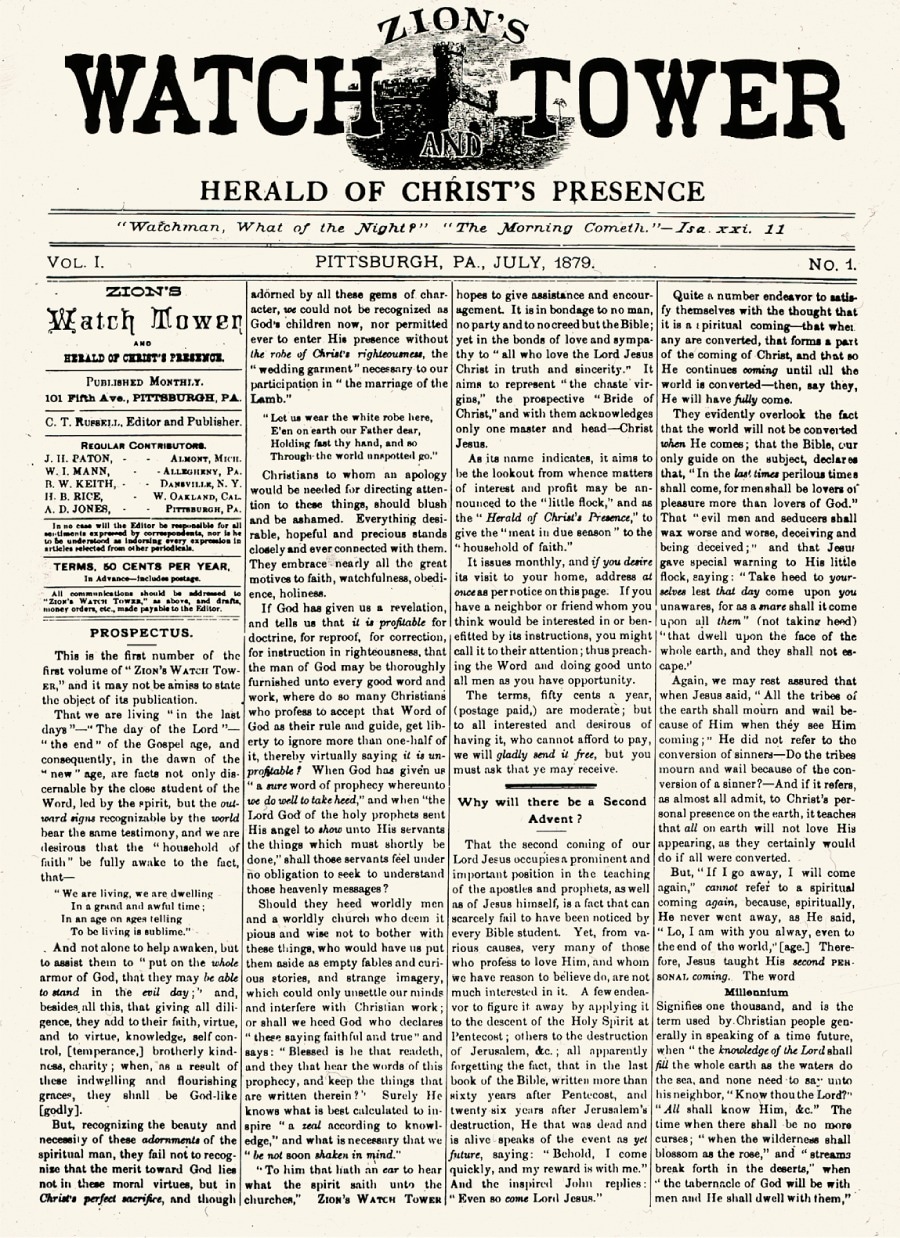
The same history describes the ransom as the cause of Charles Taze Russell's break with Nelson H. Barbour, the editor of Herald of the Morning in Rochester, New York.[7] Russell had put his own money into reviving that journal and had become one of its coeditors.[7] According to the Witness account, the August 1878 issue carried an article by Barbour that denied the substitutionary value of Christ's death, and in the next issue, September 1878, Russell answered with an article titled "The Atonement" that upheld the ransom.[7] The argument ran in the journal for several months; in the spring of 1879 Russell withdrew from fellowship with Barbour and stopped his financial support, and from the June 1879 issue his name no longer appeared as an assistant editor.[7] In July 1879 Russell began publishing Zion's Watch Tower and Herald of Christ's Presence, with a first printing of 6,000 copies.[7] The Witness history adds that Barbour kept publishing the Herald until 1903, according to available library records, and died in 1906.[7]
The July 1879 issue of Zion's Watch Tower and Herald of Christ's Presence , the magazine Charles Taze Russell started after leaving Herald of the Morning .
The Stanford Encyclopedia of Philosophy, in an entry first published in 2023, defines atonement in general terms as an act that reconciles a wrongdoer and a victim by removing or reducing the rift that a wrong has created between them.[8] Christians have explained Christ's death in several ways, and the Witness teaching can be set beside the main ones.
Early "ransom theory". The same entry describes a ransom view that was widespread in the first few centuries of Christianity, found in writers including Augustine and Gregory of Nyssa: humans who sinned fell under Satan's power, Satan brought about the death of the sinless Christ, and that unjust death worked as a ransom for which Satan owed God.[8] It notes that the view is rarely defended today.[8] A 2025 article in the Harvard Theological Review describes Origen's version, in which the devil demanded Jesus' soul as the ransom, and argues that for Origen Jesus' descent to the land of the dead completed the defeat of the devil that began when he offered himself as a ransom for humankind.[9] Witness publications, by contrast, describe the ransom as presented to God in heaven.[2]
Satisfaction. Anselm of Canterbury's Cur Deus Homo ("Why God Became Man") is described in the same philosophy entry as the most influential account of the doctrine of atonement.[8] Anselm argued that Satan had no right to treat humans as he did, and that the one paying recompense for sin had to be a human descendant of Adam who is also God.[8] Some critics, the entry notes, object that Anselm's idea of honour is at heart feudal.[8]
Penal substitution. This view, defended by many in the Reformed and wider evangelical tradition and rooted in Luther and Calvin, holds that Christ, instead of paying satisfaction for sin, suffered punishment on behalf of humans.[8] The philosophy entry also lists the "moral influence" view, often attributed to the twelfth-century theologian Peter Abelard, and the three-way grouping of atonement theories in a 1930 study by the theologian Gustaf Aulén: Christus Victor, forensic, and subjective or exemplarist.[8]
The trinitarian objection. Like Anselm, the Catholic Church ties the power of the sacrifice to Christ being divine as well as human. The Catechism of the Catholic Church states that "No man, not even the holiest, was ever able to take on himself the sins of all men," and that the existence in Christ of "the divine person of the Son" is what "makes possible his redemptive sacrifice for all."[10] It also says that Jesus "atoned for our faults and made satisfaction for our sins to the Father."[10] Jehovah's Witnesses teach instead that the ransom had to correspond exactly to the perfect man Adam.[3][5] The wider disagreement over who Jesus is lies outside this entry; see Jehovah's Witnesses.
"Ransom", Insight on the Scriptures, Volume 2. Watch Tower Bible and Tract Society of Pennsylvania, Watchtower Online Library. No date shown; accessed 25 November 2026. wol.jw.org/en/wol/d/r1/lp-e/1200003640