Compare versions
Version 1 → Version 2. Removed · Added. This shows the entry's text as it is written, including its formatting marks.
Version 1 · Version 2 · Version history
Side by side · Together
Elsa Schiaparelli (1890–1973) was an Italian-born fashion designer who ran a Paris couture house from 1927 to 1954, known for her collaborations with Surrealist artists and for the colour she named shocking pink.
## Early life and the road to Paris
Elsa Schiaparelli was born in Rome on 10 September 1890, to Maria-Luisa and Celestino Schiaparelli.[1] A 2026 review in Engelsberg Ideas describes the family as Roman aristocrats and scholars whose expectations she rebelled against.[6] She had no training as a dressmaker; she described what she did as "inventing" rather than sewing.[6]
In London she married the theosophist Wilhelm Wendt de Kerlor, and in 1916, during the First World War, the couple moved to New York, where she spent time with Gabrielle Buffet-Picabia and Man Ray.[1] Her daughter, Maria Luisa Yvonne Radha, known as "Gogo", was born on 15 June 1920.[1] After the marriage broke down she moved with Gogo to Paris in 1922.[1] There the couturier Paul Poiret encouraged her, and in 1925–1926 she became designer for Maison Lambal, a small Paris fashion house.[1]
## Founding the house
In 1927 Schiaparelli presented her first solo collections: hand-knitted sweaters with geometric patterns and trompe l'oeil (painted-to-look-real) bow-knots, which became a success.[1] The Victoria and Albert Museum (V&A) holds one of her earliest designs, a black jumper of 1927 with a white bow at the neck.[3] With funding from Charles Kahn, a co-director of Galeries Lafayette, she founded her own company and opened premises at 4 rue de la Paix in Paris.[1]
The house then grew quickly beyond clothing, according to the V&A's timeline of her life:[1]
- **1928:** she launched her first perfume, a unisex fragrance named S.
- **1931:** she became a French citizen.
- **1933:** she opened a London branch of her couture business at 6 Upper Grosvenor Street, Mayfair (it closed in 1939).
- **1934:** she became the first female fashion designer on the cover of *Time* magazine.
- **1935:** she moved her Paris salon to 21 Place Vendôme, with interiors by Jean-Michel Frank and Alberto Giacometti.
- **1937:** she launched the perfume *Shocking* and its namesake colour, Shocking Pink.
The Smithsonian Magazine credits her with popularising shocking pink.[5] Her clothes also reached the screen: Mae West wore bespoke Schiaparelli costumes in the 1937 film *Every Day's a Holiday*, and Marlene Dietrich was a client who favoured her tailored trouser suits.[1][2]
## Surrealism and collaboration
The V&A's timeline notes that André Breton's 1924 Surrealist Manifesto strongly influenced her work.[1] In the late 1930s she worked with Surrealist artists on some of her best-known pieces. With Salvador Dalí she made the Skeleton dress and the Tears dress (both 1938) and a hat in the form of an upside-down shoe; the V&A also shows Dalí's *Lobster Telephone* (1938) alongside the 1937 Lobster dress that inspired it.[2]
Jean Cocteau designed an embroidered evening coat of 1937, made with the embroidery house Lesage.[4] The Smithsonian Magazine describes the illusion on its back: a vase of flowers formed in the space between two profiles facing each other.[5] The V&A also records two 1938 collections, the Pagan and the Circus, and says that posters by Jules Chéret and Henri de Toulouse-Lautrec inspired some of her designs.[3]
Her rival [Coco Chanel](/t/3341/coco-chanel) is reported to have dismissed her as "that Italian artist who's making clothes."[2][5] Schiaparelli herself is quoted by the V&A: "For me, dress designing is not a profession but an art."[4]
## War, exile and the closing of the salon
The V&A's timeline records that in 1939 she closed her London premises and, with the outbreak of the Second World War, encouraged Americans to support the French couture sector.[1] After the German occupation of Paris she left France in 1940 for a lecture tour of 30 US cities titled "Clothes Make the Woman."[1] She spent the war years in New York, apart from a brief return to Paris; the same timeline says the FBI monitored her on suspicion of espionage and closed its investigation for lack of evidence.[1] In 1942 she organised the exhibition *First Papers of Surrealism* in New York with André Breton and Marcel Duchamp, and her Paris salon was seized and placed under German administration.[1]
She returned to Paris after the war ended in Europe and presented her first post-war collection in 1945.[1] Between 1951 and 1953 she signed licensing agreements with American manufacturers for lingerie, menswear, eyewear and other products, and designed costumes inspired by Henri de Toulouse-Lautrec for Zsa Zsa Gabor in *Moulin Rouge*.[1] In 1954 her autobiography *Shocking Life* was published and she closed her Paris couture salon, though her perfume business continued.[1] Smithsonian Magazine adds that production at the house declined in the 1940s, largely because of the war, and says that when she retired in 1954 her business declared bankruptcy.[5]
In 1971 Cecil Beaton curated *Fashion: An Anthology* at the V&A, the largest display of her work to that date, including garments she had donated.[1] She died at home in Paris in 1973, aged 83.[1]
## Revival of the house
According to the V&A, the acquisition of the Schiaparelli archives and name rights between 2006 and 2012 paved the way for the house's revival, and the salon reopened at 21 Place Vendôme in 2012.[1] Smithsonian Magazine puts it more briefly: the label stayed dormant for decades until an Italian businessman bought it in 2007 and relaunched it in 2012.[5] In 2017 the house was officially granted Haute Couture status by France's Ministry of Industry and the Haute Couture and Fashion Federation.[1]
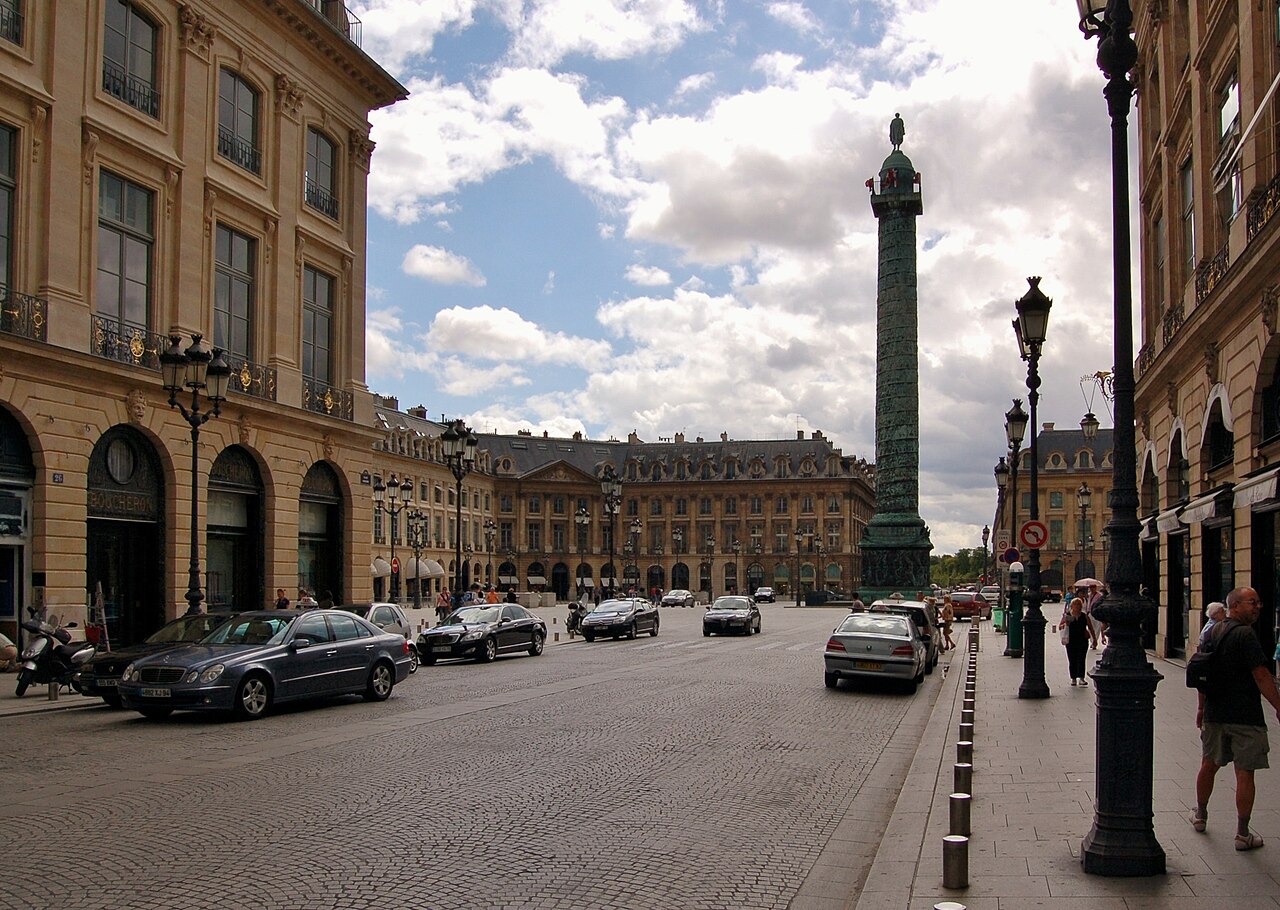
*Via Wikimedia Commons: [Place Vendôme (Paris), 2006 (01)](https://commons.wikimedia.org/wiki/File:Place_Vend%C3%B4me_(Paris),_2006_(01).jpg) by Bahnfrend, [CC BY-SA 4.0](https://creativecommons.org/licenses/by-sa/4.0).*
Daniel Roseberry was appointed creative director in 2019, and in 2024 he received the International Designer of the Year Award from the Council of Fashion Designers of America.[1] As of November 2026, the V&A's exhibition page names him as the house's creative director,[4] and the V&A's timeline says the house celebrates its centenary in 2027.[1]
## Sources
1. Victoria and Albert Museum, "Elsa Schiaparelli: a timeline", article of 26 March 2026. https://www.vam.ac.uk/articles/elsa-schiaparelli-a-timeline
2. Victoria and Albert Museum, "Five things to know about Schiaparelli", 2026. https://www.vam.ac.uk/articles/five-thing-to-know-about-schiaparelli
3. Victoria and Albert Museum, collections page "Elsa Schiaparelli". https://vam.ac.uk/collections/elsa-schiaparelli
4. Victoria and Albert Museum, "Schiaparelli: Fashion Becomes Art", exhibition page (28 March to 15 November 2026). https://www.vam.ac.uk/exhibitions/schiaparelli
5. Smithsonian Magazine, "The Surrealism-inspired fashions of Elsa Schiaparelli take the spotlight in London", 2026. https://www.smithsonianmag.com/smart-news/the-surrealism-inspired-fashions-of-elsa-schiaparelli-take-the-spotlight-in-london-180988503/
6. Muriel Zagha, "Elsa Schiaparelli's baroque fantasy", Engelsberg Ideas, 2026. https://engelsbergideas.com/reviews/elsa-schiaparellis-baroque-fantasy/
