Version 2
Nov 26, 2026. Compare with the current version · Version history
Elsa Schiaparelli (1890–1973) was an Italian-born fashion designer who ran a Paris couture house from 1927 to 1954, known for her collaborations with Surrealist artists and for the colour she named shocking pink.
Early life and the road to Paris
Elsa Schiaparelli was born in Rome on 10 September 1890, to Maria-Luisa and Celestino Schiaparelli.[1] A 2026 review in Engelsberg Ideas describes the family as Roman aristocrats and scholars whose expectations she rebelled against.[6] She had no training as a dressmaker; she described what she did as "inventing" rather than sewing.[6]
In London she married the theosophist Wilhelm Wendt de Kerlor, and in 1916, during the First World War, the couple moved to New York, where she spent time with Gabrielle Buffet-Picabia and Man Ray.[1] Her daughter, Maria Luisa Yvonne Radha, known as "Gogo", was born on 15 June 1920.[1] After the marriage broke down she moved with Gogo to Paris in 1922.[1] There the couturier Paul Poiret encouraged her, and in 1925–1926 she became designer for Maison Lambal, a small Paris fashion house.[1]
Founding the house
In 1927 Schiaparelli presented her first solo collections: hand-knitted sweaters with geometric patterns and trompe l'oeil (painted-to-look-real) bow-knots, which became a success.[1] The Victoria and Albert Museum (V&A) holds one of her earliest designs, a black jumper of 1927 with a white bow at the neck.[3] With funding from Charles Kahn, a co-director of Galeries Lafayette, she founded her own company and opened premises at 4 rue de la Paix in Paris.[1]
The house then grew quickly beyond clothing, according to the V&A's timeline of her life:[1]
- 1928: she launched her first perfume, a unisex fragrance named S.
- 1931: she became a French citizen.
- 1933: she opened a London branch of her couture business at 6 Upper Grosvenor Street, Mayfair (it closed in 1939).
- 1934: she became the first female fashion designer on the cover of Time magazine.
- 1935: she moved her Paris salon to 21 Place Vendôme, with interiors by Jean-Michel Frank and Alberto Giacometti.
- 1937: she launched the perfume Shocking and its namesake colour, Shocking Pink.
The Smithsonian Magazine credits her with popularising shocking pink.[5] Her clothes also reached the screen: Mae West wore bespoke Schiaparelli costumes in the 1937 film Every Day's a Holiday, and Marlene Dietrich was a client who favoured her tailored trouser suits.[1][2]
Surrealism and collaboration
The V&A's timeline notes that André Breton's 1924 Surrealist Manifesto strongly influenced her work.[1] In the late 1930s she worked with Surrealist artists on some of her best-known pieces. With Salvador Dalí she made the Skeleton dress and the Tears dress (both 1938) and a hat in the form of an upside-down shoe; the V&A also shows Dalí's Lobster Telephone (1938) alongside the 1937 Lobster dress that inspired it.[2]
Jean Cocteau designed an embroidered evening coat of 1937, made with the embroidery house Lesage.[4] The Smithsonian Magazine describes the illusion on its back: a vase of flowers formed in the space between two profiles facing each other.[5] The V&A also records two 1938 collections, the Pagan and the Circus, and says that posters by Jules Chéret and Henri de Toulouse-Lautrec inspired some of her designs.[3]
Her rival Coco Chanel is reported to have dismissed her as "that Italian artist who's making clothes."[2][5] Schiaparelli herself is quoted by the V&A: "For me, dress designing is not a profession but an art."[4]
War, exile and the closing of the salon
The V&A's timeline records that in 1939 she closed her London premises and, with the outbreak of the Second World War, encouraged Americans to support the French couture sector.[1] After the German occupation of Paris she left France in 1940 for a lecture tour of 30 US cities titled "Clothes Make the Woman."[1] She spent the war years in New York, apart from a brief return to Paris; the same timeline says the FBI monitored her on suspicion of espionage and closed its investigation for lack of evidence.[1] In 1942 she organised the exhibition First Papers of Surrealism in New York with André Breton and Marcel Duchamp, and her Paris salon was seized and placed under German administration.[1]
She returned to Paris after the war ended in Europe and presented her first post-war collection in 1945.[1] Between 1951 and 1953 she signed licensing agreements with American manufacturers for lingerie, menswear, eyewear and other products, and designed costumes inspired by Henri de Toulouse-Lautrec for Zsa Zsa Gabor in Moulin Rouge.[1] In 1954 her autobiography Shocking Life was published and she closed her Paris couture salon, though her perfume business continued.[1] Smithsonian Magazine adds that production at the house declined in the 1940s, largely because of the war, and says that when she retired in 1954 her business declared bankruptcy.[5]
In 1971 Cecil Beaton curated Fashion: An Anthology at the V&A, the largest display of her work to that date, including garments she had donated.[1] She died at home in Paris in 1973, aged 83.[1]
Revival of the house
According to the V&A, the acquisition of the Schiaparelli archives and name rights between 2006 and 2012 paved the way for the house's revival, and the salon reopened at 21 Place Vendôme in 2012.[1] Smithsonian Magazine puts it more briefly: the label stayed dormant for decades until an Italian businessman bought it in 2007 and relaunched it in 2012.[5] In 2017 the house was officially granted Haute Couture status by France's Ministry of Industry and the Haute Couture and Fashion Federation.[1]
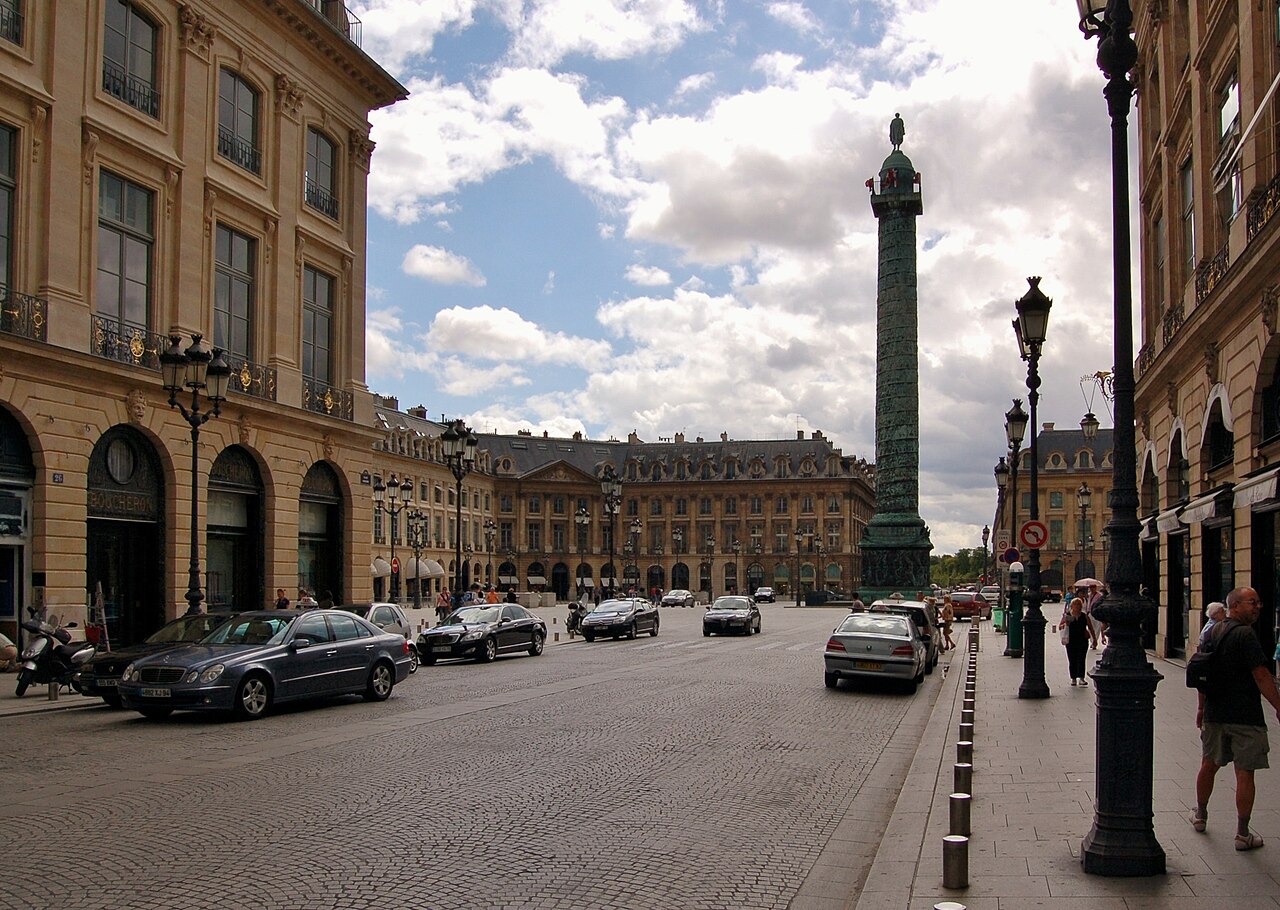
Via Wikimedia Commons: Place Vendôme (Paris), 2006 (01) by Bahnfrend, CC BY-SA 4.0.
Daniel Roseberry was appointed creative director in 2019, and in 2024 he received the International Designer of the Year Award from the Council of Fashion Designers of America.[1] As of November 2026, the V&A's exhibition page names him as the house's creative director,[4] and the V&A's timeline says the house celebrates its centenary in 2027.[1]
Sources
- Victoria and Albert Museum, "Elsa Schiaparelli: a timeline", article of 26 March 2026. vam.ac.uk/articles/elsa-schiaparelli-a-timeline
- Victoria and Albert Museum, "Five things to know about Schiaparelli", 2026. vam.ac.uk/articles/five-thing-to-know-about-schiaparelli
- Victoria and Albert Museum, collections page "Elsa Schiaparelli". vam.ac.uk/collections/elsa-schiaparelli
- Victoria and Albert Museum, "Schiaparelli: Fashion Becomes Art", exhibition page (28 March to 15 November 2026). vam.ac.uk/exhibitions/schiaparelli
- Smithsonian Magazine, "The Surrealism-inspired fashions of Elsa Schiaparelli take the spotlight in London", 2026. smithsonianmag.com/smart-news/the-surrealism-inspired-fashions-of-e…
- Muriel Zagha, "Elsa Schiaparelli's baroque fantasy", Engelsberg Ideas, 2026. engelsbergideas.com/reviews/elsa-schiaparellis-baroque-fantasy/
