Coco Chanel
French couturière who founded the fashion house Chanel
French couturière who founded the fashion house Chanel

Gabrielle "Coco" Chanel (1883–1971) was a French couturière who founded the fashion house Chanel and worked in fashion for about sixty years, from a millinery shop opened in Paris in 1910 to her final collection in 1971.[2]
Gabrielle Chanel was born in 1883 in the Loire Valley of western France and grew up in poverty. Her mother died when she was 11, and her father then placed her and her two sisters in a Catholic convent-orphanage at Aubazine.[3] At about 20 she worked as a seamstress and sang at a café frequented by cavalry officers, where she gained the nickname "Coco".[3]
The V&A dates the start of her career in fashion to the opening of her first millinery boutique in Paris in 1910, and her last collection to 1971.[2] The V&A's exhibition on her work traced the establishment of the House of Chanel and the evolution of her design style, and the museum says her style continues to influence the way women dress.[1] Among the dated pieces it showed were a marinière blouse from spring/summer 1916, costumes for the ballet Le Train Bleu from 1924 and a trouser suit from 1937–38.[1]
In 1923 an acquaintance introduced Chanel to a social circle that included British royals and Winston Churchill, and she began a relationship of roughly ten years with the Duke of Westminster, which also opened the English market to her fashion business.[3] A 2025 biographical article states that in 1924 the Jewish Wertheimer family backed the launch of her perfume line in exchange for most of the profits.[5]
The V&A says that by November 1916 British and American Vogue declared that "Chanel is master of her art, and her art resides in jersey", a knitted fabric.[6] The same article says she promoted black from the late 1910s, and that in October 1926 American Vogue predicted her black crêpe de chine day dress would be "the frock that all the world will wear".[6] Tweed suits first appeared in her collections in the 1920s, moving from sports and outdoor wear to fashionable daywear.[6] Her boutiques sold costume jewellery from the early 1920s; in 1931 she was described as "largely responsible for the vogue for artificial pearls".[6]
After her return to fashion in 1954, the V&A says, the Chanel suit became closely tied to the house's look.[6]
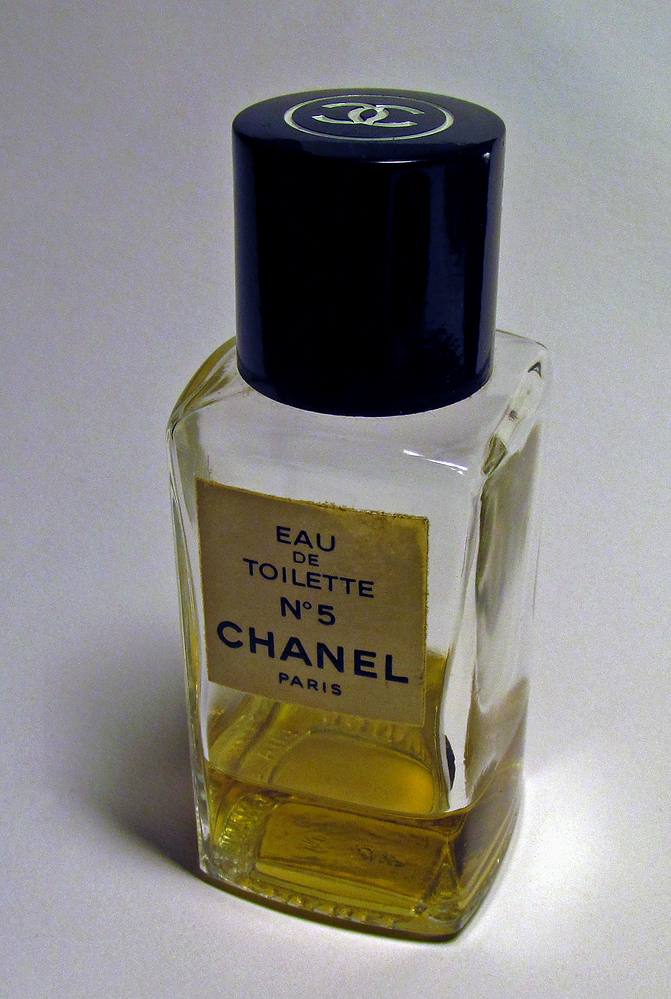
Via Wikimedia Commons: CHANEL N°5 by Foto: Jonn Leffmann, CC BY 3.0.
Chanel No. 5 was launched in 1921 and became the house's signature scent; the perfumer Ernest Beaux created it, and Chanel chose sample number five.[6] History.com gives the launch date as 5 May 1921, at her boutique on the Rue Cambon in Paris, and says the choice of the number may reflect her interest in the number five.[7] The square bottle's stopper became faceted and octagonal in 1924.[6]
The V&A says the quilted 2.55 handbag was launched in February 1955, and that Karl Lagerfeld, the house's later designer, re-released the original design for its 50th anniversary.[6] In 1962 Chanel chose the shoemaker Massaro, based on the rue de la Paix, to develop the two-tone shoe; versions in brown, navy and gold toecap followed.[6]
What Chanel did during the German occupation of France is documented partly and disputed in its details. Accounts agree on the outline: she lived at the Hôtel Ritz in Paris with Baron Hans Günther von Dincklage, a German officer and embassy attaché, who was 13 years her junior.[3][4] One account says the relationship began in 1941,[3] another places its start in 1940, after the occupation began.[5]
Two articles say that she was registered as an agent of the German military intelligence service, the Abwehr, with the number F-7124 and the code name "Westminster", and that her nephew André Palasse, held in a German prisoner-of-war camp, was later released.[4][5] PBS's article says no documentation of her Madrid mission was recovered.[3] The accounts differ on the date of a later scheme, called Operation Modellhut, to carry a peace proposal to Churchill. One places it in April 1943,[4] another in winter 1943,[3] another in late 1943 and early 1944.[5] All three say it failed after Vera Lombardi denounced Chanel and her associates in Madrid.[3][4][5]
The AFP report carried by FashionUnited says she also tried to use Nazi "aryanisation" laws to take back her perfume business from the Wertheimer brothers, who had moved it to a non-Jewish businessman before fleeing.[4] It cites Hal Vaughan's 2011 book Sleeping With the Enemy, which calls her a "fanatical anti-Communist" and "a vicious anti-Semite". Edmonde Charles-Roux, who wrote a biography of Chanel, said Chanel never made anti-Semitic remarks to her, and the Wertheimer family denied the claim while acknowledging "an element of mystery" about her wartime activities.[4]
After the liberation of Paris in August 1944 she was arrested and questioned. PBS says she was released after several hours because there was no hard evidence;[3] the AFP report says Churchill's intervention secured her release.[4] Biography.com says she was questioned by the Free French Purge Committee and fled to Switzerland, and that she never faced consequences for her dealings.[5]
The sources date the reopening of her fashion house to 1953 (after a deal with the Wertheimers)[4] or to 1954, "aided by" the family.[5] PBS says only that by the mid-1950s she was designing again.[3] She died on 10 January 1971 at the Ritz in Paris.[3]
Gabrielle Chanel. Fashion Manifesto, the first UK exhibition devoted to her work, ran at the V&A South Kensington from 16 September 2023 to 10 March 2024, in partnership with Paris Musées and the Palais Galliera, and with support from Chanel.[1]
Added a Later designs section (the 2.55 handbag and the two-tone shoe, from the V&A article, source 6), requested pictures and finished the entry.
 Get Micwyn on your home screenIts own icon, full screen, and notifications.