Sirach is a book of Jewish wisdom teaching written in Hebrew by Jesus ben Sira, a scribe of Jerusalem, in the early second century BCE, and counted as scripture by the Catholic and Orthodox churches but not by Jews or Protestants.[1][4][8]
Names
Greek manuscripts usually title the book the "Wisdom of Jesus, the son of Sirach".[3] Rabbinic writers generally quote it simply as "Ben Sira", and the Talmud also calls it "Hokhma" ("Wisdom").[3] The Jewish Encyclopedia gives its Hebrew name as Ḥokmat ben Sira.[2] Jerome reported that the Hebrew title in his day was "Mishle" ("Proverbs" or "Parables") of Jesus son of Sirach.[3]
In the Latin-speaking church the book became known as Ecclesiasticus, a name the Latin Church Fathers used from Cyprian onward.[2] The Catholic Encyclopedia (1909) describes the word as Greek with a Latin ending and explains it as meaning "a church reading book", a name it links to the book's heavy use for public reading and instruction in church.[3] The Council of Trent used this title in its 1546 list of the books of the Bible.[3][7] It is a different book from Ecclesiastes.[3]
Author and date
The author is the only writer of the Old Testament or the Apocrypha (books found in the Greek and Latin Old Testaments but not in the Hebrew Bible) who signed his work.[2] The Greek text calls him "Jesus the son of Sirach of Jerusalem".[2] The Jewish Encyclopedia (published 1901–1906) concluded from the evidence that his full name was Jesus son of Simon son of Eleazar ben Sira.[2] He was commonly known by the surname Ben Sira, as both the Hebrew text and the ancient translations show.[3] Britannica describes him as a scribe.[1]
The latest possible date of writing comes from the grandson's translation, made after 132 BCE.[1][2] Within that limit, scholars have given somewhat different dates:
The Jewish Encyclopedia placed the book in the first third of the second century BCE, before the persecution of the Jews under King Antiochus in 168 BCE, which the author does not mention.[2]
The Catholic Encyclopedia (Francis Gigot, 1909) dated it to roughly 190–170 BCE, counting back from the grandson, and noted an older view that put it about a century earlier, around 280 BCE; the dating depends partly on which high priest named Simon the book praises, and Gigot favoured Simon II.[3]
Britannica gives about 180–175 BCE.[1]
Lindsey Askin (University of Cambridge thesis, 2016) gives a range between 198 and 175 BCE, in Jerusalem.[4]
The Greek translation and its prologue
The Greek version opens with a prologue by the translator, who says he was the author's grandson.[2] He writes that he came to Egypt in the thirty-eighth year of King Euergetes and translated his grandfather's book there.[2][3] Two Ptolemaic kings bore the name Euergetes; the Catholic Encyclopedia identifies the later one, whom it numbers Ptolemy VII (Physcon), who counted his reign from an earlier accession, so that his thirty-eighth year was 132 BCE.[3] The Jewish Encyclopedia likewise dates the translator's arrival in Egypt to 132 BCE.[2] Britannica says the translation was made shortly after that year, in Alexandria.[1] The prologue states that the book was written in Hebrew, and the translator asks readers to forgive the shortcomings of his version.[3] His own name is not known; a later prologue attached to the "Synopsis" ascribed to Athanasius calls him Jesus, but both encyclopedias treat that prologue as not genuine.[2][3]
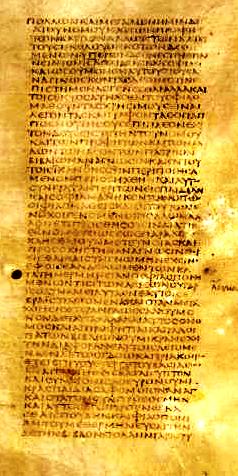
A column of Codex Sinaiticus, a fourth-century Greek Bible manuscript, which Wikimedia Commons describes as the introduction to Sirach.
Because Jewish copyists did not regard the book as scripture, its Hebrew text was handed down less faithfully than the biblical books.[3] The first fragments of a Hebrew text to come to light were identified in May 1896.[3]
In 1896 the sisters Agnes Smith Lewis and Margaret Dunlop Gibson brought a parchment leaf back from a journey in the East and showed it at Cambridge to Solomon Schechter, who recognized it as Sirach 39:15–40:7 in Hebrew.[2][5] The leaf had come from the genizah (a store for disused sacred writings) of the Ben Ezra Synagogue in Cairo, and Schechter went to Cairo and obtained permission to examine the collection.[2][4] The find set off a bitter rivalry between Schechter and Adolf Neubauer of Oxford University.[5] Fragments of six different Ben Sira manuscripts, conventionally labelled A to F, have been identified among the Cairo Genizah papers.[5] By 1900 more than half of the Hebrew text had been identified and published.[3] The Catholic Encyclopedia dated these copies to the tenth or eleventh century at the earliest.[3] Further pieces have continued to appear: in 2011 Shulamit Elizur and Michael Rand reported a new fragment in Cambridge University Library, T-S AS 118.78, containing Sirach 7:18–8:18.[5]
Older copies came from the Judaean Desert. In 1964 Yigael Yadin's excavation at Masada found a scroll of Ben Sira (catalogued as Mas1h), which Askin dates between the first century BCE and the first century CE.[4] It contains parts of chapters 39–44, and Yadin's edition of it was republished in the final excavation reports in 1999.[6] At Qumran, the Psalms scroll from Cave 11 (11QPsa), dated about 30–50 CE, includes Sirach 51:13–30.[4] Elizur and Rand describe the Qumran and Masada manuscripts as of even greater antiquity than the Genizah copies.[5]
Other ancient versions
The Old Latin translation was made from the Greek, probably in the second century CE.[3] It was the version in general use in the churches of North Africa in the first half of the third century.[2] The Latin text of Sirach in the Vulgate (the standard Latin Bible of the Western church, largely the work of Jerome) is this older translation: Jerome himself said it was not his work, and the Catholic Encyclopedia judged that he revised it little, if at all.[2][3]
The Syriac translation was made directly from Hebrew, but it was later revised against the Greek.[3] Its translator worked from an incomplete copy, so it has many gaps, and the Jewish Encyclopedia suggested it may be the work of more than one translator.[2]
Contents
Sirach is the longest of the deuterocanonical books (books that the Catholic Church counts in its Old Testament but that are not in the Hebrew Bible).[3] The Catholic Encyclopedia divides it into two main parts: chapters 1 to 42:14 and 42:15 to 50:26.[3]
The first part consists mainly of sayings meant to teach the fear of God.[3] Its practical advice covers the duties of parents and children, husbands and wives, the young, masters, friends, the rich and the poor.[2] Britannica lists subjects such as hypocrisy, generosity and respect for parents.[1] In chapter 24, Wisdom, pictured as a woman, speaks at length about her eternal relationship with God, and the book identifies wisdom with the Law of Moses.[1] Chapter 36:1–19 is a prayer for the Jews of the Dispersion (Jews living outside the land of Israel).[3]
The second part begins with a hymn on God's wisdom seen in nature (42:15–43:33).[3] Chapters 44 to 50, which the Jewish Encyclopedia calls the "Hymn of the Patriarchs", review the great figures of Israel's history from Enoch down to the high priest Simon.[2][3] The book calls this Simon the son of Johanan, given as Onias in the Greek.[2] A conclusion with the author's signature follows, and chapter 51 is an appendix in which the writer gives thanks to God.[3]
Canonical status
A canon is the list of books a religious community accepts as scripture. Jews never accepted Sirach into the Hebrew Bible.[1][2] Rabbinic opinion on reading it was divided, according to the Jewish Encyclopedia:
The Jerusalem Talmud attributes to Rabbi Akiba the view that readers of "foreign works" have no share in the world to come, and the passage counts the books of Ben Sira among them.[2]
The Tosefta (an early collection of rabbinic teachings) states that the writings of Ben Sira "do not defile the hands", the rabbinic expression for a text that is not holy scripture.[2]
In the Babylonian Talmud, Rabbi Joseph says it is forbidden to read Ben Sira; the Jewish Encyclopedia suggested this may have applied only to public reading.[2]
At the same time, the Talmud frequently quotes the book, sometimes introducing its sayings with the formula used for biblical books.[2]
The Catholic Church counts Sirach as scripture. The Council of Trent, in its fourth session on 8 April 1546, listed "Ecclesiasticus" among the sacred and canonical books and declared anathema anyone who rejected them.[7]
The Orthodox churches also accept it. The Synod of Jerusalem of 1672 declared Tobit, Judith, Ecclesiasticus and the Wisdom of Solomon to be canonical books of the Bible.[8]
Protestant churches do not count it as canonical.[1] The Thirty-Nine Articles of the Church of England, agreed in 1562 and confirmed in 1571, name "Jesus the Son of Sirach" in Article VI among "the other Books" that the church reads "for example of life and instruction of manners" but does not use to establish any doctrine.[9] The Westminster Confession of Faith (1647), a Reformed statement, says that the books "commonly called Apocrypha" are not divinely inspired, are no part of the canon, and should be used only like other human writings.[10]
Reception and influence
Sirach was read in both Jewish and Christian settings.[2][3] In Jewish tradition it remained popular despite its exclusion from the Bible: besides the Talmud, single verses appear in many Midrashim (rabbinic commentaries) and in the writings of Saadia.[2]
The Jewish Encyclopedia takes the many titles that Christian writers gave the book as evidence of the high regard in which it was held.[2] The Catholic Encyclopedia states that it was used readily for public reading in church in the early centuries of Christianity.[3] Augustine reported that, because of its style, many attributed it to Solomon.[3] In 1909 the Catholic Encyclopedia noted that passages read from it in the Roman Breviary (the book of daily prayer) were sometimes headed "Parables of Solomon", and that the Roman Missal introduced readings from it as the "Book of Wisdom".[3]
Britannica describes Sirach as the only apocryphal work whose author is known.[1]
Sources
Editors of Encyclopaedia Britannica (revised by Brian Duignan). "Ecclesiasticus." Encyclopaedia Britannica. No date shown; accessed 26 November 2026. britannica.com/topic/Ecclesiasticus
Francis Gigot. "Ecclesiasticus." The Catholic Encyclopedia, vol. 5. New York: Robert Appleton Company, 1909 (New Advent edition). newadvent.org/cathen/05263a.htm
Lindsey Arielle Askin. "Scribal Culture in Ben Sira (Sir 38:1-15; 41:1-15; 43:11-19; 44-50)." PhD thesis, Faculty of Divinity, University of Cambridge, 2016. core.ac.uk/download/77411947.pdf
Shulamit Elizur and Michael Rand. "More Ben Sira uncovered." Genizah Fragments no. 61. Cambridge University Library, Genizah Research Unit, April 2011. wwwe.lib.cam.ac.uk/GF/Genizah_Fragments_61.pdf
Yigael Yadin. "The Ben Sira Scroll from Masada." In Masada VI: Yigael Yadin Excavations 1963–1965, Final Reports, ed. Joseph Aviram, Gideon Foerster and Ehud Netzer, 151–252. Jerusalem: Israel Exploration Society and the Hebrew University of Jerusalem, 1999. Bibliographic record, Orion Center, Hebrew University of Jerusalem. No date shown; accessed 26 November 2026. orion-bibliography.huji.ac.il/node/58728
Editors of Encyclopaedia Britannica. "Synod of Jerusalem." Encyclopaedia Britannica. No date shown; accessed 26 November 2026. britannica.com/event/Synod-of-Jerusalem
Philip Schaff. "The Westminster Confession of Faith, A.D. 1647." The Creeds of Christendom, vol. 3. Christian Classics Ethereal Library. No date shown; accessed 26 November 2026. ccel.org/ccel/schaff/creeds3.iv.xvii.ii.html