The Gospel of Mary is an early Christian dialogue in which the risen Savior teaches his disciples and a woman named Mary relates a vision; less than half of it survives, in one Coptic codex and two Greek papyrus fragments.[1]
Name and genre
The work takes its name from the title written at its end, "The Gospel according to Mary."[5] Scholars catalogue it among the Christian apocrypha, the large body of early writings about Jesus, his family and his first followers that are not included in the New Testament.[10][1] In the standard reference lists of these writings it is numbered CANT 30 (Clavis Apocryphorum Novi Testamenti) and ECCA 323 (e-Clavis: Christian Apocrypha).[1]
Judith Hartenstein, who compiled the e-Clavis entry for the North American Society for the Study of Christian Apocryphal Literature (NASSCAL) in 2018, places it among the "post-resurrection dialogue gospels," writings in which the risen Jesus answers his disciples' questions before departing.[1] Ardyth L. Bass, in a 2007 doctoral dissertation at Marquette University, argued instead that the surviving text has a single deliberate design and is best read as an expanded "pronouncement story," a short narrative built around a saying.[9]
Manuscripts
Three ancient copies are known, all incomplete.[7]
The Berlin Codex
The longest copy is the first text in a Coptic papyrus codex (a book of bound leaves, as opposed to a scroll) held by the Egyptian Museum and Papyrus Collection of the National Museums in Berlin under the number P. 8502.[2] Coptic is the late form of the Egyptian language, written mainly in Greek letters. The codex comes from Akhmim in Egypt and measures 13.5 by 10.5 cm; NASSCAL's manuscript catalogue dates it to the 5th century, Hartenstein to the 4th or 5th, and the Gnostic Society Library's introduction to the late 4th or early 5th.[2][1][6] It is also called the Berlin Gnostic Codex, abbreviated BG 8502.[6][1]
The codex was bought at a dealer's market in Cairo in 1896 by Carl Reinhardt.[5] Encyclopaedia Britannica notes that it was announced in 1896 but not published until the mid-20th century.[8] According to Sarah K. Balstrup (2015), the scholar Carl Schmidt prepared an edition, but a burst water main flooded the printing house and destroyed his work; the world wars then halted progress, and after Schmidt's death in 1938 Walter Till took over the project.[5] When a library of Coptic codices was found near Nag Hammadi in Egypt in 1945, two of the Berlin Codex's other texts turned out to have copies in it, and Till held back publication so that the Berlin texts could appear together with the new find; in the end he published his edition and translation in 1955.[8][5][6] A second edition, revised by Hans-Martin Schenke, appeared in 1972.[2]
Besides the Gospel of Mary, which occupies pages 7–10 and 15–19, the codex contains the Apocryphon (Secret Book) of John (pages 19–77), the Wisdom (or Sophia) of Jesus Christ (pages 77–127) and the Act of Peter (pages 128–141).[2]
The Greek fragments
Two small Greek fragments, both from Oxyrhynchus in Egypt and both dated to the 3rd century, are older than the Coptic copy.[3][4] The Gnostic Society Library's introduction describes them as coming from separate Greek copies of the work.[6]
P. Rylands 463, held by the John Rylands Library in Manchester, is a single leaf about 8.9 by 9.9 cm written on both sides, which are numbered 21 and 22.[3][5] C. H. Roberts published it in 1938.[3]
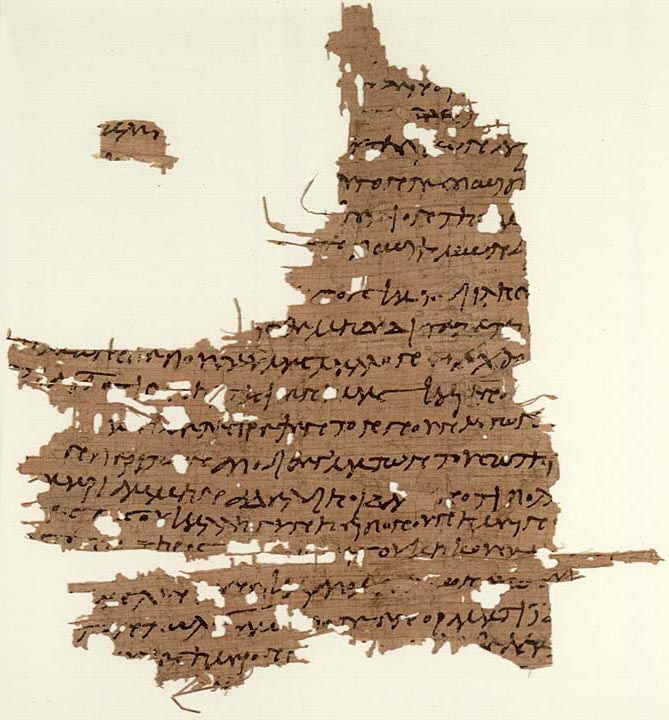
P. Oxyrhynchus L 3525, held in the papyrology rooms of the Sackler Library in Oxford, is written in a cursive Greek hand on one side only.[4][5] Peter J. Parsons published it in 1983 in volume 50 of The Oxyrhynchus Papyri.[4]
According to Hartenstein, the Greek fragments do not add any passages to the text known from the Coptic.[1] Their wording does differ in places, however: Karen L. King regards the Greek as closer to the original and sees some Coptic differences as reflecting a later period in which women's leadership was being challenged, while Christopher Tuckett (2007) concluded that the later Coptic text represents a more original version than the Greek fragments.[7][5]
Papyrus Oxyrhynchus L 3525, a third-century Greek fragment of the Gospel of Mary, held in Oxford.
Via Wikimedia Commons: Gospel of Mary by Unknown author Unknown author, public domain.
Missing parts
Pages 1 to 6 and 11 to 14 of the Berlin Codex are lost.[2][6] As a result the opening of the work and a section in its middle are missing, and less than half of the text survives.[1] The surviving text begins partway through a conversation, with the question "Will matter then be destroyed or not?"[6] Hartenstein suggests that the lost first pages probably described an appearance of the risen Jesus and the start of his dialogue with the disciples.[1] The second gap falls inside Mary's account of her vision, so the middle of that account is lost.[6]
Date, language and authorship
No author is named in the surviving text.[6] The work was written in Greek, and the surviving Coptic text is a translation.[7]
The Greek fragments show that the work existed by the 3rd century, and Balstrup notes that they may themselves be copies of earlier versions that are now lost.[5] Balstrup (2015) reports three proposals: Karen King dates it to the late 1st or early 2nd century, Esther de Boer to between 90 and 150, and Christopher Tuckett to the first half of the 2nd century.[5] Peter Kirby's Early Christian Writings site gives a range of 120 to 180.[7]
Contents
The summary below follows the surviving Coptic text in order.[6]
The dialogue with the Savior. The text opens with the disciples asking the Savior whether matter will be destroyed; he answers that all things will return to their own roots.[6] Peter then asks about the sin of the world, and the Savior answers that sin arises from acts contrary to nature.[6][5] The Savior's parting words, which Hartenstein describes as a pastiche of well-known sayings of Jesus, include the instruction "Go then and preach the gospel of the Kingdom" and a warning not to lay down rules beyond what he has given; then he departs.[1][6]
The disciples' grief. The disciples are distressed and afraid, asking, "If they did not spare Him, how will they spare us?"[6]
Mary comforts them. Mary tells them not to weep or grieve, because the Savior's grace will be with them and protect them.[6]
Peter's request. Peter addresses her as "Sister," says that the Savior loved her more than other women, and asks her to tell them the words of the Savior that she remembers and they have not heard.[6][5]
Mary's vision. Mary says, "I saw the Lord in a vision," and recounts what he said to her.[6][5] At this point pages 11 to 14 are missing.[6]
The ascent of the soul. When the text resumes, Mary is describing a soul rising past a series of powers that challenge it, the fourth of which takes seven forms, beginning with darkness, desire and ignorance, until the soul is freed.[6] Then Mary falls silent, "since it was to this point that the Savior had spoken with her."[6]
The dispute. Andrew says he does not believe the Savior said these things, and Peter asks whether the Savior really spoke privately with a woman and not openly to them.[6][5] Mary weeps and asks Peter whether he thinks she invented this or is lying about the Savior.[6] Levi rebukes Peter as hot-tempered and defends her, asking who Peter is to reject her if the Savior made her worthy.[6][5]
The ending. The disciples go out to proclaim and to preach, and the manuscript closes with the title.[6][5]
Which Mary
The text calls her only "Mary."[6] Balstrup notes that most scholars identify her as Mary Magdalene, and Karen King's 2003 study is titled The Gospel of Mary of Magdala.[5][1] Others have questioned this: Balstrup reports that Stephen Shoemaker argued the identification is far from certain and that the text could refer to Mary of Nazareth, the mother of Jesus, and Bass (2007) set aside the assumption that she is Mary Magdalene in her study.[5][9]
Classification
Whether the Gospel of Mary should be called "Gnostic" is debated. "Gnostic," from the Greek gnosis ("knowledge"), is a modern label for a range of early Christian groups and writings that stressed saving knowledge. Balstrup notes that the newly found texts were first studied, and mostly translated, as Gnostic writings.[5] Karen King and Esther de Boer instead treat it as an early Christian text that shows Stoic and Platonic influence; de Boer's 2004 study is titled The Gospel of Mary: Beyond a Gnostic and a Biblical Mary Magdalene.[5][1] Tuckett, by contrast, reads one passage as referring to the unnatural combination of spirit and matter that is typical of Gnostic thought.[5] Hartenstein notes both that the text uses philosophical, probably Stoic, ideas to describe the dissolution of matter and that its account of the soul's ascent has parallels in "gnostic" texts, the closest being the Book of Allogenes in Codex Tchacos.[1]
Church positions
The Gospel of Mary is not part of the New Testament of any church; it belongs to the writings that scholars group as Christian apocrypha because they are not included in the New Testament.[10][1] No council or official church decision about it was found in the sources consulted for this entry. Balstrup observes that, unlike writings known to scholars through the church fathers, the Gospel of Mary had no earlier record, and until its discovery nobody suspected that it existed.[5]
Early reception
The surviving copies show that the work was copied in Egypt, in Greek and in Coptic, between the 3rd and 5th centuries.[3][4][2] No ancient writer is known to mention it.[5]
Modern interest
Since its publication the Gospel of Mary has drawn particular attention for its portrayal of Mary, and Balstrup (2015) traces how feminist scholarship and popular writing have used it.[5] Major editions and translations include King's study (2003), Tuckett's critical edition of all three manuscripts in the Oxford Early Christian Gospel Texts series (2007), and an edition by Bart Ehrman and Zlatko Pleše (2011).[1] Hartenstein's entry records its use in Dan Brown's novel The Da Vinci Code (2003), Abel Ferrara's film Mary (2005) and Marianne Fredriksson's novel Enligt Maria Magdalena (1997; in English According to Mary Magdalene).[1]
Sources
Judith Hartenstein (compiler), "Gospel of Mary", e-Clavis: Christian Apocrypha, North American Society for the Study of Christian Apocryphal Literature (NASSCAL), created February 2018. nasscal.com/e-clavis-christian-apocrypha/gospel-of-mary/
"The Gospel of Mary" (English translation with introduction), The Gnostic Society Library, gnosis.org. No date shown; accessed 26 November 2026. gnosis.org/library/marygosp.htm