The Mayflower was an English merchant sailing ship that in 1620 carried 102 passengers from England to Cape Cod and then to Plymouth Harbor, where they founded Plymouth Colony.[1][2]
Records and dates
The main records were written by people who made the voyage. Mourt's Relation, a journal of the voyage and the colony's first months, was printed for John Bellamie in London in 1622; its preface is signed "G. Mourt", whom the nineteenth-century editor Henry Martyn Dexter identified as George Morton, and Dexter credited the journals mainly to William Bradford and Edward Winslow.[3] Bradford, a passenger who later governed the colony, began his manuscript history Of Plimoth Plantation in 1630 and made his last entries in 1650.[4] According to the State Library of Massachusetts, the manuscript disappeared from a Boston church library, presumably taken by British soldiers during the American Revolution, was found in 1855 in the library of the Bishop of London, and was returned to Massachusetts on 26 May 1897; the State Library has held it since.[4] A legal record of 1624, the High Court of Admiralty appraisal of the ship, also survives.[5]
The colonists used the Julian calendar, now called "Old Style". By 1582 it ran 10 days behind the corrected Gregorian ("New Style") calendar introduced that year, and England and its colonies did not change until 1752; they also counted the new year from 25 March, so dates from January to March are often written with two years, such as 1621/2.[6] Dates in this entry are Old Style, as in the records; for example, the Pilgrim Society marks the landing at Plymouth on 21 December, the New Style equivalent of the 11 December date in Mourt's Relation.[6]
The ship and its master
No detailed description of the original ship survives. Britannica reports that marine archaeologists estimate it was a square-rigged ship of about 180 tons and about 90 feet (27 metres) long.[1] MayflowerHistory.com says it could carry about 180 tons of cargo, and Pilgrim Hall Museum describes it as a cargo ship of around 100 feet that had served for many years in the wine trade.[7][8]
Britannica notes that some sources say the ship was built at Harwich, England, and that the merchant Christopher Jones bought it in 1608; MayflowerHistory.com says Jones and several partners bought it about 1607 and that its earlier history is uncertain.[1][7] Its first documented voyage, according to MayflowerHistory.com, was to Trondheim, Norway, in 1609, when a North Sea storm forced the crew to throw much of the cargo overboard on the way home.[7] After that it traded mainly to Bordeaux, France, bringing wine, cognac, vinegar and salt back to London.[7] The 1620 voyage was the first recorded Atlantic crossing for both ship and master.[7] Plimoth Patuxet Museums says a crew of about 20 to 30 lived on the upper decks under Jones as master (captain), while the passengers were carried in the cold, damp cargo area.[2]
The Speedwell and the false starts
The core of the passenger group came from a congregation of Separatists, English Protestants who wanted churches separate from the Church of England, which was illegal at the time.[9] The congregation had moved to the Netherlands and spent about 11 or 12 years in Leiden before agreeing terms with English investors to found a farming settlement in northern Virginia.[9] Pilgrim Hall Museum records that they sailed in a smaller ship, the Speedwell, to Southampton to meet the Mayflower, which the investors had chartered.[8] The Speedwell leaked so badly that both ships turned back to England, putting in first at Dartmouth and then at Plymouth.[8] The Speedwell was left behind and its passengers were divided.[2][9]
The Mayflower sailed alone from Plymouth on 6 September 1620, the date Bradford gives; Mourt's Relation records that "we loosed from Plimoth" that Wednesday with a light east-north-east wind.[10][3] Pilgrim Hall Museum's voyage page gives 16 September, the New Style date.[8]
Passengers
Plimoth Patuxet Museums gives the number on board as 102 passengers plus crew.[2] Not all were members of the Leiden congregation: Bradford refers to "strangers" among them, and the museum says the men who signed the Mayflower Compact included both Separatists and members of the Church of England.[10][2] One baby, Oceanus Hopkins, was born at sea, and another, Peregrine White, was the first child born after the ship arrived.[2][9]
The crossing
Bradford describes storms in which one of the main beams amidships bowed and cracked; it was forced back into place with "a great iron screw" the passengers had brought from Holland.[10] A young passenger, John Howland, was swept overboard and saved when he was hauled back by a rope.[10] Bradford records two deaths: a young seaman whom he calls "proud & very profane" fell ill, died and "was himself the first that was thrown overboard", and one passenger, William Butten, a youth and servant to Samuel Fuller, died as they drew near the coast.[10] The museum's student guide says instead that only one person, a sailor, died during the crossing.[2]
Mourt's Relation dates the first sight of land to 9 November, and MayflowerHistory.com counts 66 days at sea to that point.[3][7] Bradford writes that the ship then ran into danger along the coast and turned back for the Cape, and that it was "arrived at Cape-Cod the 11 of November", where the passengers fell on their knees and gave thanks.[10]
The Mayflower Compact
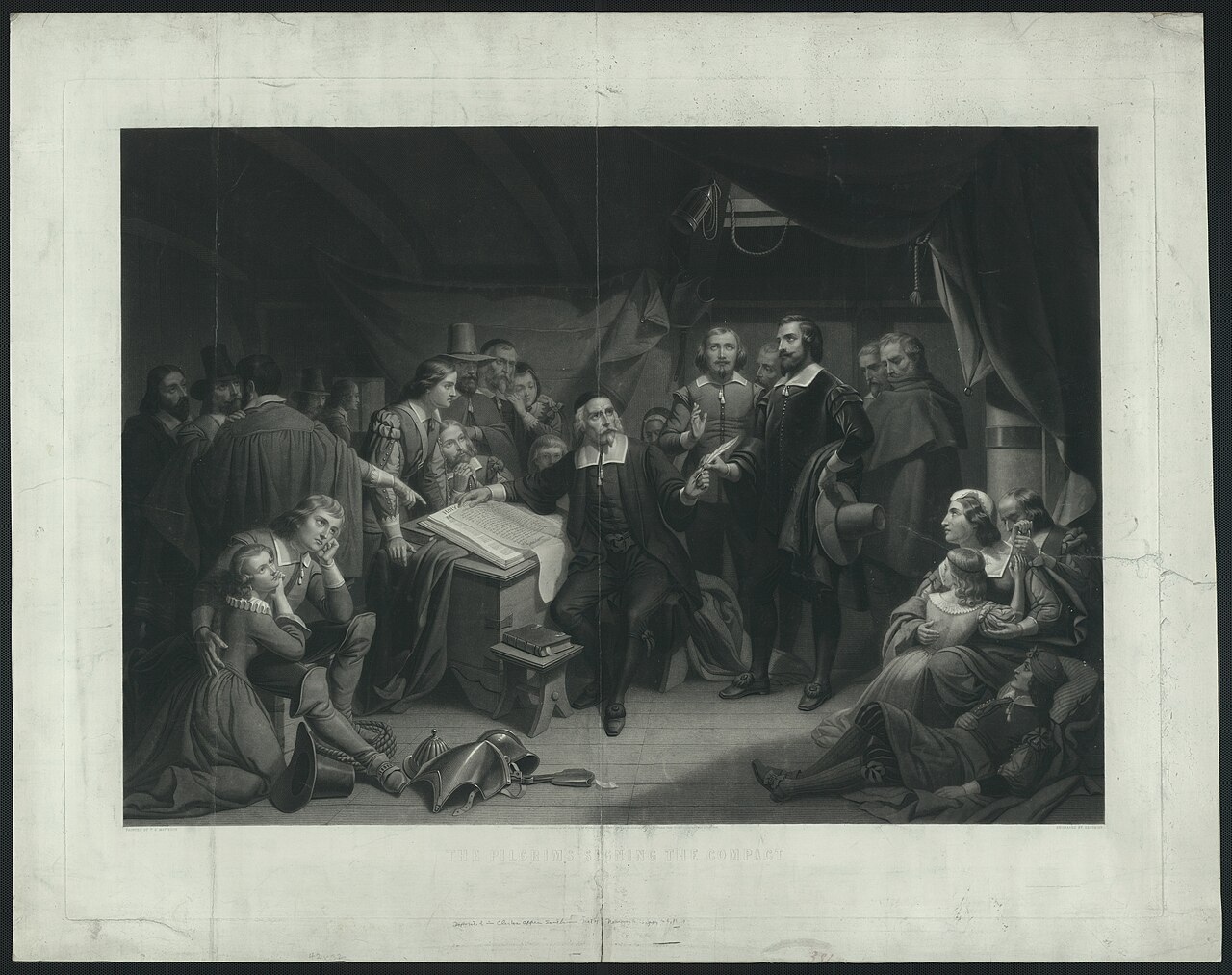
Bradford's history contains the text of an agreement signed at Cape Cod on 11 November 1620, in which the signers, as loyal subjects of King James, "covenant & combine our selves together into a civil body politic".[10] He gives two reasons for it: "discontented & mutinous speeches" by some of the strangers, who said that once ashore they would "use their own liberty", and the wish that such an act might be "as firm as any patent", a patent being the legal grant to settle; the museum says they were waiting for a new one.[10][2] The signers then chose, or confirmed, John Carver as governor.[10]
Plimoth Patuxet Museums says the agreement was signed by 41 men, that the original document is lost, that the text first appeared in print in Mourt's Relation, and that Nathaniel Morton printed it in 1669 with a list of 41 likely signers.[2] The name "Mayflower Compact" was first used in 1793, according to the museum.[2]
The signing of the Mayflower Compact as imagined in an engraving by Gauthier after a painting by T. H. Matteson, published in 1859; it is a later artist's imagi
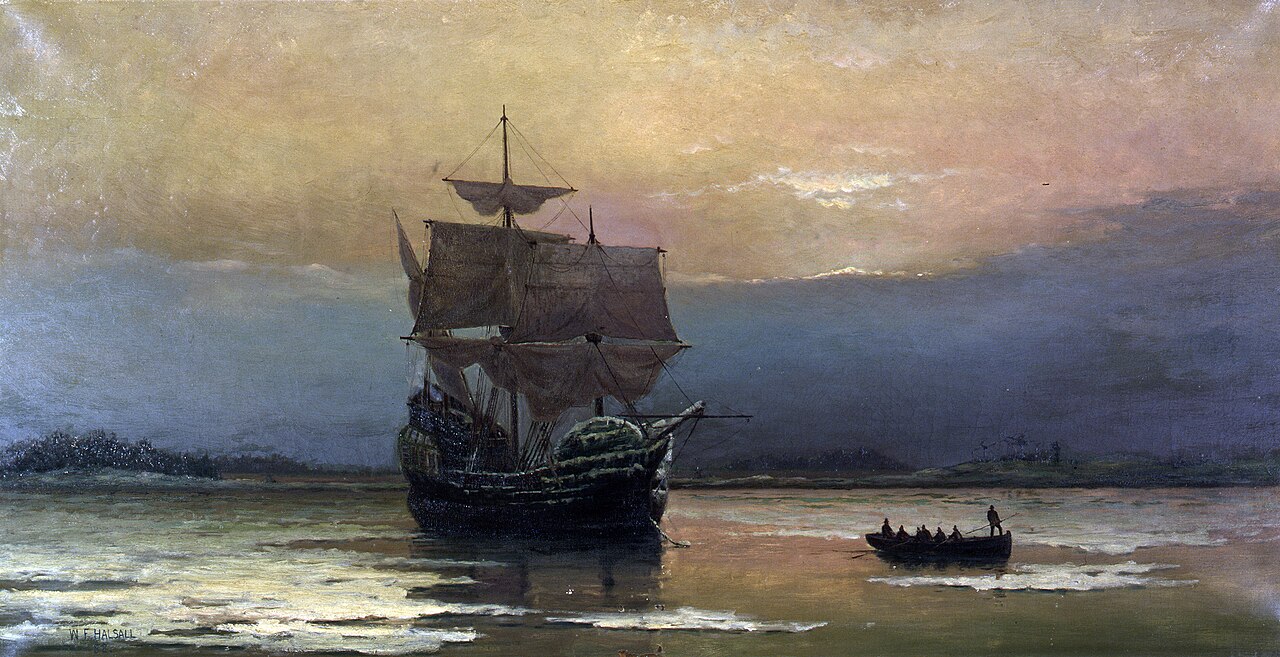
The ship reached Plymouth Harbor on 16 December 1620, according to Plimoth Patuxet Museums.[9] The settlement was built on what the museum calls the land "Indigenous people called Patuxet and English colonists called Plymouth", in the Wampanoag homeland; the Wampanoag are the subject of a separate entry.[11] Britannica describes it as the first permanent colony in New England.[1]
The first winter was deadly. Bradford writes that in two or three months half the company died, especially in January and February, that at the worst only six or seven people were well, and that "of 100 & odd persons, scarce 50 remained".[10] Plimoth Patuxet Museums gives 52 survivors of the first year.[9] The ship stayed at Plymouth through the winter and left on 5 April 1621 with half its crew, reaching England on 6 May.[9][7] The colony's harvest gathering of autumn 1621 is described in the entry on Thanksgiving.
The Mayflower at anchor in Plymouth Harbor as imagined by the painter William Halsall in 1882, more than 260 years after the voyage; it is not a contemporary pi
Christopher Jones died in March 1621/2.[7] On 26 May 1624 the High Court of Admiralty had the ship appraised at the request of three of its four owners, among them Jones's widow; the request describes the ship as "in ruinis" (in ruins).[5] Two shipwrights and two mariners of Rotherhithe valued the hull, anchors, sails, rigging and other fittings at a total of £128 8s 4d; the record is in the Admiralty court papers (HCA 24/81) now at the National Archives in London.[5] No later record of the ship is known, and MayflowerHistory.com says it was almost certainly broken up and sold for scrap.[7]
A later tradition holds that the ship's timbers were reused in a barn at Jordans, Buckinghamshire. The claim was put forward in the 1920s by the biblical scholar James Rendel Harris, who pointed to a repaired beam that he linked with Bradford's account and to carved letters he read as "HAR", possibly for Harwich.[12] A 2019 University of Exeter article notes that Harris had Quaker and Mayflower-related motives for the claim and that historians such as J. W. Horrocks disputed it.[12] Historic England's listing of 1982 dates the barn to the seventeenth century and says only that it is "held by some" to include timbers from the Mayflower.[13]
Later tradition and commemoration
The name "Pilgrims" was not a group label at first. Plimoth Patuxet Museums says Mourt's Relation and Bradford both used the word, and that by the early 1800s at least it had become the popular name for all the Mayflower passengers and other early Plymouth settlers.[9]
Plymouth Rock also comes from later tradition. Pilgrim Hall Museum notes that neither Bradford nor Mourt's Relation mentions a rock; a town record of 1715/16 mentions a "great rock" on the waterfront, the landing tradition first appeared in print in 1775, and an 1832 town history traced it through the Faunce family to Elder Thomas Faunce's farewell to the rock in 1741.[14] The rock was split in 1774, its halves were reunited in 1880 with "1620" carved on the face, and its present portico was dedicated in November 1921.[14]
Descendants' societies followed. The first Society of Mayflower Descendants was formed in New York City on 22 December 1894, and the General Society of Mayflower Descendants was set up at Plymouth, Massachusetts, on 12 January 1897; members must prove direct descent from a passenger of 1620.[15] As of November 2026 the society's website says it has welcomed more than 100,000 members since its founding.[15]
A full-size replica, Mayflower II, was built in England to plans by the naval architect William A. Baker, whom Plimoth Plantation (now Plimoth Patuxet Museums) hired in 1951; the British side was led by Warwick Charlton's Project Mayflower Ltd., formed to honour the friendship between Britain and the United States after the Second World War.[16] Its keel was laid in July 1955 and it was rigged by shipwrights at Brixham; it sailed from Plymouth, England, on 20 April 1957 with 33 men under Alan Villiers, reaching Plymouth, Massachusetts, on 13 June 1957, where the museum says 25,000 people met it.[16] A restoration with Mystic Seaport Museum, begun in 2015, replaced nearly 70 per cent of its timbers, planking, frames, knees and beams, the museum reported on 30 October 2020.[17] The ship returned to Plymouth on 10 August 2020 and was added to the US National Register of Historic Places on 22 October 2020.[16]
The 400th anniversary in 2020 was marked on both sides of the Atlantic. In a statement of 6 July 2020, the museum called the commemoration "complex" and said it planned a new name; it now uses the name Plimoth Patuxet Museums.[11][16] In Plymouth, England, The Box museum's exhibition "Mayflower 400: Legend and Legacy" (2020–2021) was made in partnership with the Wampanoag Advisory Committee to Plymouth 400 and covered the effects of colonisation on Indigenous people; it included a pot by a Wampanoag artist, which the museum describes as Plymouth's first artistic commission to a Wampanoag artist.[18]
[Bradford, William, and Edward Winslow]; ed. Henry Martyn Dexter. Mourt's Relation, or Journal of the Plantation at Plymouth (1622; reprinted Boston: J. K. Wiggin, 1865). Internet Archive (Cornell University Library copy). Accessed 26 November 2026. archive.org/details/cu31924028815079/
Bradford, William. Of Plymouth Plantation, Book 1 chapters 9–10 and Book 2 (excerpts, from Bradford's History of 'Plimoth Plantation', Project Gutenberg text). In: American Literature to 1865 (open anthology), University of Central Florida Pressbooks. No date shown; accessed 26 November 2026. pressbooks.online.ucf.edu/aml3031/chapter/william-bradford/