Thanksgiving is a national holiday in the United States, fixed by a 1941 federal law on the fourth Thursday of November, that grew from colonial and presidential days of thanks and is often linked in popular memory to a 1621 harvest gathering at Plymouth.[1][3][6]
Date
Under the joint resolution that President Franklin D. Roosevelt signed on 26 December 1941, Thanksgiving Day in the United States falls on the fourth Thursday of November.[3] In 2026 that day is Thursday, 26 November; the National Archives, for example, announced that its research rooms would close on Thursday, 26 November 2026 for the Thanksgiving holiday.[3]
The 1621 harvest gathering at Plymouth
The only known eyewitness description of the 1621 gathering comes from Edward Winslow, one of the English colonists at Plymouth, who wrote it in a letter dated December 1621.[1] The letter was printed in 1622 in the book now known as Mourt's Relation.[1]
Winslow wrote that once the harvest had been brought in, the governor sent four men out to hunt birds so that the colonists could "rejoice together" after gathering the fruits of their work.[1] He recorded that the four men killed enough fowl in one day to feed the company for almost a week.[1] He also wrote that the colonists exercised their arms, that "many of the Indians" came among them, and that Massasoit, whom he called "their greatest king", arrived with about 90 men.[1] According to the letter, the English entertained and feasted these guests for three days, and the visitors went out and killed five deer, which they gave to the governor, the captain and others.[1] Winslow closed the passage by saying that, by the goodness of God, the colony was far from want.[1]
Plimoth Patuxet Museums identifies Massasoit as Ousamequin, who came with about 90 Pokanoket men, and suggests that the "many" other Indigenous people Winslow mentions may have come from other communities within Ousamequin's sphere of diplomatic influence.[1] The museum notes that about half of the 102 passengers who had arrived on the Mayflower were still alive at the time of the harvest: 24 men, five women and 24 children and teenagers.[1] It also quotes the Wampanoag and Penobscot historian Nancy Eldridge, who judged it probable that Ousamequin's attendance was "a political show of force".[1] The Smithsonian's National Museum of the American Indian (NMAI) states that the Wampanoag and neighbouring Native nations had been dealing with European explorers, traders and enslavers for nearly a hundred years before English settlers arrived at the Wampanoag village of Patuxet in 1620.[6] The NMAI describes the Wampanoag decision to help the English as a matter of political alliance and diplomacy rather than "a budding friendship".[6]
What the sources record and what came later
The passage that Plimoth Patuxet transcribes from Winslow's letter does not use the word "thanksgiving".[1] According to the museum, the label "the first Thanksgiving" came later: in 1841 the Unitarian minister and antiquarian Alexander Young published a collection of early Plymouth documents and, because the passage resembled the Thanksgiving feasts of his own day, added a footnote calling the event "the first Thanksgiving, the harvest festival of New England."[1] The NMAI likewise describes the familiar "First Thanksgiving" story as a myth that took hold in the mid-1800s, and calls the national story incomplete because the Wampanoag voice and perspective have been largely absent from it.[6] The NMAI also states that the Wampanoag practised daily and seasonal traditions of giving thanks long before they met English settlers.[6]
On 28 September 1789, shortly before a recess, the first Federal Congress passed a resolution asking the President to recommend a day of thanksgiving to the nation.[3] A few days later, on 3 October 1789, George Washington issued a proclamation, a formal public announcement by the President, naming Thursday, 26 November 1789 as a day of public thanksgiving.[2][3] The National Archives describes this as the first Thanksgiving celebrated under the new Constitution and the first time a President of the United States issued a Thanksgiving proclamation.[2][3]
Washington's text opens by stating that both houses of Congress had asked him to recommend a day of "public thanksgiving and prayer", in part to acknowledge the opportunity to establish "a form of government for their safety and happiness".[2] It asks the people to give thanks for a national government that would be "a blessing to all the people" through wise, just and constitutional laws.[2] The proclamation was signed "at the City of New York", then the seat of government, and dated simply "in the year of our Lord 1789" without the count of years since independence that later proclamations added.[2]
According to the National Archives, later presidents also issued Thanksgiving proclamations, but the dates, and even the months, of the celebrations varied from one proclamation to the next.[3]
Sarah Josepha Hale and Lincoln's proclamation of 1863
Sarah Josepha Hale, editor of the popular women's magazine Godey's Lady's Book, campaigned for a national day of Thanksgiving through a series of editorials in that magazine.[5][6] On 28 September 1863 she wrote to President Abraham Lincoln from Philadelphia, saying that she had set forth the idea in the magazine "for the last fifteen years".[5]
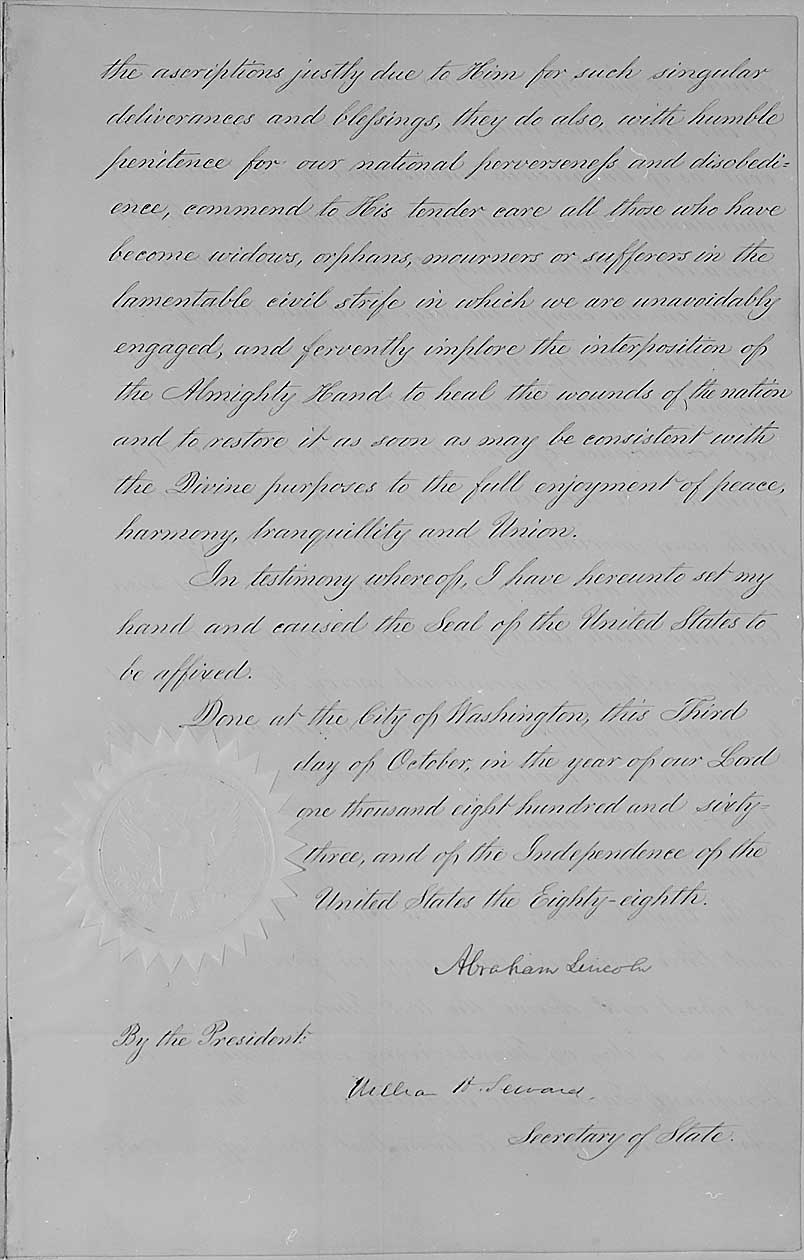
A page of Abraham Lincoln's proclamation of 3 October 1863 setting the last Thursday of November as a day of thanksgiving.
On 3 October 1863, during the Civil War, Lincoln issued a proclamation, countersigned by Secretary of State William H. Seward, inviting Americans at home, at sea and abroad to observe the last Thursday of November as a day of thanksgiving and praise.[4] The Abraham Lincoln Presidential Library and Museum states that Seward wrote the text.[5] The proclamation gives thanks for "fruitful fields and healthful skies", continued peace with foreign nations, and growth in industry and population despite the war, and asks people to pray for the widows, orphans, mourners and sufferers of the conflict and for the healing of the nation.[4] The National Archives states that from Lincoln's 1863 proclamation onward, Thanksgiving was regularly observed each year on the last Thursday of November.[3]
The change of date, 1939 to 1941
In 1939 the last Thursday of November fell on 30 November, the last day of the month.[3] According to the National Archives, President Franklin D. Roosevelt, concerned that a shorter Christmas shopping season might weaken the economic recovery, issued a proclamation moving Thanksgiving to the second-to-last Thursday of November.[3] Thirty-two states issued matching proclamations, while sixteen refused the change and kept the last Thursday.[3] For two years the country therefore had two Thanksgiving days: the President and part of the nation observed the earlier date, and the rest observed the following week.[3]
To end the confusion, Congress set a fixed date.[3] On 6 October 1941 the House of Representatives passed a joint resolution (House Joint Resolution 41) naming the last Thursday of November as the legal Thanksgiving Day.[3] The Senate amended it to the fourth Thursday, to allow for years in which November has five Thursdays; the House agreed, and Roosevelt signed the resolution on 26 December 1941, establishing the fourth Thursday of November as the federal Thanksgiving holiday.[3]
Customs connected with the presidency
The National Archives notes that Presidents customarily issue a statement each year to mark the holiday, alongside rituals such as the pardoning of a turkey.[2] At a Rose Garden ceremony on 17 November 1989, while signing that year's Thanksgiving proclamation, President George H. W. Bush said that the turkey presented to him would not end up on anyone's dinner table, that it had been granted "a Presidential pardon as of right now", and that it would live out its days on a children's farm not far from the White House.[10]
Indigenous perspectives and the National Day of Mourning
The United American Indians of New England (UAINE), a Native-led organization, states that in 1970 it declared the United States Thanksgiving Day a National Day of Mourning.[7] According to UAINE, this followed the suppression of a speech by Wamsutta, an Aquinnah Wampanoag man who had been asked to speak at a Commonwealth of Massachusetts banquet marking the 350th anniversary of the Pilgrims' landing.[7] UAINE says the organizers asked for a copy of his planned speech and that he was then told by a state official that he would not be allowed to give it, on the stated ground that the anniversary's theme was brotherhood and "anything inflammatory would have been out of place".[7] UAINE describes its own work as opposing what it calls the racism of the Pilgrim mythology perpetuated in Plymouth.[7]
The Mashpee Wampanoag Tribe, in a notice dated 26 October 2022, announced UAINE's 53rd annual National Day of Mourning at Cole's Hill, above Plymouth Rock, and stated that the first official National Day of Mourning took place when Wamsutta's supporters heard his original speech there in 1970.[8] Both UAINE and the Mashpee Wampanoag Tribe present this account as their own history of the observance.[7][8]
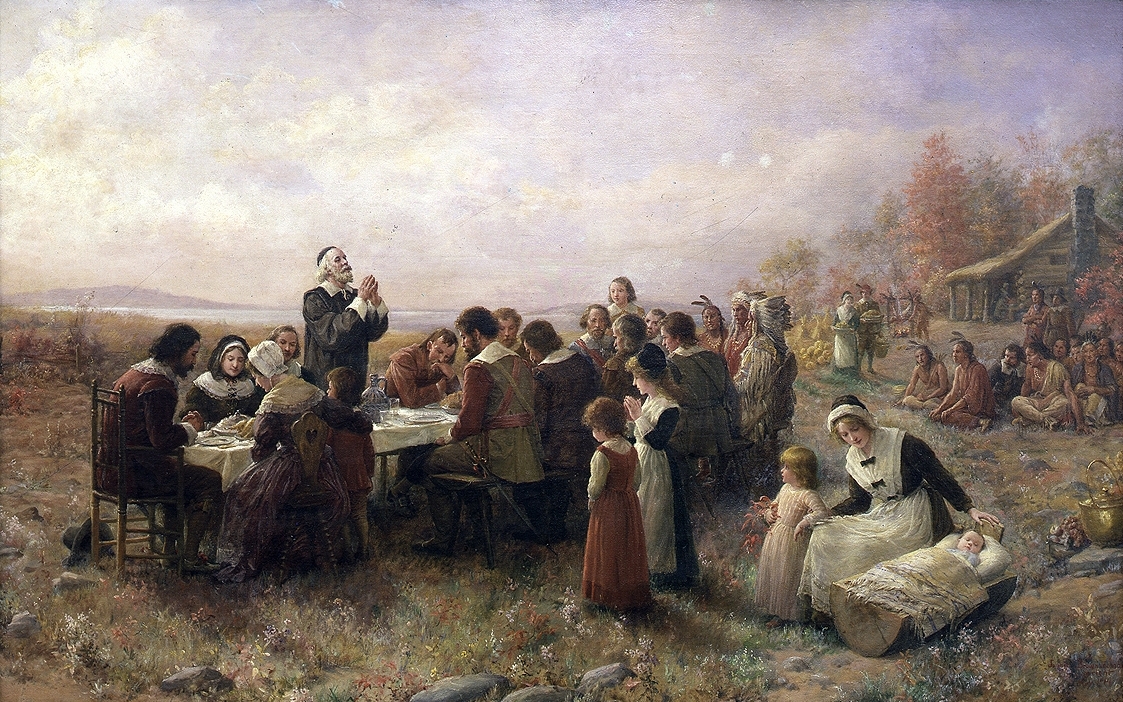
Jennie Brownscombe's painting "The First Thanksgiving at Plymouth", a later artist's imagining of the 1621 gathering.
The NMAI, for its part, presents the holiday's history as more complex than the familiar story and urges that it include the Wampanoag perspective.[6]
Canadian Thanksgiving
Canada holds its own Thanksgiving on the second Monday of October.[9] The Canadian Encyclopedia states that on 31 January 1957 that day was proclaimed as a "day of General Thanksgiving to Almighty God for the bountiful harvest with which Canada has been blessed".[9] It credits Sir Martin Frobisher and his crew with the first European thanksgiving ceremony in North America, held in the Eastern Arctic in 1578, and dates the first annual national Thanksgiving in Canada to 6 November 1879.[9] From 1921 Thanksgiving and Armistice Day were observed on the same day, until 11 November was set aside solely as Remembrance Day in 1931.[9] The encyclopedia also notes that Indigenous peoples in what is now Canada celebrated the autumn harvest long before European settlers arrived.[9]
Center for Legislative Archives. "Congress Establishes Thanksgiving." U.S. National Archives and Records Administration. No date shown; accessed 25 November 2026. archives.gov/legislative/features/thanksgiving
United American Indians of New England. "Background Information." No date shown for the page (article dated 10 April 2003); accessed 25 November 2026. uaine.org/background.htm