William Pitt the Elder
British statesman who directed the Seven Years' War and was created Earl of Chatham in 1766
🚧 Under construction This entry is still being built. What is here has been checked against its sources, but more sections are coming.
British statesman who directed the Seven Years' War and was created Earl of Chatham in 1766
🚧 Under construction This entry is still being built. What is here has been checked against its sources, but more sections are coming.

William Pitt the Elder, 1st Earl of Chatham (1708–1778), was a British statesman who directed Britain's war effort against France in the Seven Years' War and was known as "the Great Commoner" for refusing a peerage until 1766.[1][3]
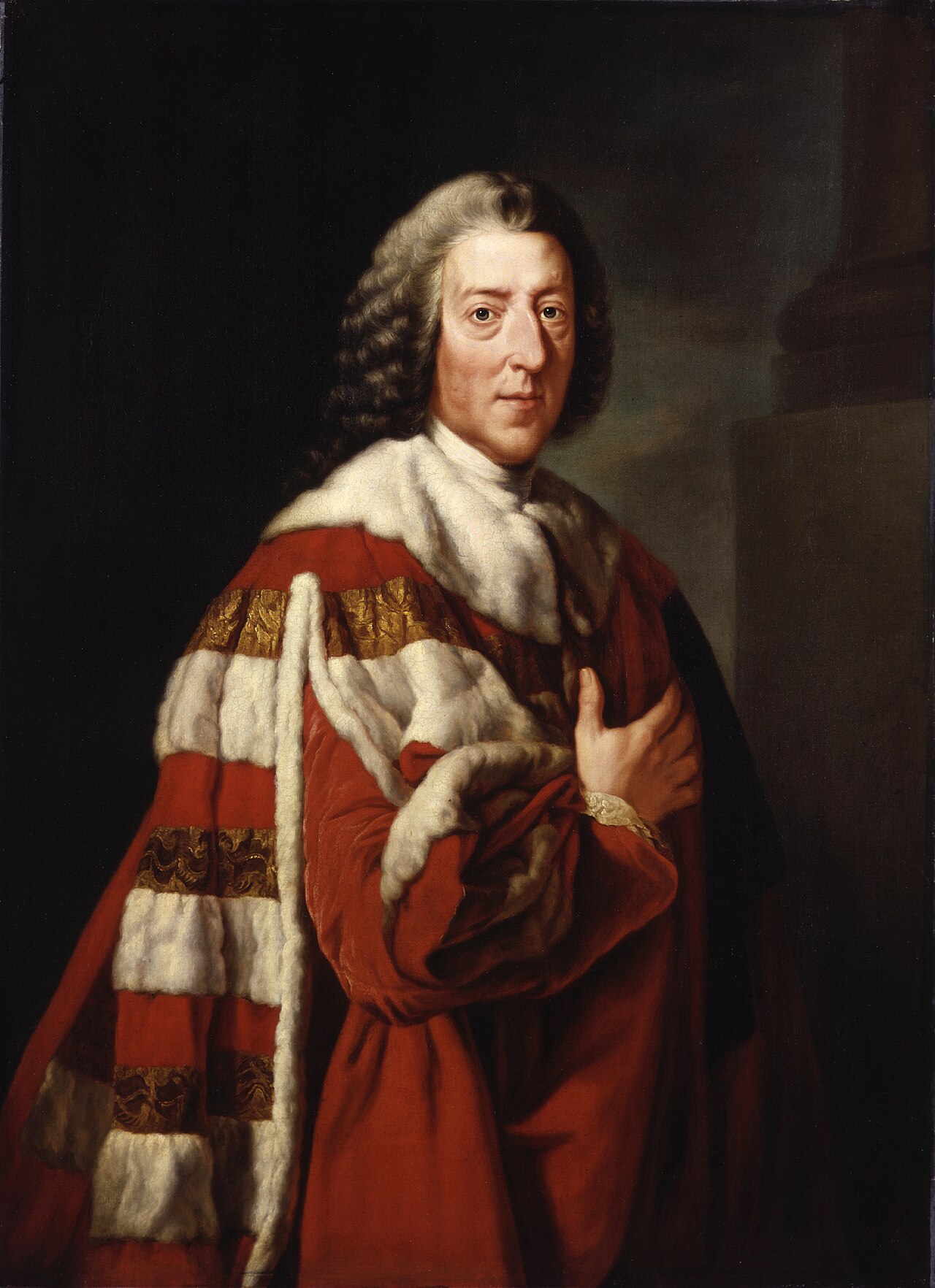
Via Wikimedia Commons: William Pitt, 1st Earl of Chatham after Richard Brompton by After Richard Brompton, public domain.
Pitt was born in Westminster on 15 November 1708, the younger son of Robert Pitt of Boconnoc in Cornwall and Harriet Villiers, and a grandson of the colonial governor Thomas Pitt.[1][2] He was educated at Eton and Trinity College, Oxford, matriculating in January 1727 but leaving without a degree.[1] On 9 February 1731 he obtained a cornetcy (the lowest commissioned cavalry rank) in a regiment of horse.[1]
In February 1735 he succeeded his elder brother Thomas as member of Parliament for Old Sarum, a borough controlled by his family.[1][2] He joined the opposition "Patriot" Whigs against the prime minister Sir Robert Walpole, and delivered his first speech in the House of Commons on 29 April 1736.[1] Walpole had him removed from the army, and in 1737 he became a groom of the bedchamber to the Prince of Wales.[1][2]
In 1746, under Henry Pelham's ministry, Pitt became paymaster-general of the forces, appointed on 6 May 1746, and refused the perquisites customarily taken by the holder of that office.[1] He married Hester Grenville on 16 November 1754; the couple had five children, among them John, later 2nd Earl, and William Pitt the Younger (1759–1806), who also became prime minister.[1][4] When Pelham died in 1754, Pitt expected promotion under the new head of the government, the Duke of Newcastle, and was passed over.[2] He was dismissed from office on 20 November 1755.[1]
On 4 December 1756 Pitt became secretary of state for the southern department, with the Duke of Devonshire as first lord of the treasury.[1] George II dismissed him on 5 and 6 April 1757 and recalled him on 20 June 1757, with Newcastle again at the head of the treasury.[1] Encyclopedia.com describes the arrangement as an agreement of July 1757 that Pitt and Newcastle would govern together, with Pitt leading the war effort.[3] In that role he won the confidence of Prussia and backed large operations in Europe, though his chief aim was colonial expansion, and by 1761 Britain had driven the French from Canada, India and most of the Caribbean, according to that account.[3] Fort Duquesne fell to British forces in late 1758 and was renamed Pittsburgh, and Quebec surrendered in 1759 after the deaths of Generals Wolfe and Montcalm.[2]
Pitt and his brother-in-law Earl Temple resigned on 5 October 1761, after the cabinet and the king refused to declare war on Spain.[1][3] Pitt accepted a pension of £3,000 a year, and his wife was created Baroness Chatham.[1] In 1762 the government under Lord Bute did go to war with Spain.[2]
In July 1766, after the fall of the Marquess of Rockingham's ministry, Pitt was asked to form a government. On 30 July 1766 he took the office of lord privy seal, and on 4 August 1766 he was created Viscount Pitt of Burton Pynsent and Earl of Chatham, moving to the House of Lords.[1] The Duke of Grafton led the ministry in practice.[1][3] Illness kept Chatham from the Lords for most of this period, and he resigned the privy seal on 14 October 1768.[1] Encyclopedia.com says that within months of taking office he fell into a state of "virtual insanity" and did not recover until late 1769.[3]
Pitt opposed the Stamp Act of 1765. According to the Dictionary of National Biography, he denied that Parliament had the right to tax the colonies and urged the repeal of the Act.[1] Encyclopedia.com says he attacked his brother-in-law, the prime minister George Grenville, for passing it, and that he did not side with the Rockingham faction that repealed it in 1766.[3] In 1767 Charles Townshend introduced the American Import Duties Act, which History Home describes as against Chatham's policy; it says he tried to avert open conflict with the colonies and withdrew to the country when he failed.[2]
On 1 February 1775 Chatham introduced in the House of Lords a bill "for settling the troubles in America". As the Dictionary of National Biography describes it, the bill would have kept British supremacy except over taxation, repealed the contested acts and proposed a congress at Philadelphia; the Lords rejected it.[1] Encyclopedia.com states that he was against American independence but believed, as late as 1778, that an imperial settlement could still be reached.[3]
On 7 April 1778 Chatham attended the House of Lords for a debate on the Duke of Richmond's motion on the American war, and spoke against what he called the dismemberment of the monarchy.[1][2] While rising to answer the Duke of Richmond a second time he fell in a fit, and the debate was adjourned.[1] History Home says he collapsed on the Duke of Portland.[2] He died at Hayes on 11 May 1778, in his seventieth year.[1][2]
The House of Commons petitioned unanimously for a public funeral and a monument. His body lay in state in the Painted Chamber on 7 and 8 June, and he was buried the following day in the north transept of Westminster Abbey.[1]
 Get Micwyn on your home screenIts own icon, full screen, and notifications.